Immediate reflections and two-week follow-up
27 August 2026
One question continued to stay with me after the prototype testing:
What remains after the experience ends? After two weeks?
Rather than evaluating EMPTYING only through participants’ immediate responses, I wanted to understand whether reflection continued beyond the intervention itself.
To explore this, I revisited two forms of evidence:
- reflection cards completed immediately after the experience
- a two-week follow-up conducted through social media
The follow-up is still ongoing, so the observations below represent emerging patterns rather than final conclusions.
1. Immediate reflections: Different understandings of EMPTYING
Figure 1–8. Selected participant reflection cards completed immediately after the intervention.


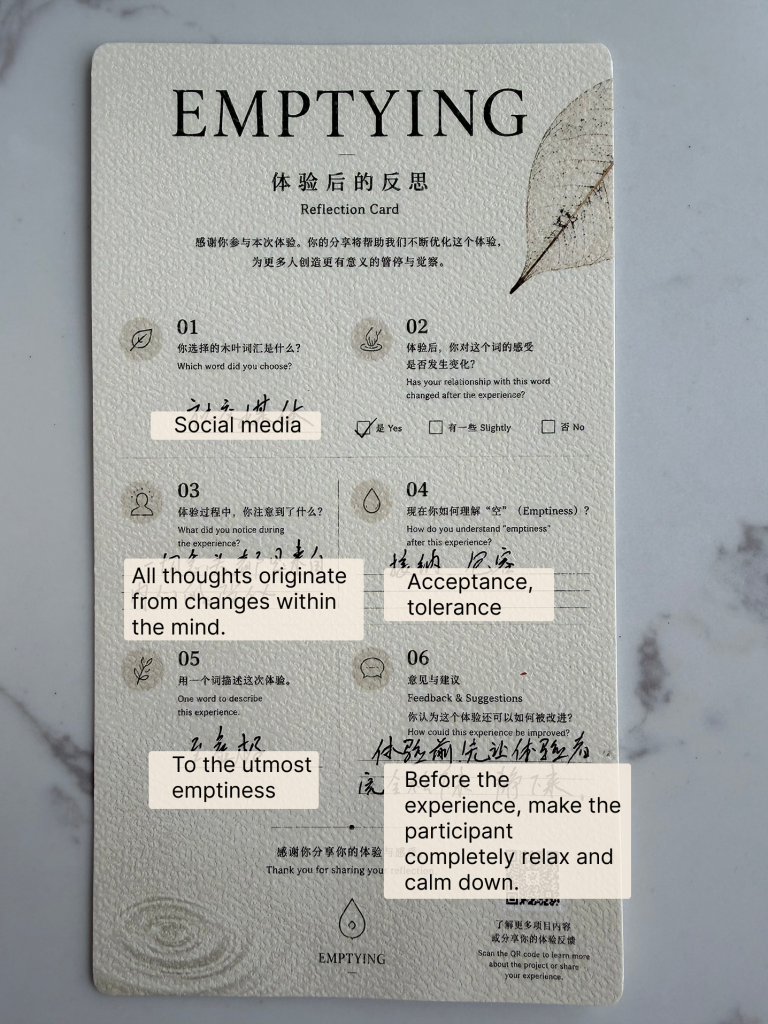

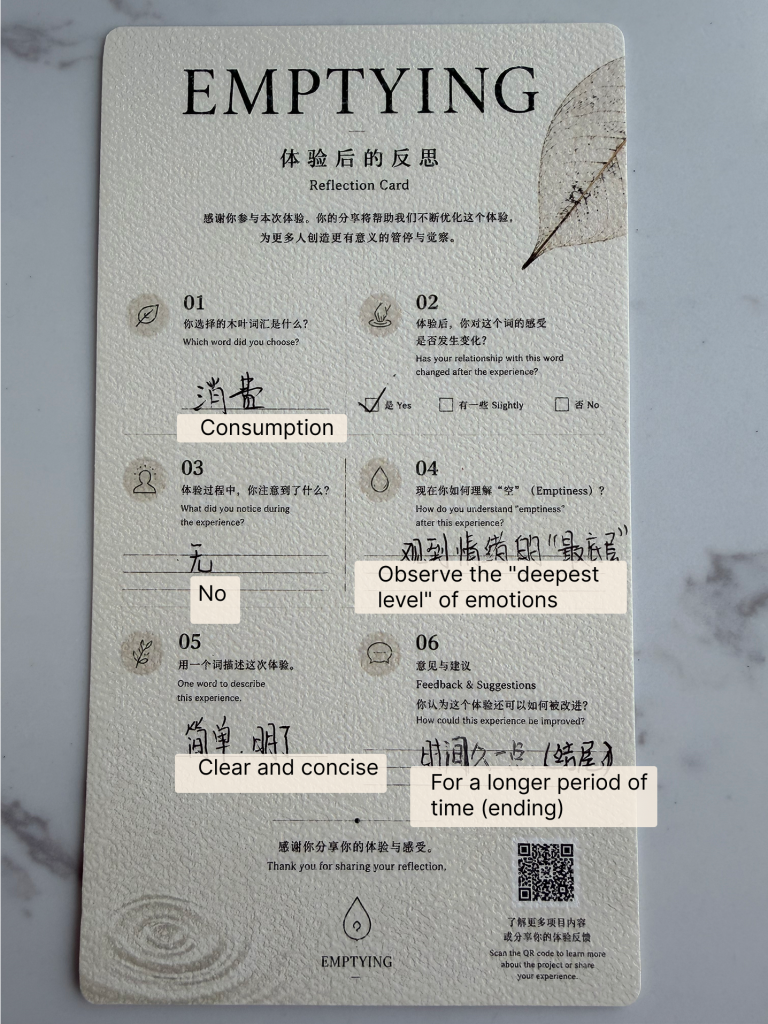

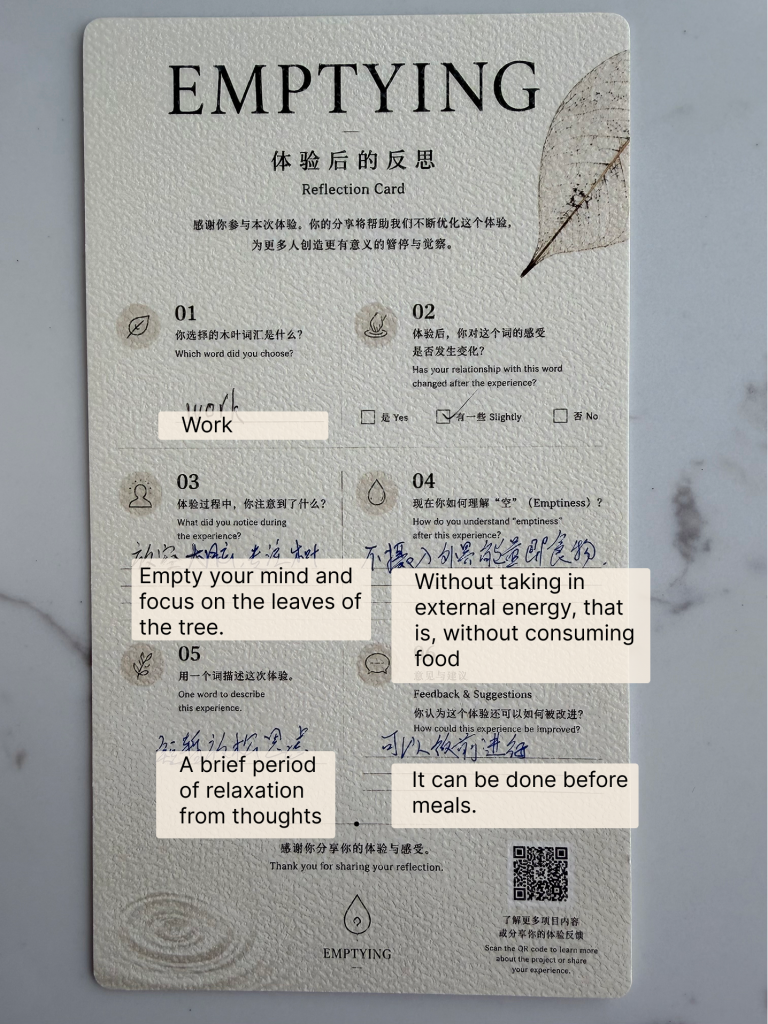
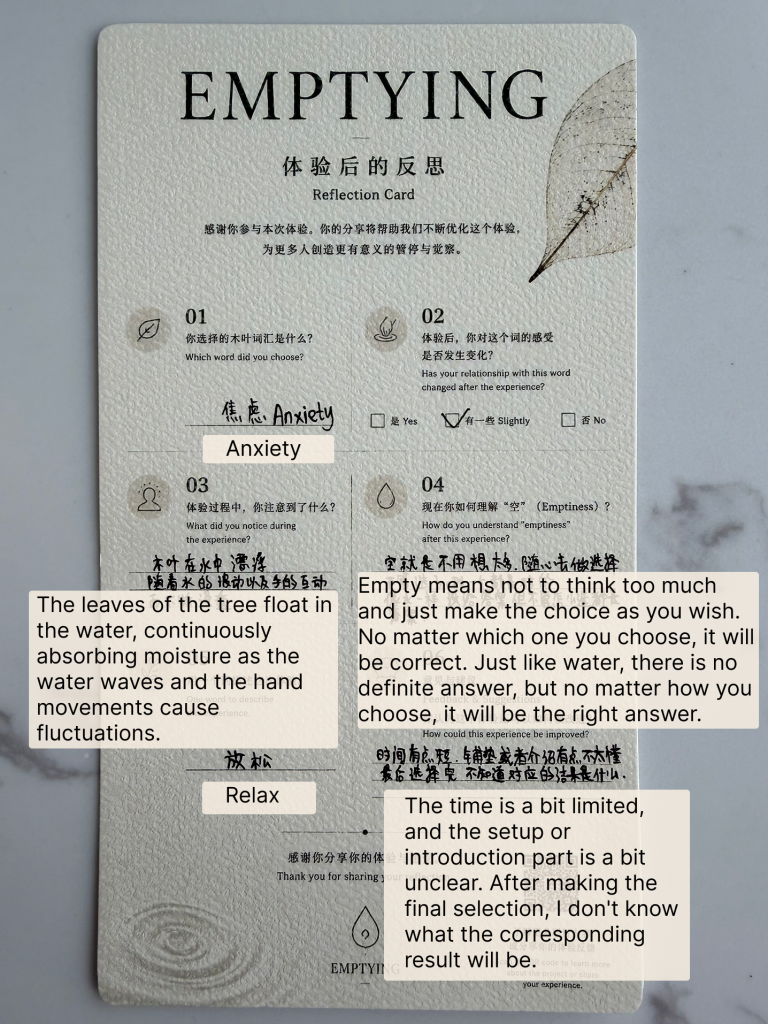
The reflection cards revealed that participants understood EMPTYING in highly personal ways. Rather than arriving at one shared definition of emptiness, participants described it as acceptance, tolerance, love, letting go, lightness and a pause.
Some responses reflected emotional awareness:
“Emptiness is a kind of power, a kind of tolerance, and a kind of love.”
Others described the experience through a change of perspective:
“‘Empty’ does not mean to clear; rather, it is the pause button.”
Several participants also wrote about observing their own thoughts instead of trying to change them, suggesting that the intervention encouraged reflection rather than providing answers.
Most encouragingly, several participants anticipated that the experience would continue to prompt reflection and return to them in everyday life. This suggested that EMPTYING had created a space for reflection that extended beyond the intervention itself.
The reflection cards also generated valuable suggestions for future development. Participants consistently recommended:
- a longer experience
- a quieter environment
- breathing guidance before beginning
- a clearer introduction to the project
2. Two weeks later: What remained?
To explore whether reflection continued beyond the intervention, I conducted a two-week follow-up with participants through WeChat.
Participants were invited to reflect on:
- what they still remembered
- whether the wooden leaf had come to mind in everyday life
- whether their relationship with the word they had chosen had changed
The follow-up is still ongoing, and the responses below represent emerging themes rather than final findings.
The conversations revealed a more varied picture. For some participants, the experience continued to influence everyday life.
Several described recalling the wooden leaf when they noticed themselves trying to control others.
One participant wrote:
“When I want to control other people at work, I immediately think of the wooden leaf and let go.”
Another reflected:
“I have let go of much of my desire to control others and feel much more relaxed.”
Others connected the experience with different aspects of daily life, including responses to noise, relationships and emotional awareness.
However, not every participant reported lasting change.
Some remembered the experience but did not describe any behavioural difference, while one participant simply replied:
“Two weeks later, it hasn’t left any particular influence on me.”
Rather than seeing these different responses as success or failure, they suggest that EMPTYING creates the possibility for reflection without determining what that reflection should become.
3. Reflections for the next iteration
Although the follow-up is still in progress, it has already become an important part of the project.
It shifted my attention away from what happens during the intervention towards what, if anything, continues afterwards.
The findings also reinforced an idea that emerged throughout the project:
Participants do not experience EMPTYING in the same way.
Instead, each person constructs meaning through their own memories, relationships and everyday situations.
In this sense, the intervention is less about producing a fixed outcome than creating the conditions in which different forms of reflection may emerge.
The follow-up conversations will continue beyond this blog and will inform the future development of EMPTYING.
Final Reflection
Looking back over this summer, I realise that the most valuable outcome of this project is not simply the intervention itself, but the questions it has continued to open.
Through EMPTYING, I have explored how the Daoist philosophy of Bigu can be reinterpreted beyond fasting and translated into a contemporary embodied wellbeing experience.
The project explores how design can create the conditions for personal reflection through materials, interaction and space.
The testing and follow-up conversations also reminded me that meaningful experiences do not produce identical outcomes. Instead, each participant brings their own memories, relationships and interpretations into the experience.
So far, the intervention has only been tested with Chinese participants, and the follow-up study is still ongoing.
I hope future iterations will involve participants from different cultural backgrounds and continue exploring what remains after the experience ends.
Thank You
As this summer comes to an end, I would like to express my sincere gratitude to everyone who has accompanied this project.
Thank you to my tutors for your guidance, encouragement and thoughtful feedback throughout this journey. Every conversation challenged me to think more deeply and helped shape the project in ways I could not have imagined at the beginning.
Thank you to my family for believing in me, supporting every idea and always encouraging me to keep going.
Thank you to the Chinese professors who generously shared their knowledge of Daoist philosophy and Bigu, helping me build a stronger theoretical foundation for this project.
Most importantly, thank you to every participant who chose to spend time with EMPTYING. Thank you for your trust, your honesty, your patience and your willingness to share your reflections—not only during the intervention, but also in the weeks afterwards. Your experiences have shaped this project far more than I ever could have done alone.
If you’ve read all the way here… thank you. I hope our paths cross again somewhere, with another wooden leaf, another conversation, or simply another quiet moment. Until then, thank you for making space with me.
Leave a Reply