From designing an experience to finding real human responses
10 August 2026
August 7 marked the first full intervention testing session of EMPTYING, and it became one of the most meaningful moments in my project so far. Until now, the intervention had existed mainly as sketches, prototypes, and my own imagination. For the first time, it entered the real world and became an experience shared between people.
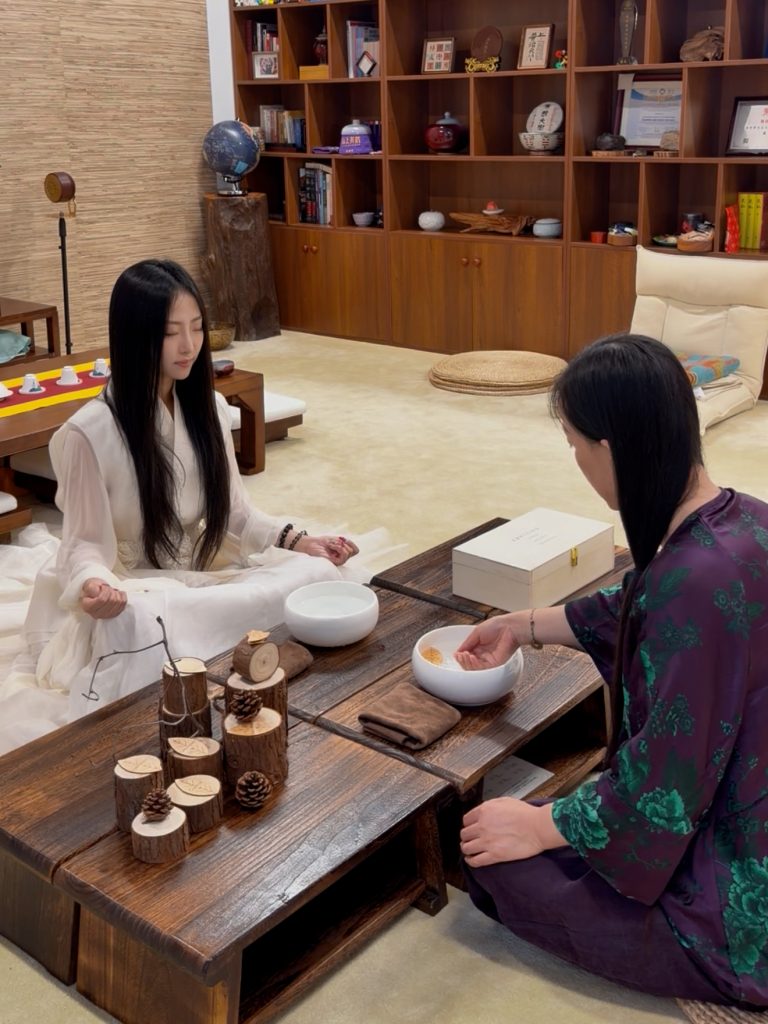
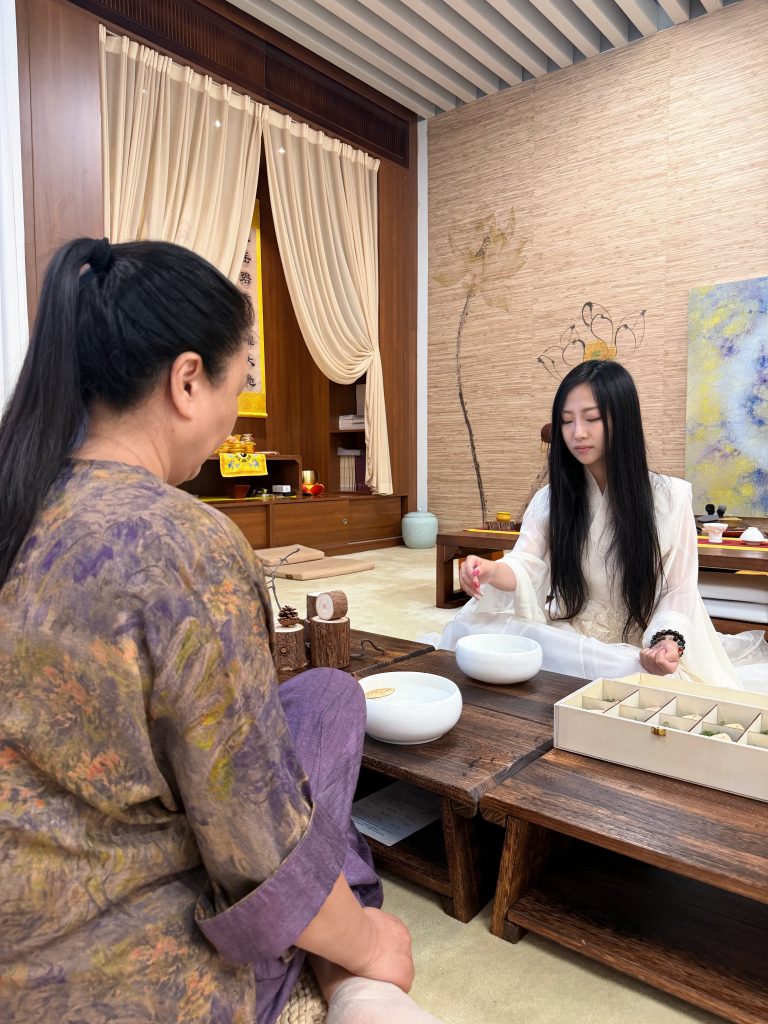
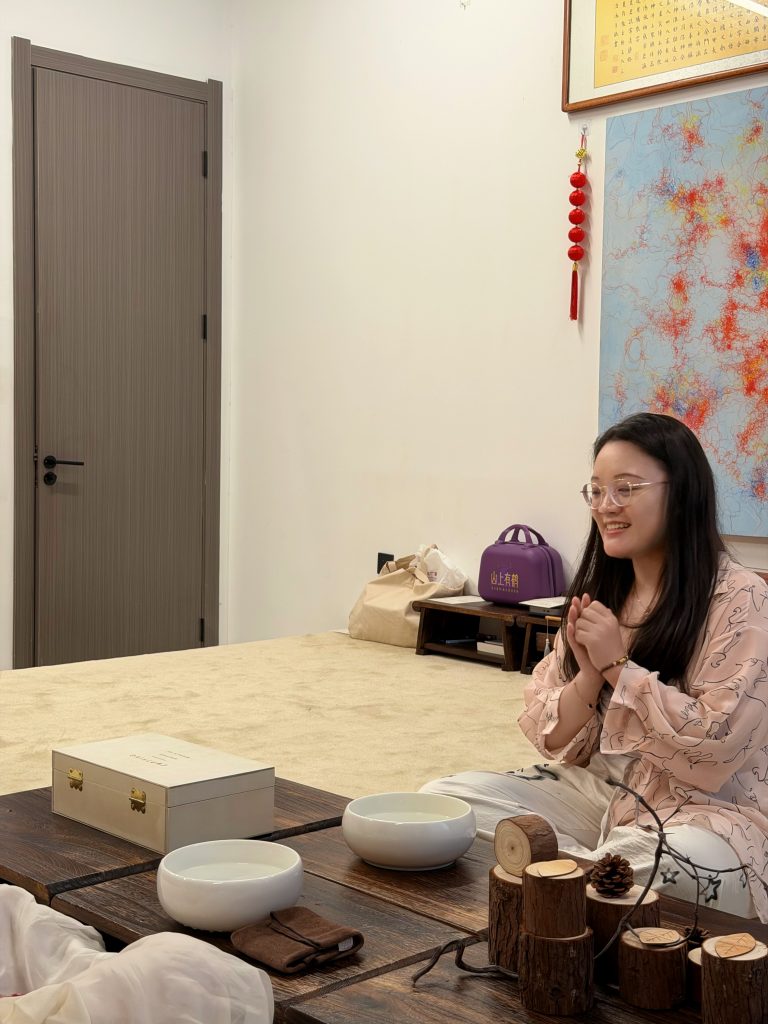
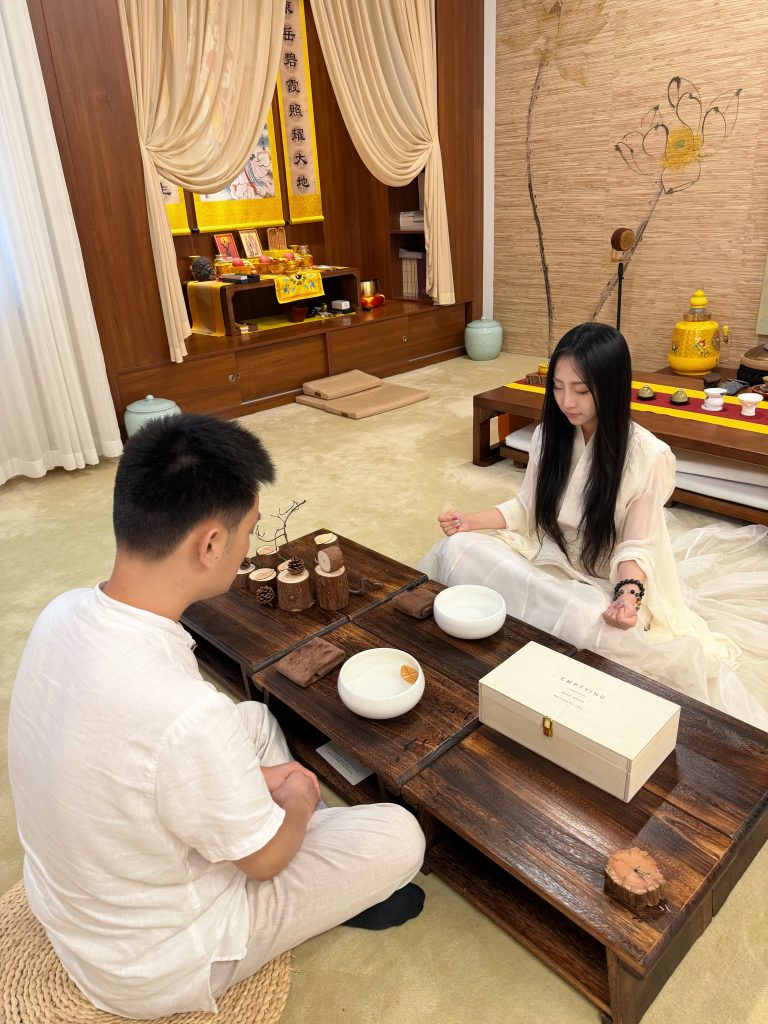
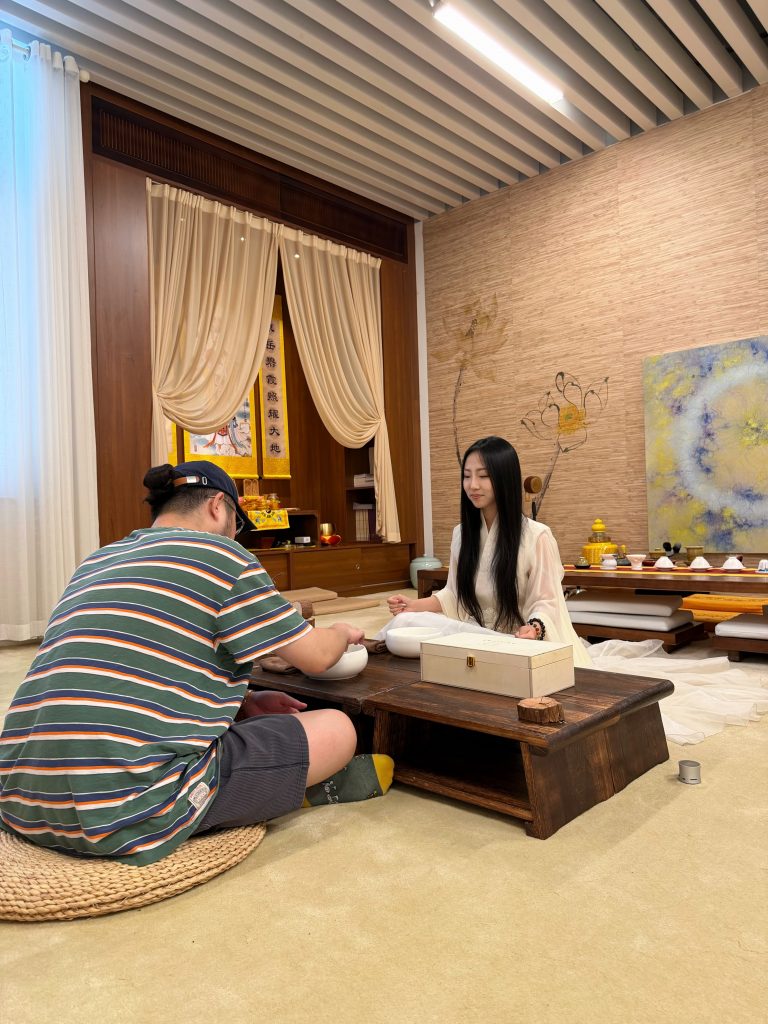
The testing took place in a quiet and beautiful indoor space in China, surrounded by books, natural materials and a peaceful atmosphere. I intentionally chose this environment because it reflected the calmness and sense of pause that the intervention hopes to create.
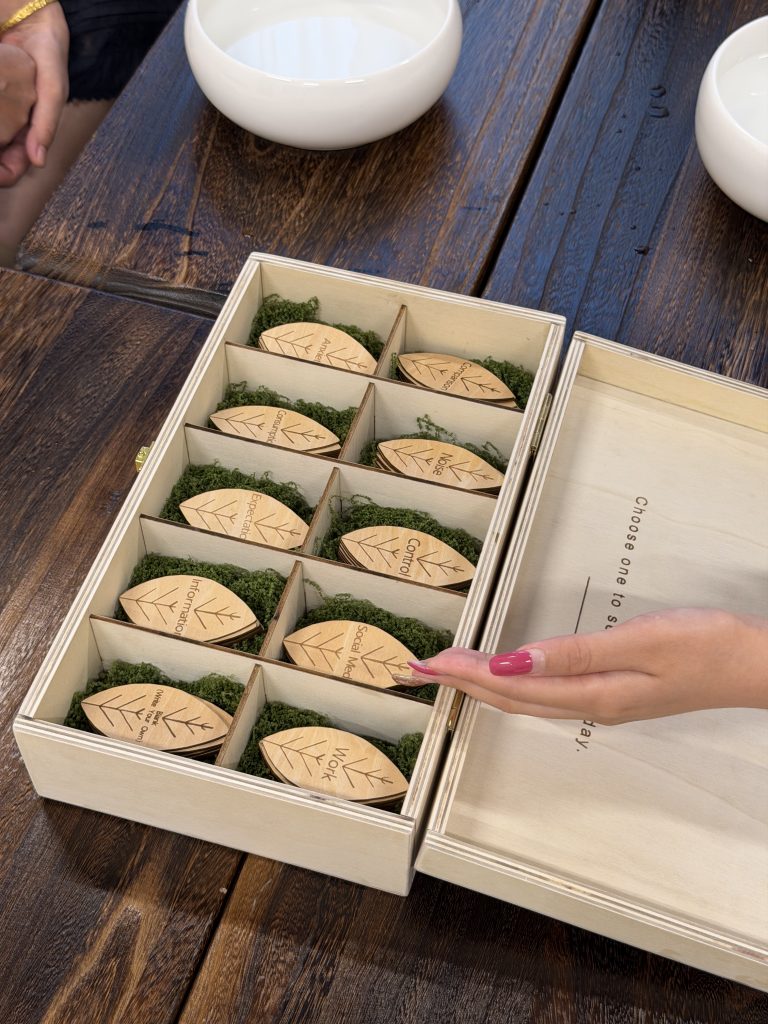
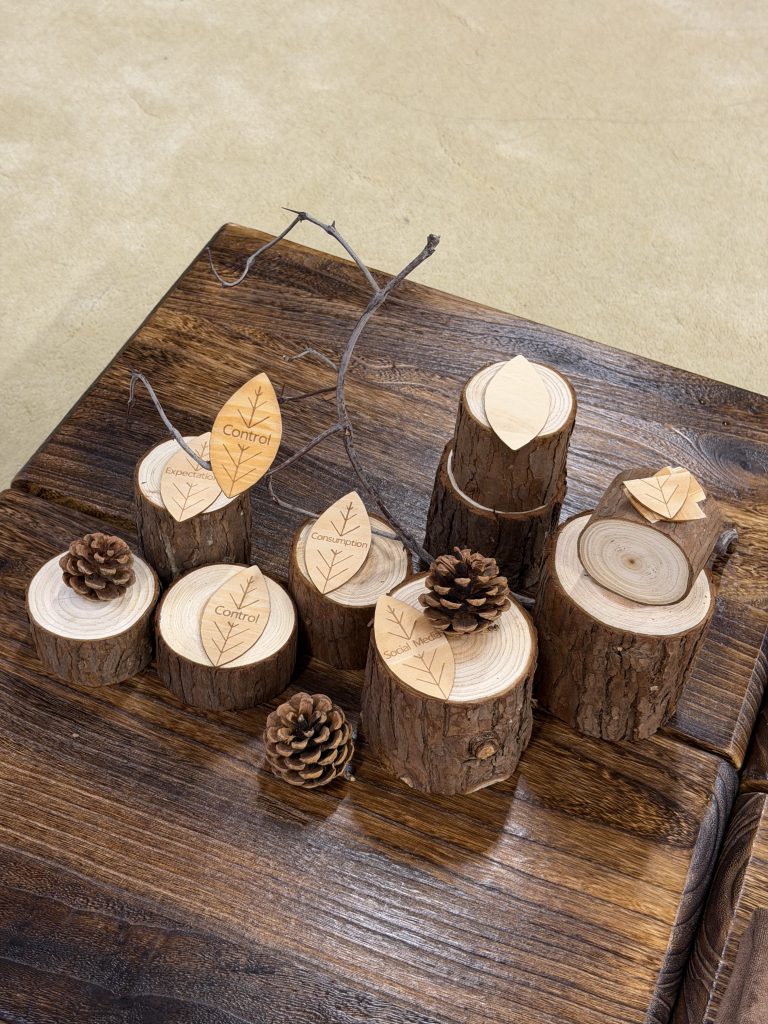
Figures 1–10. Intervention setup and prototype before user testing.
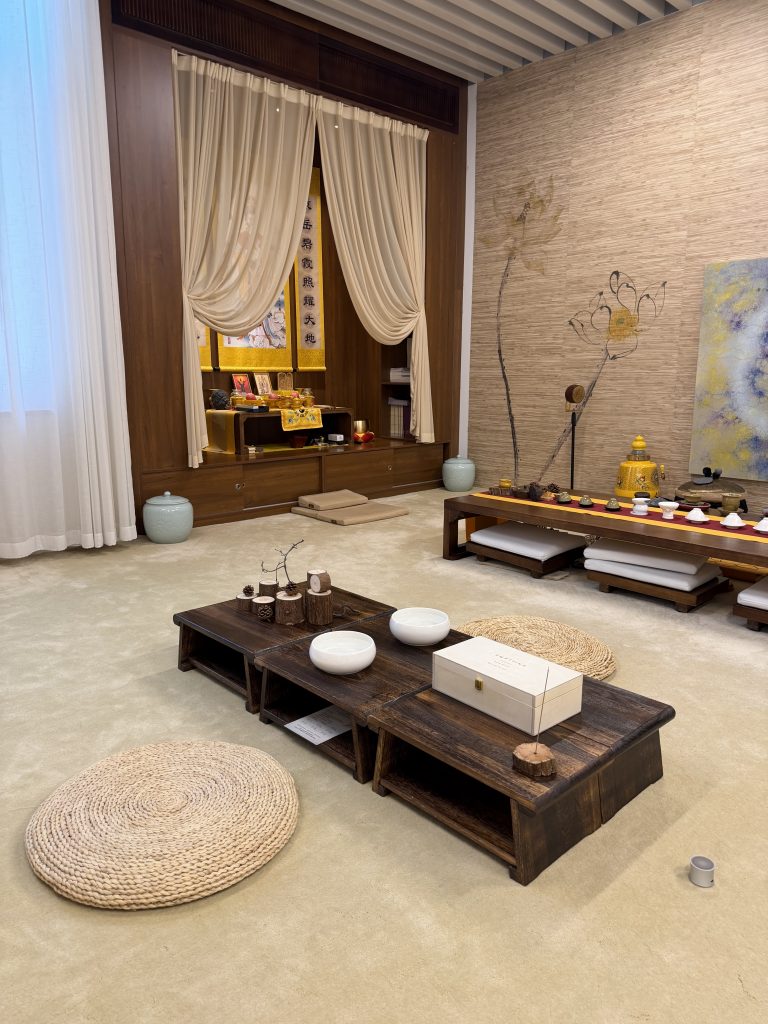
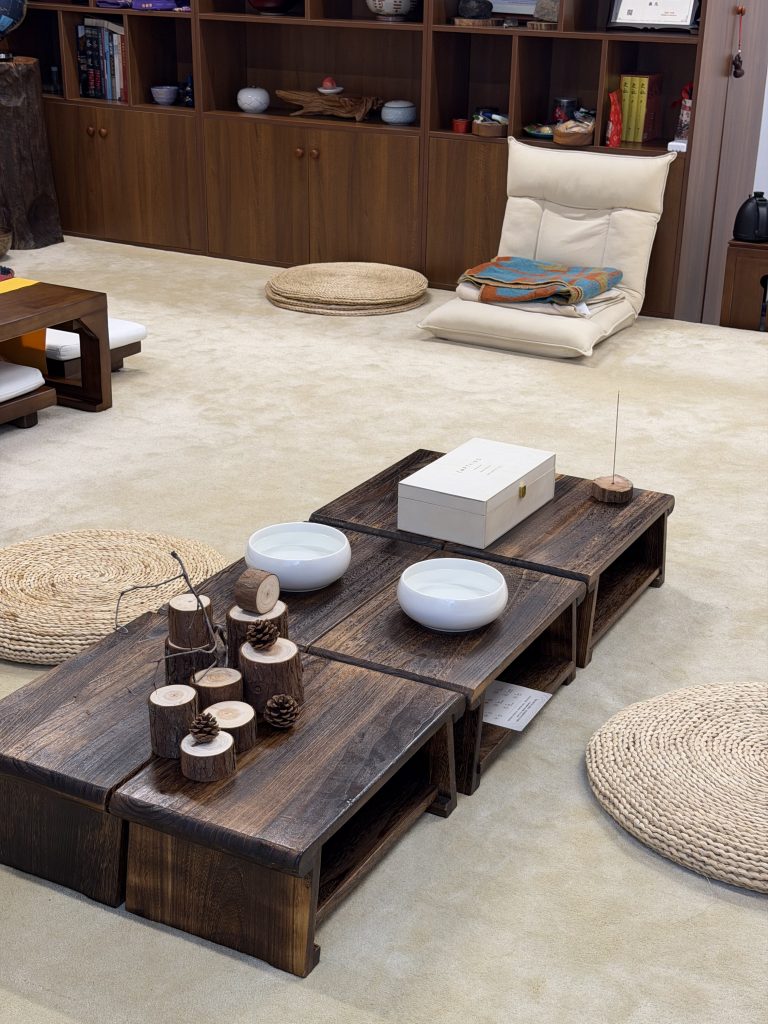
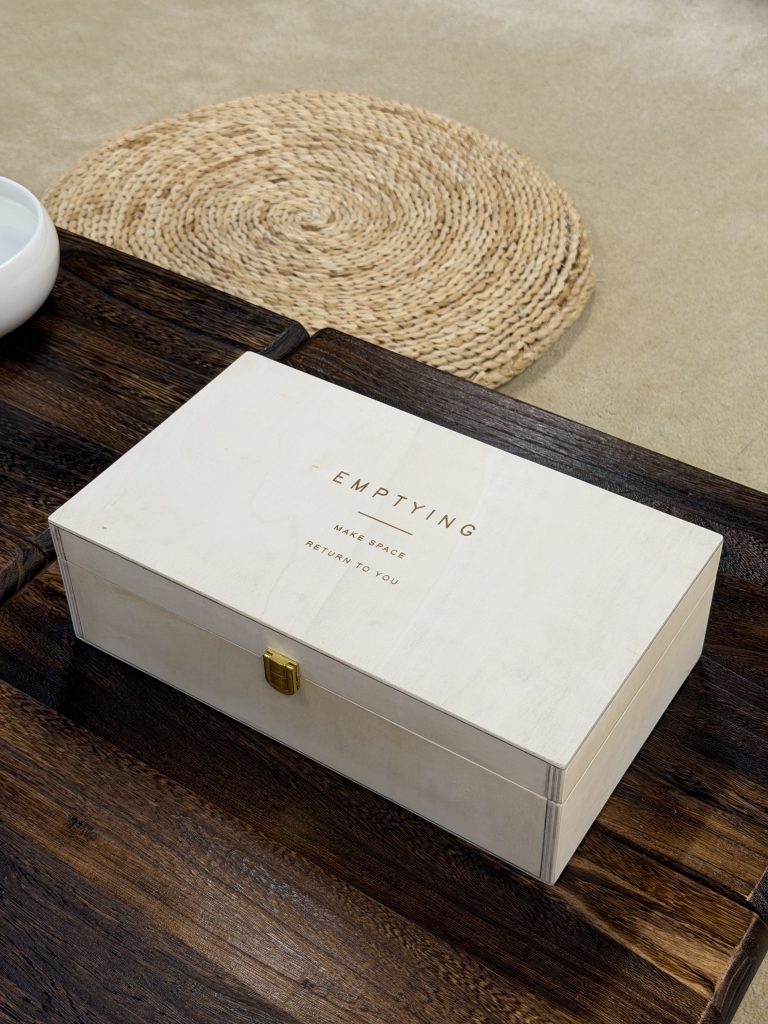
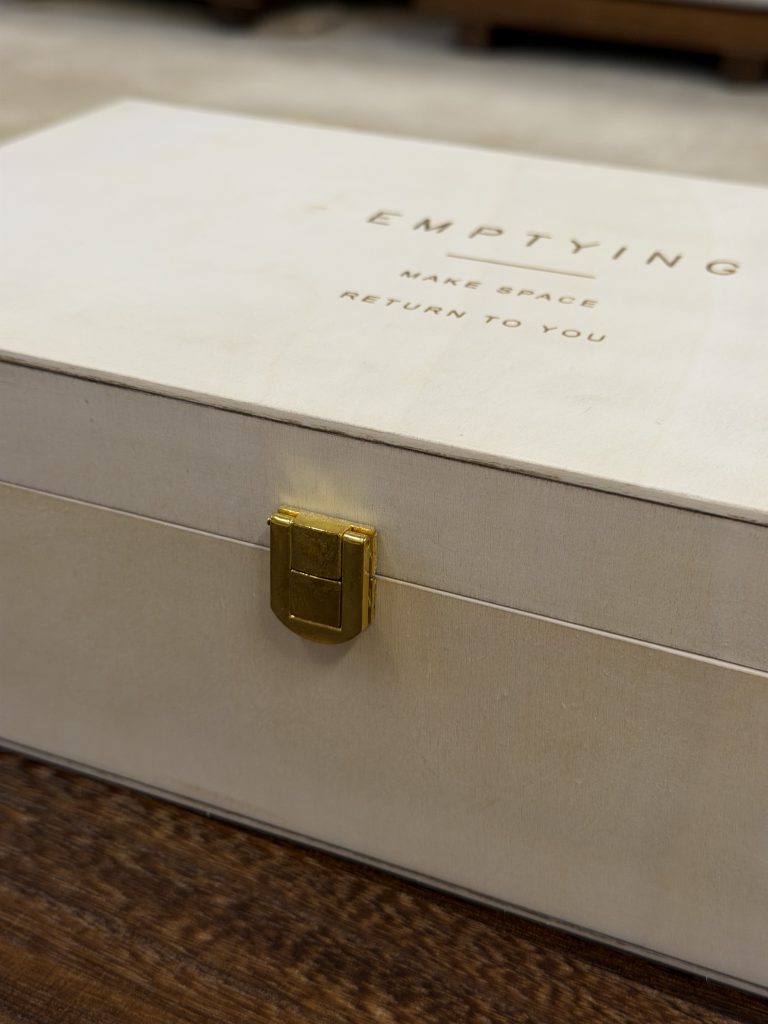
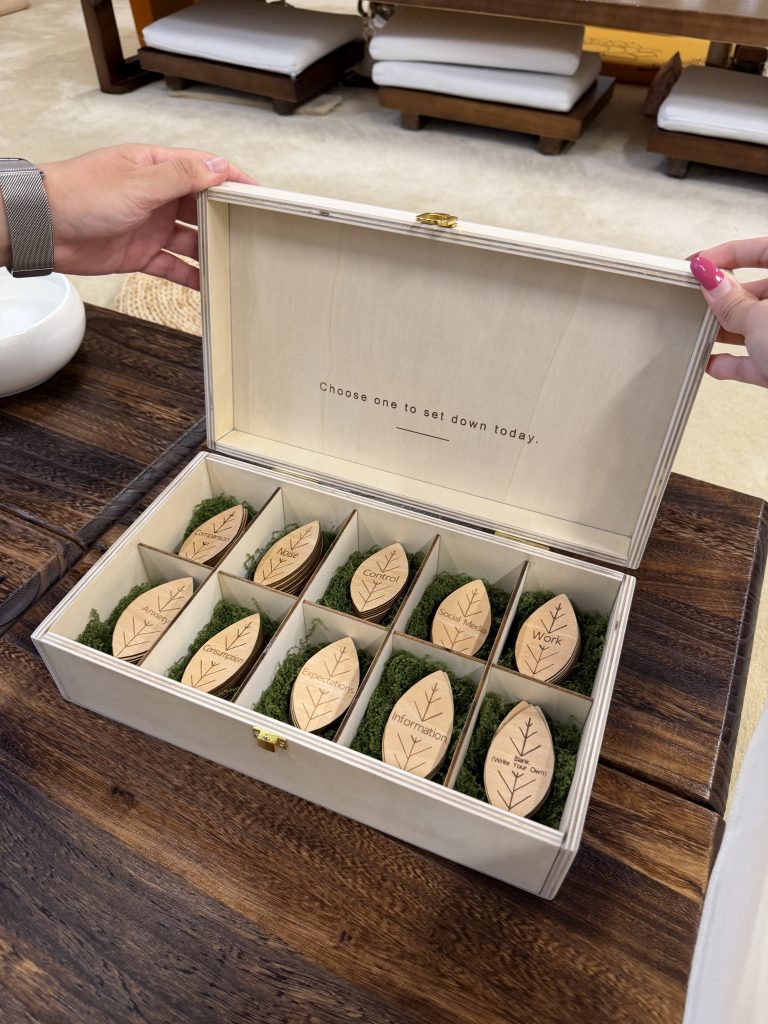
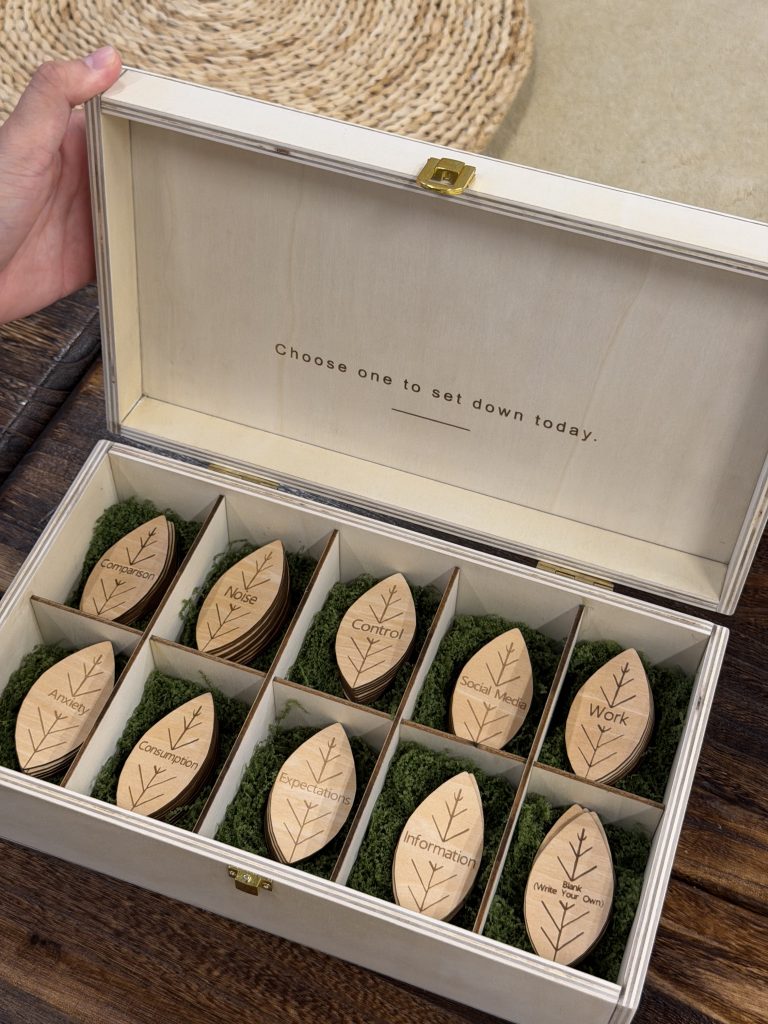
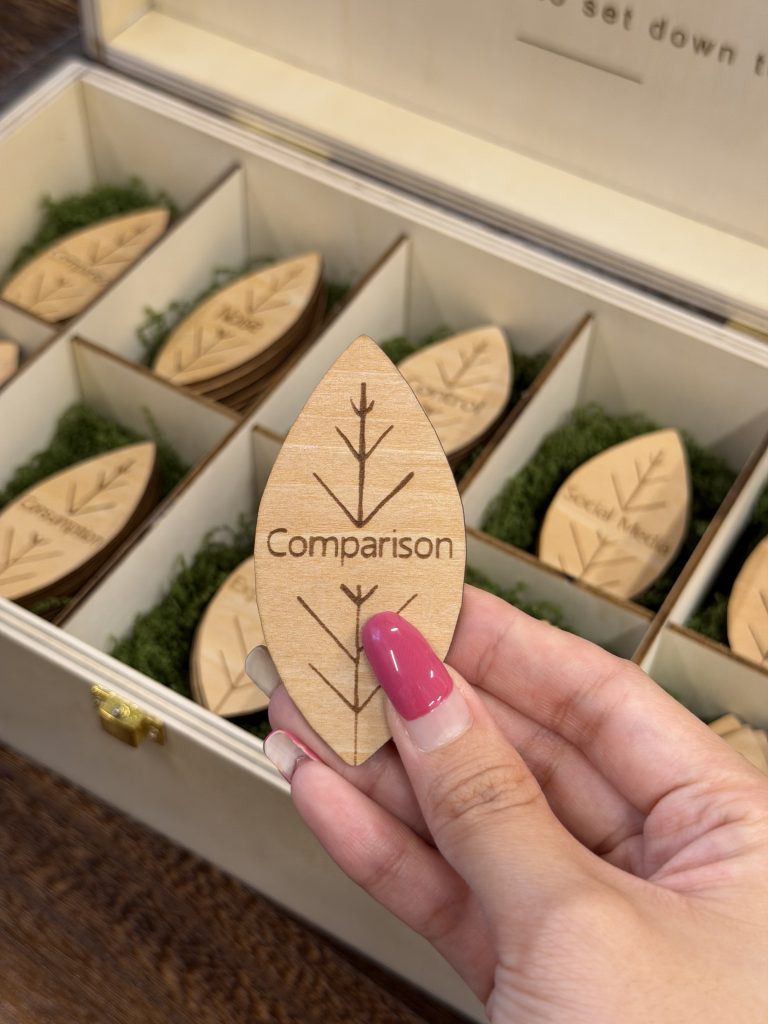
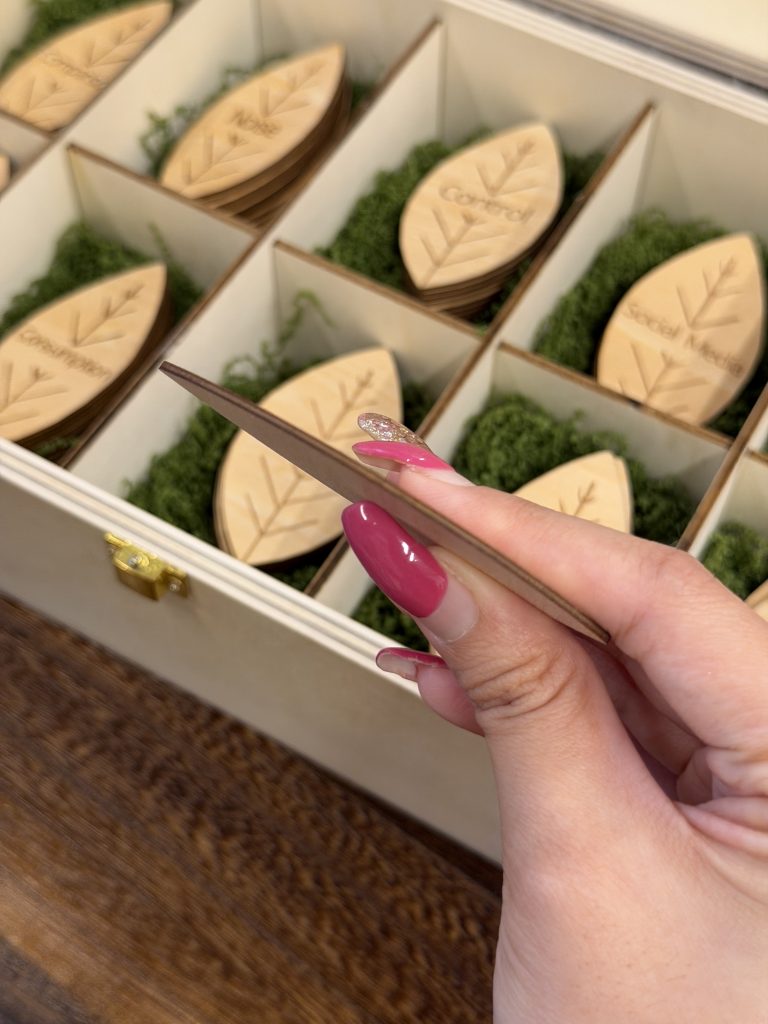
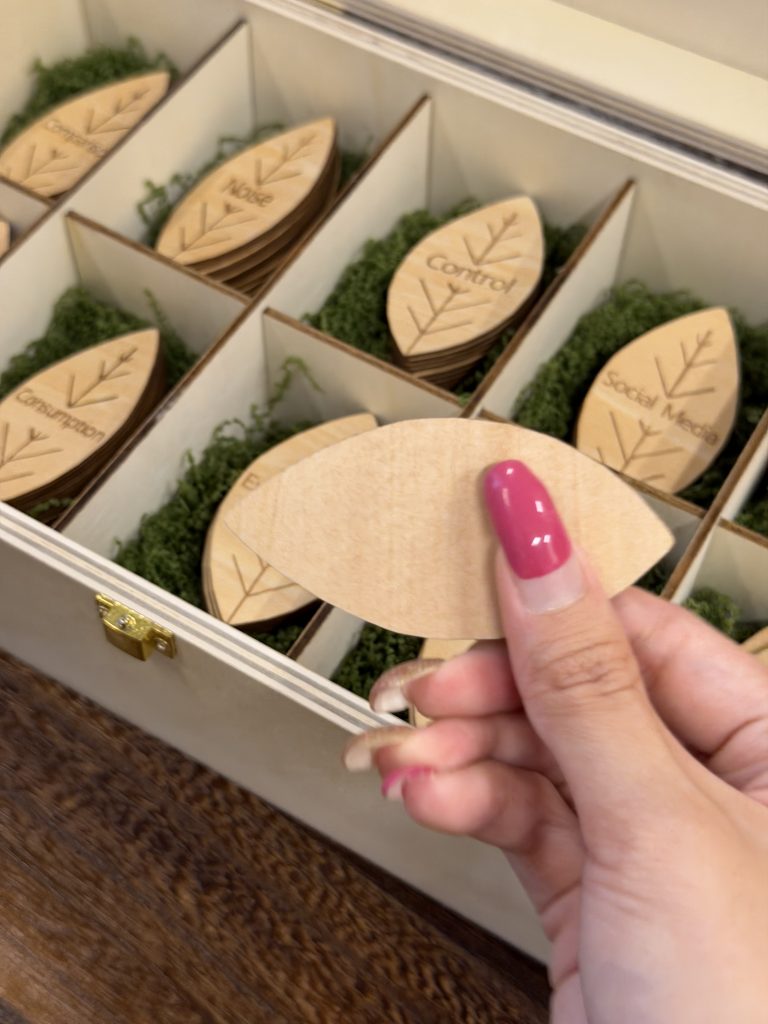
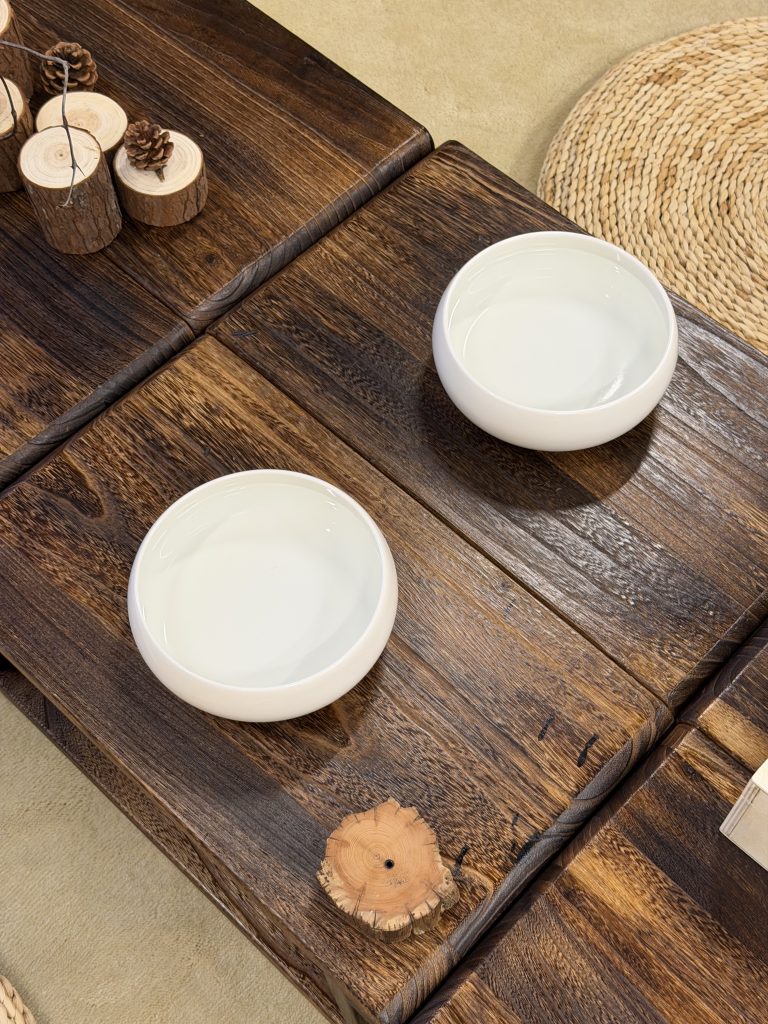
A total of 11 participants (all of Chinese participants around 25-40 years old) took part in the testing. Together with myself as the facilitator and researcher, there were 12 people involved in the session.
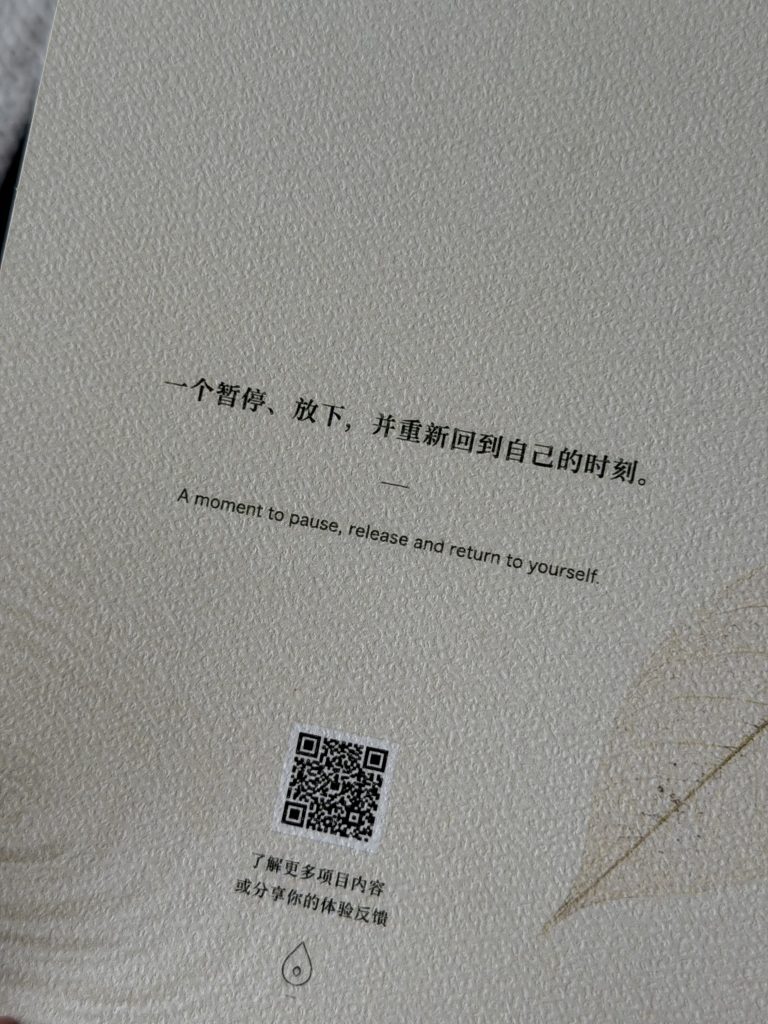
Before the testing began, I introduced the project and briefly explained the purpose of today’s research. Each participant received a Project Introduction Card (I printed the cards in an A5 format with double-sided printing on textured art paper to enhance the tactile quality of the experience.), followed by reading and signing the Participant Information Sheet and Consent Form. Rather than simply asking people to “experience an artwork”, I wanted every participant to understand that they were contributing to the development of this research.
Figures 11–13. Project Introduction Cards.
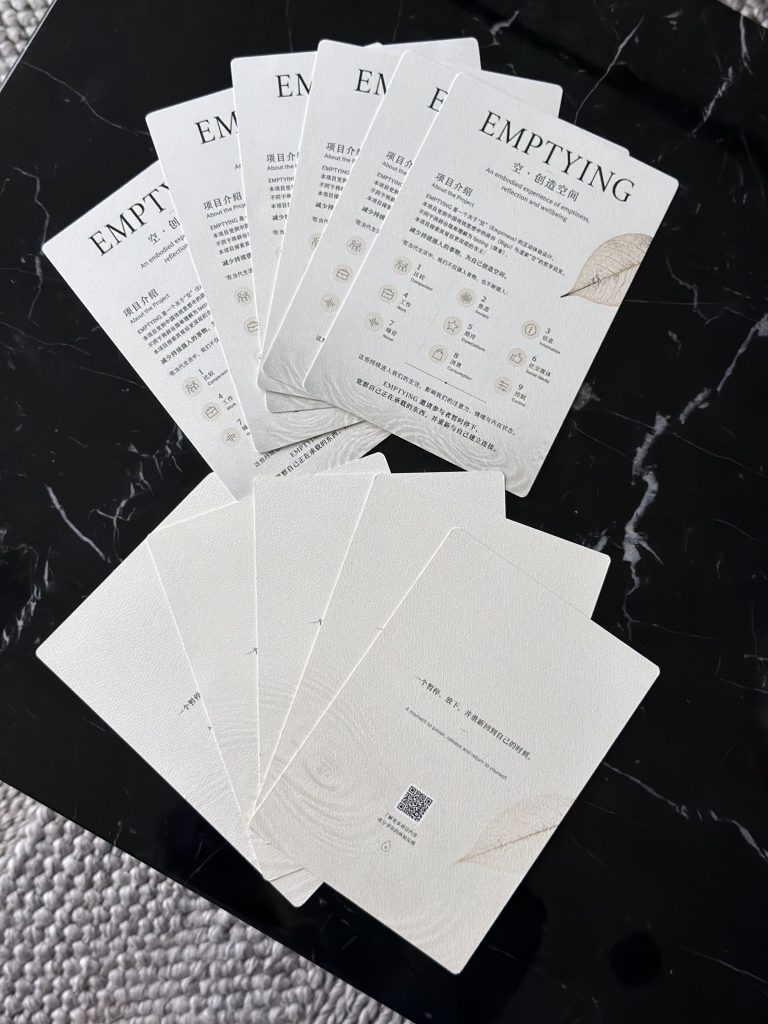
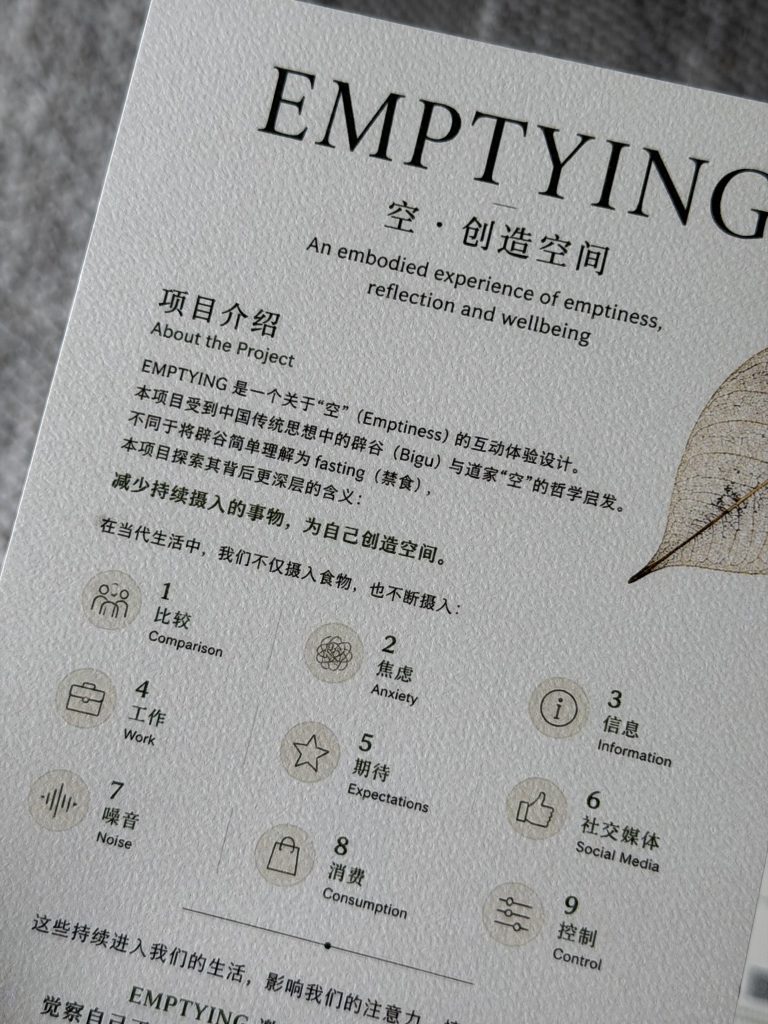
One-to-One Intervention
The intervention was carried out individually.
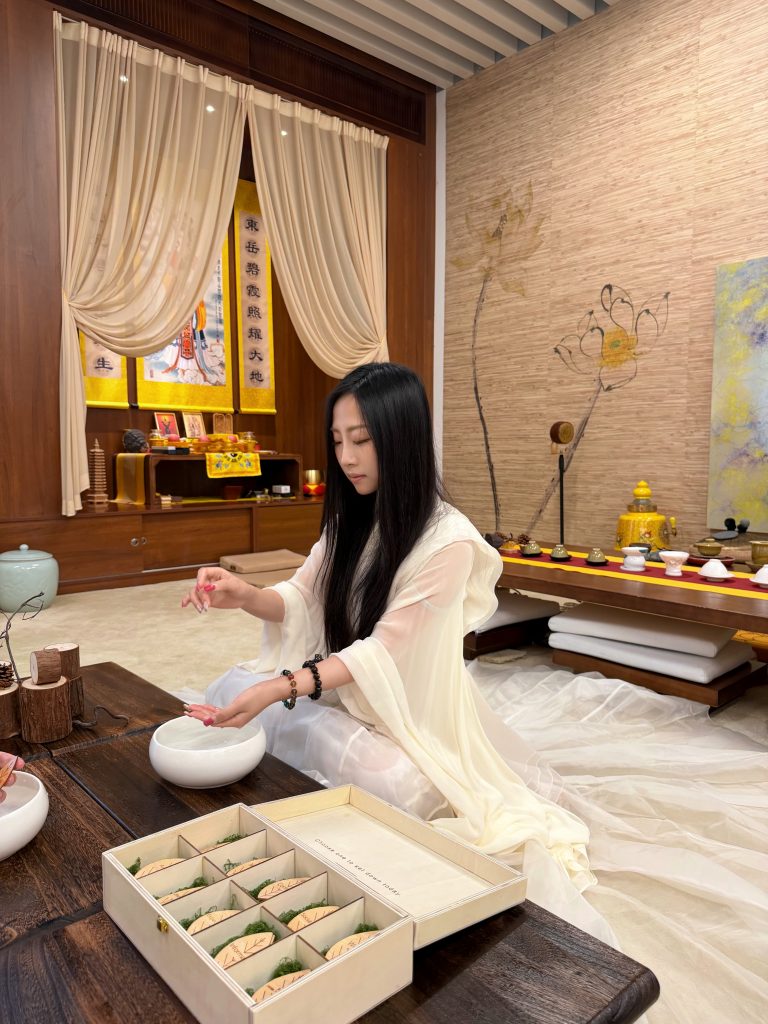
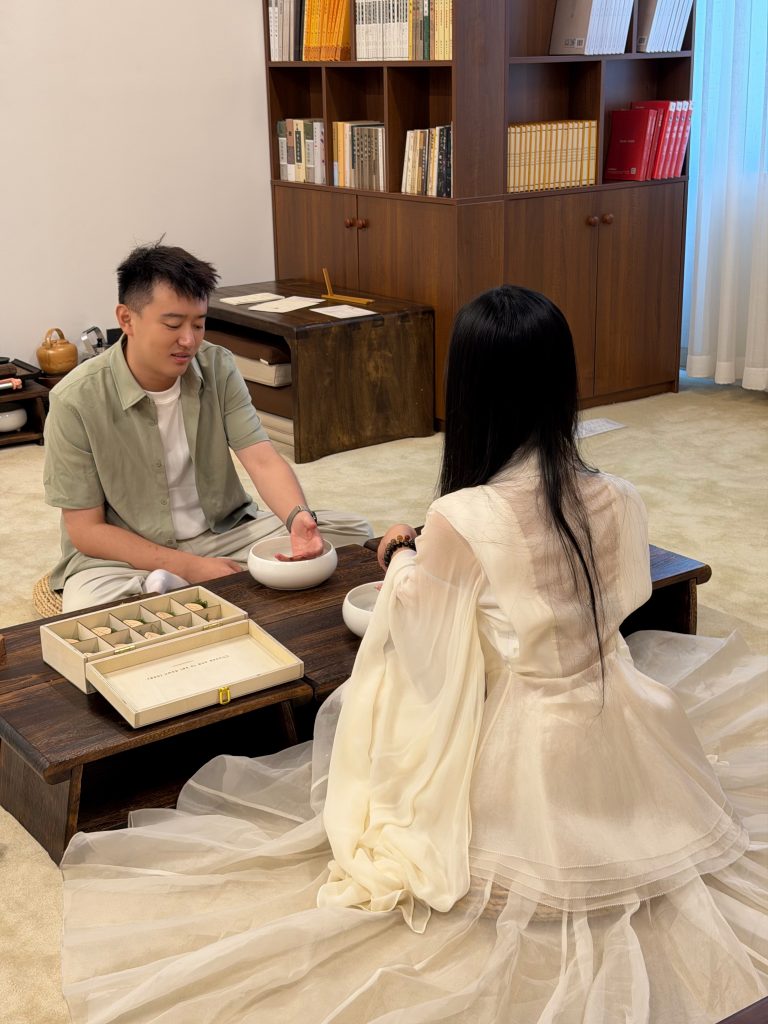
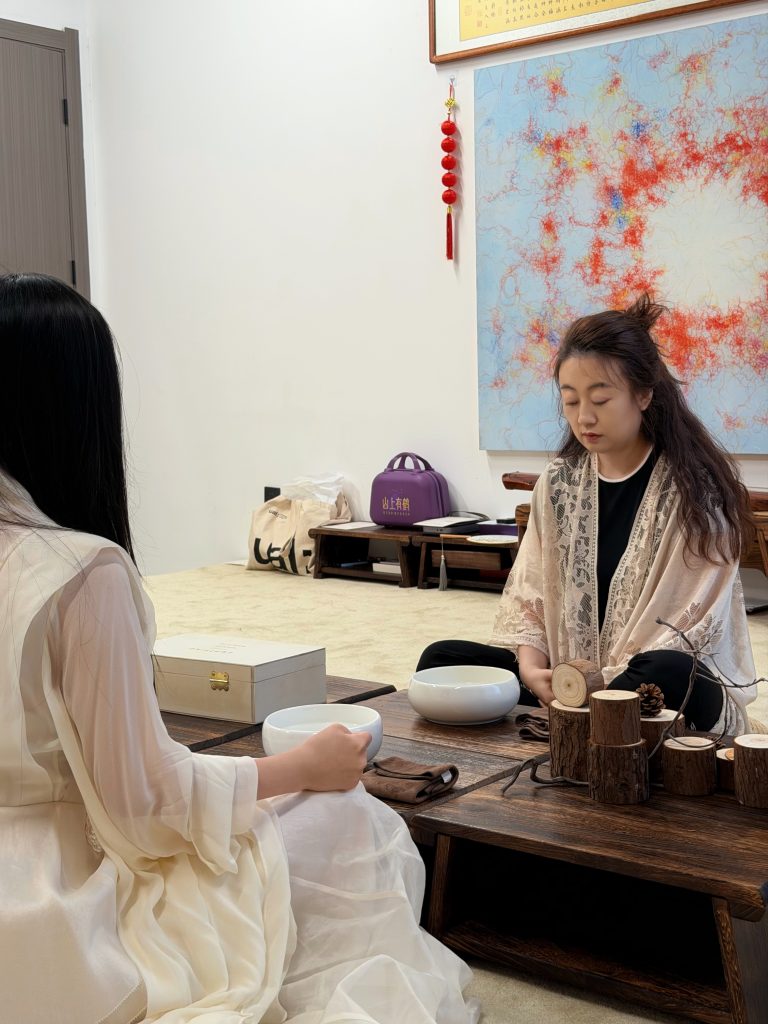
Each participant experienced EMPTYING in a one-to-one session with me, lasting approximately 5–10 minutes, although the duration naturally varied from person to person.
Throughout the intervention, my role was not to explain or interpret, but to accompany each participant through the experience. I guided them gently while allowing enough silence for their own thoughts to emerge.
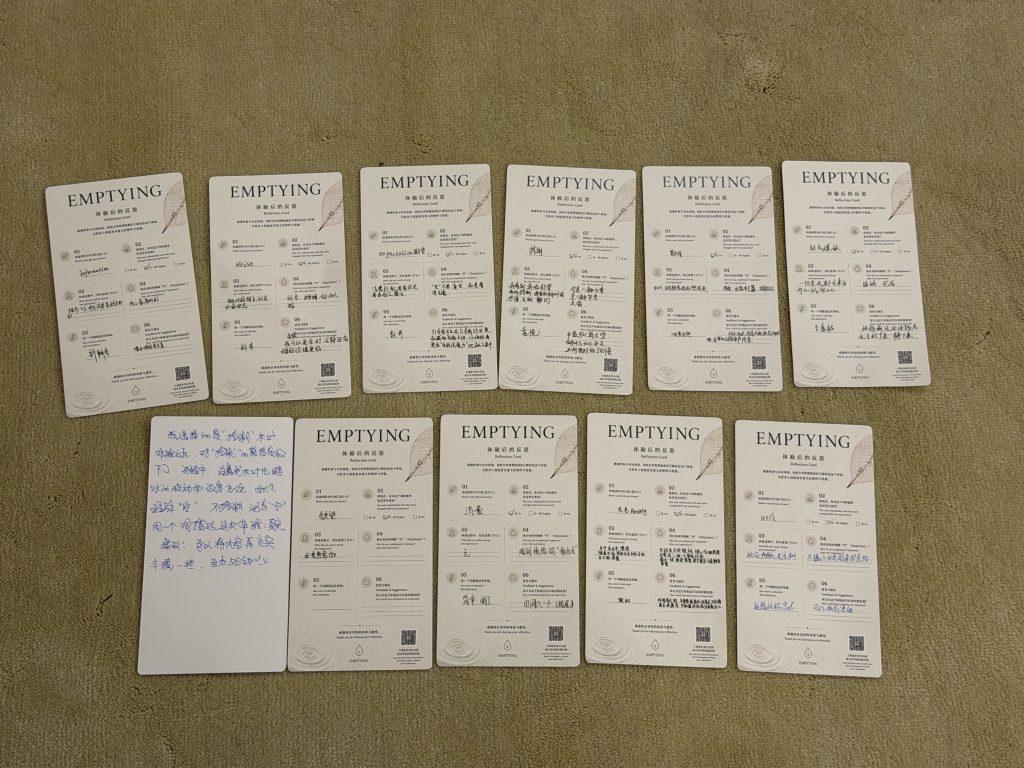
After each participant completed the intervention, they received a Reflection Card to record their immediate thoughts and feelings.
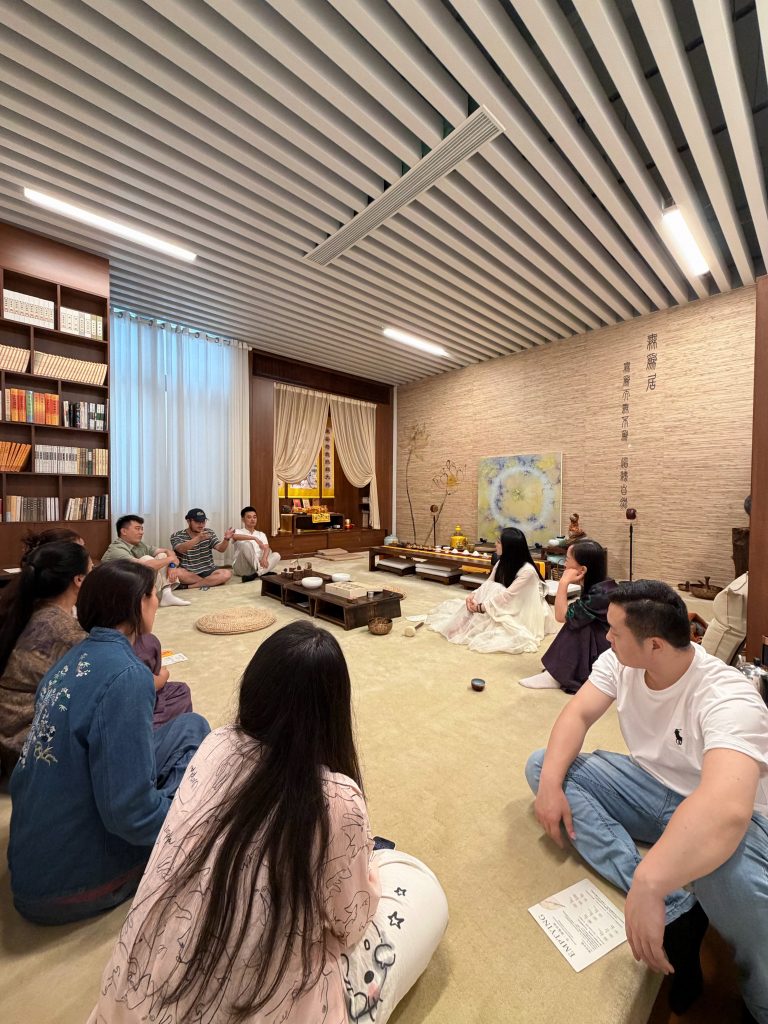
Once everyone had finished the individual experience, all participants gathered together again for an approximately one-hour group discussion and interview. This became an unexpectedly valuable part of the testing, allowing participants to openly share their interpretations, emotions and suggestions while also responding to each other’s experiences.
I also documented the testing through photographs and video recordings, and I plan to edit these into a short documentary montage for my next tutorial.
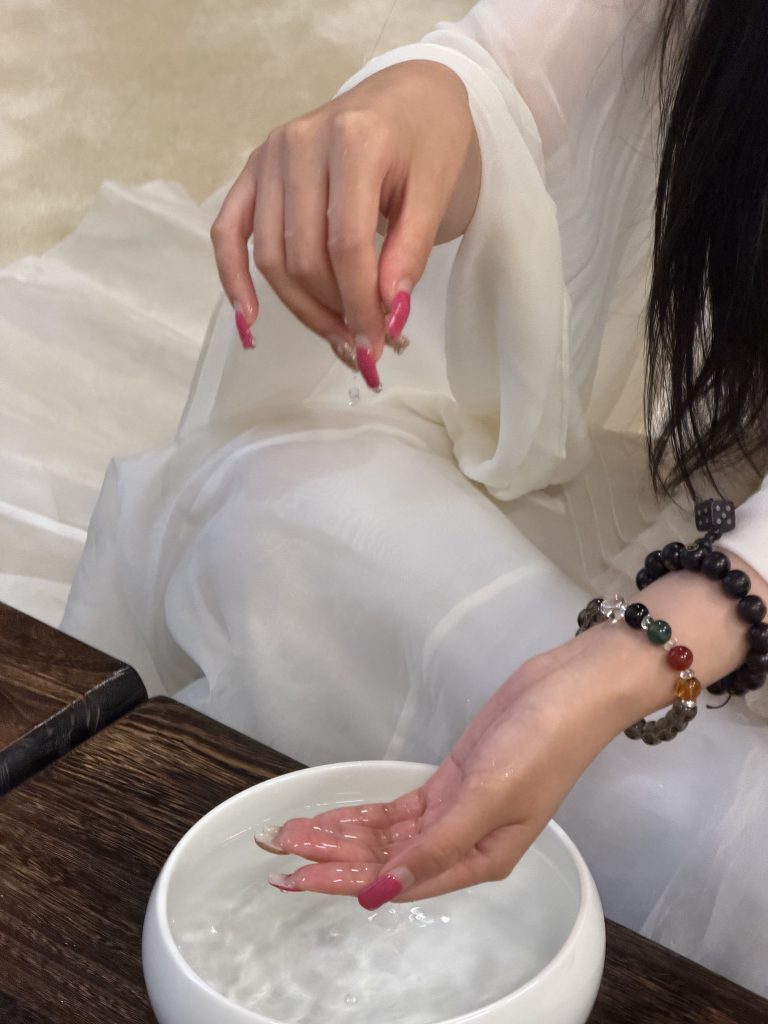
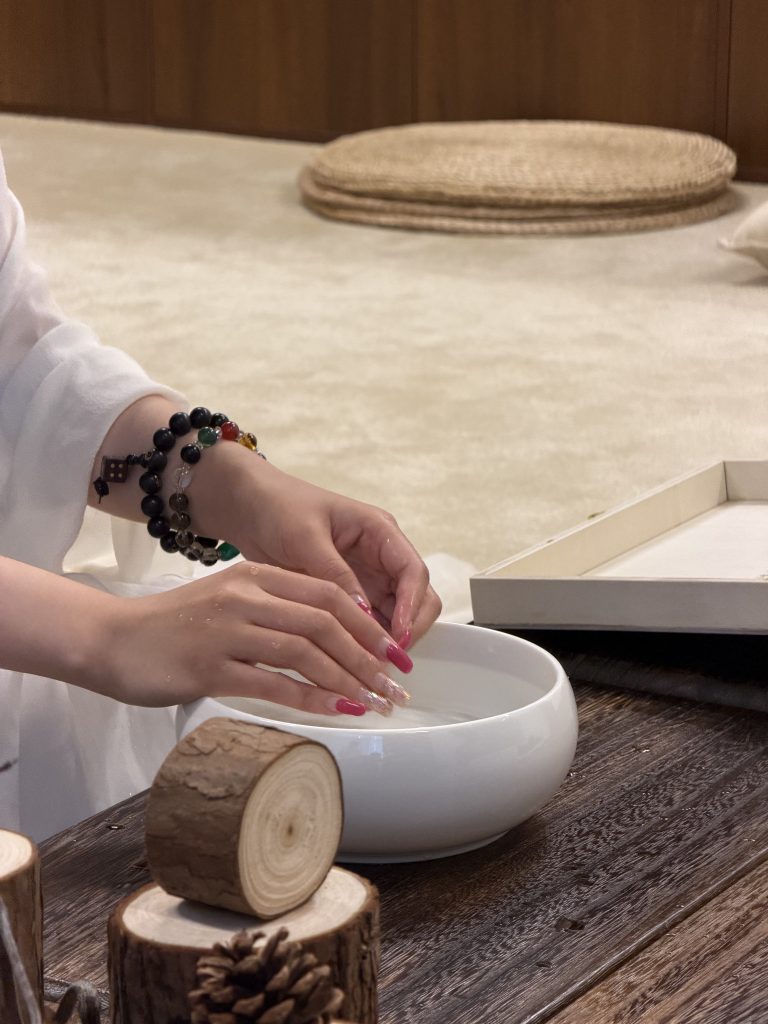
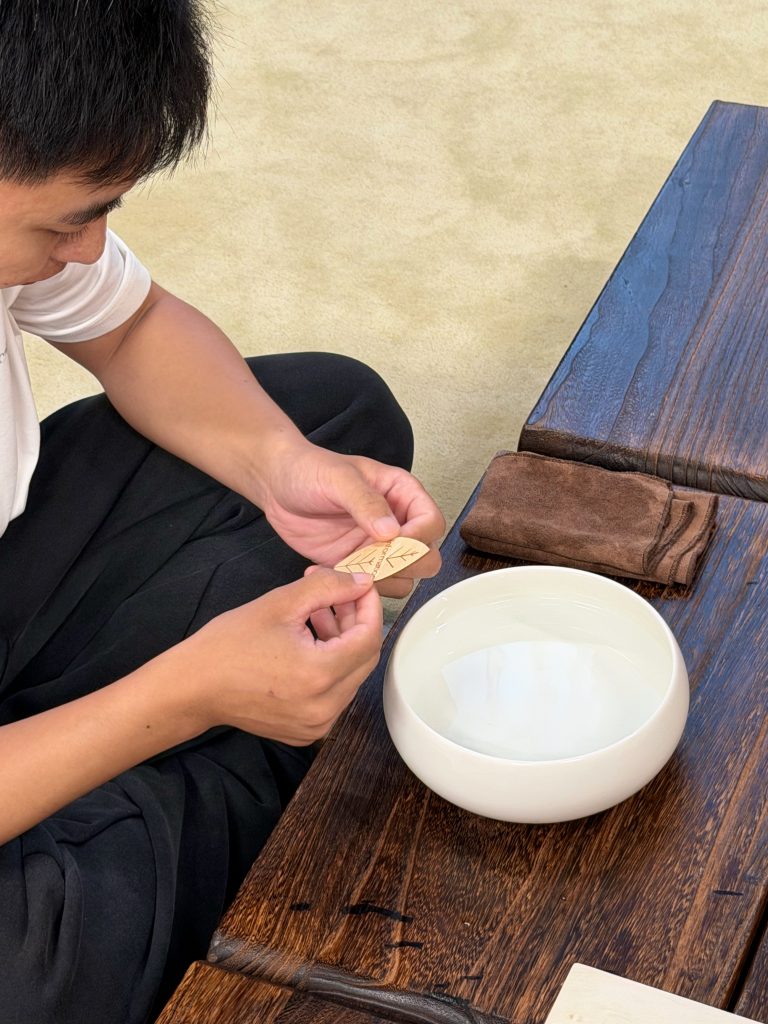
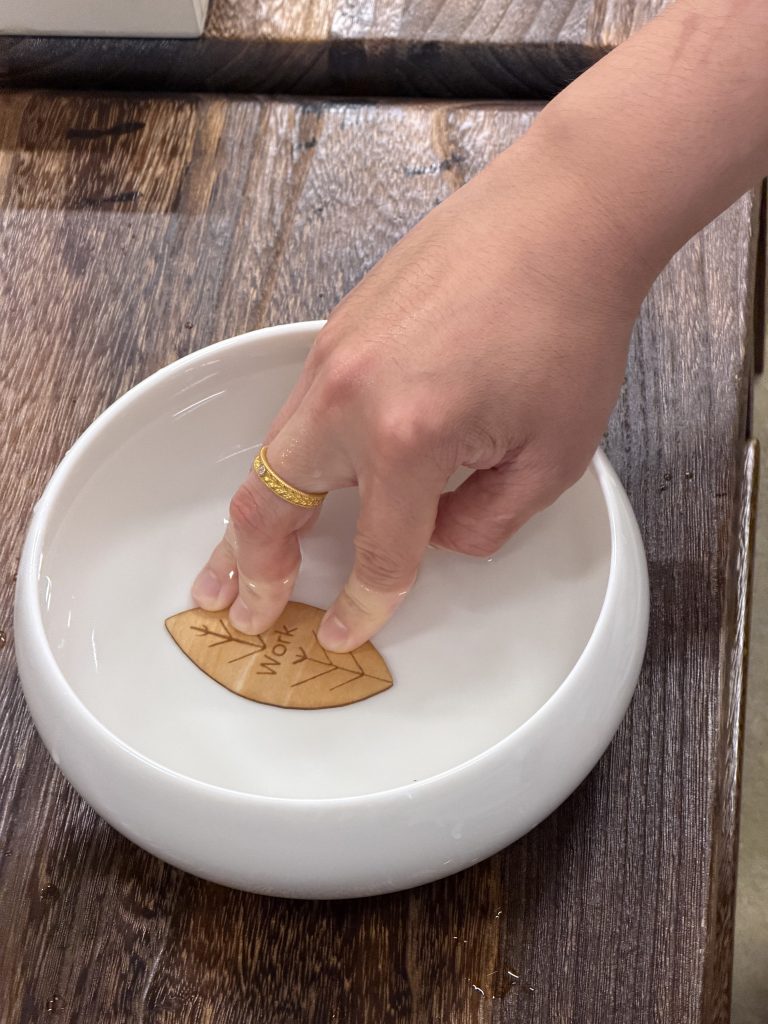
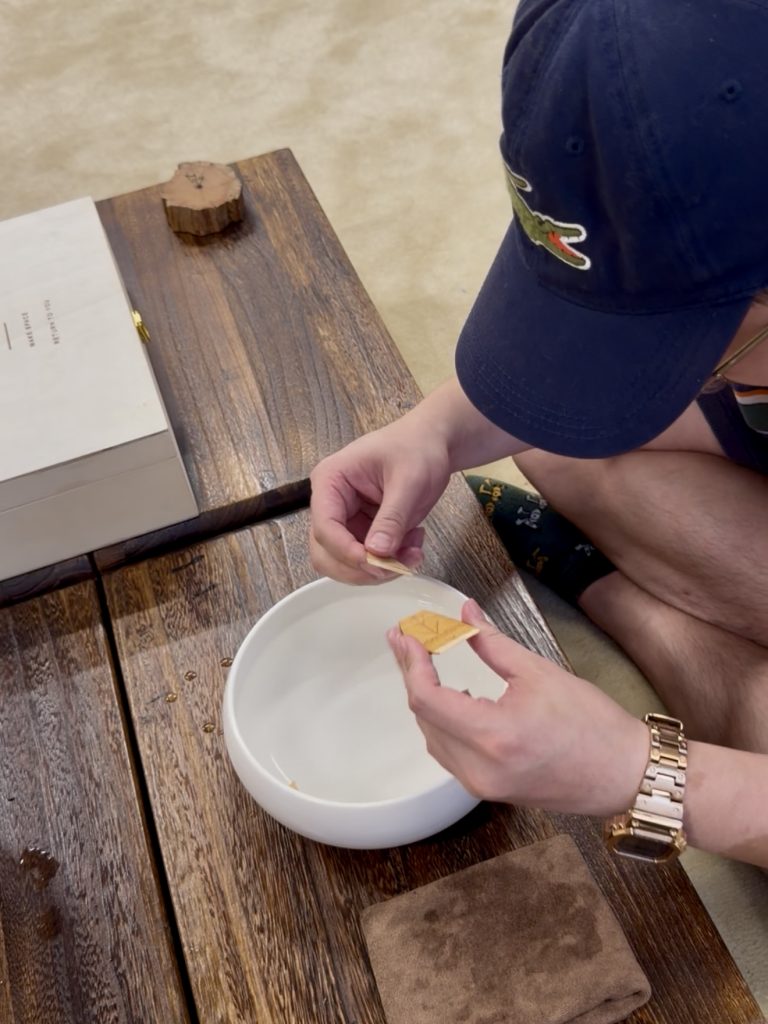
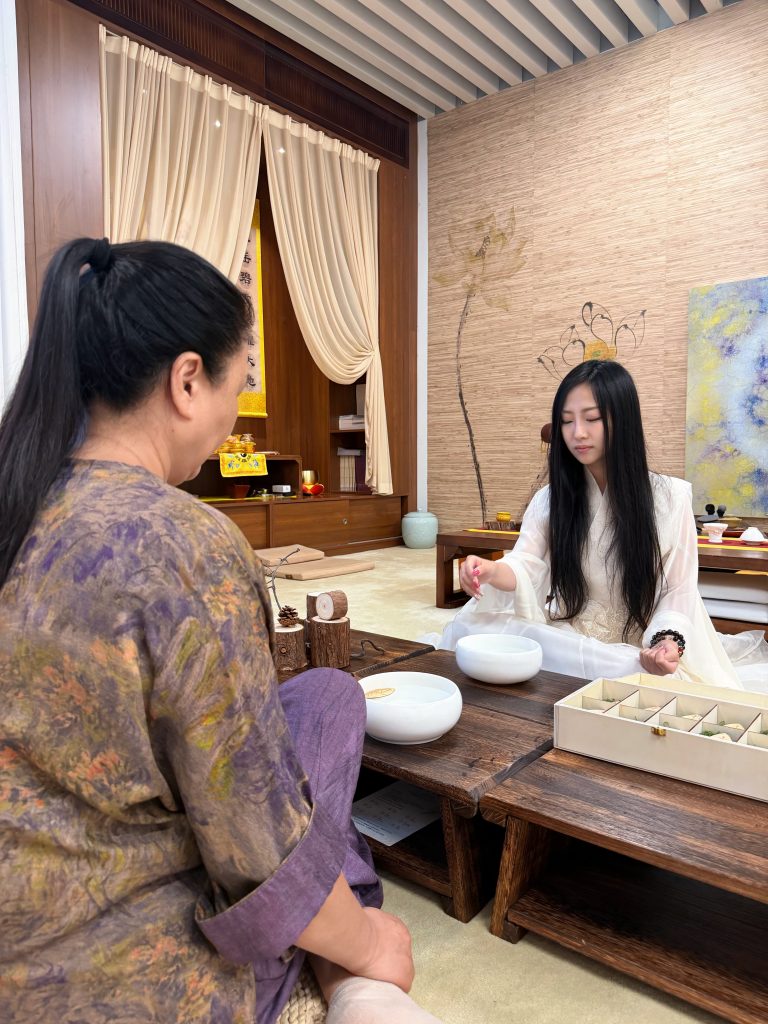
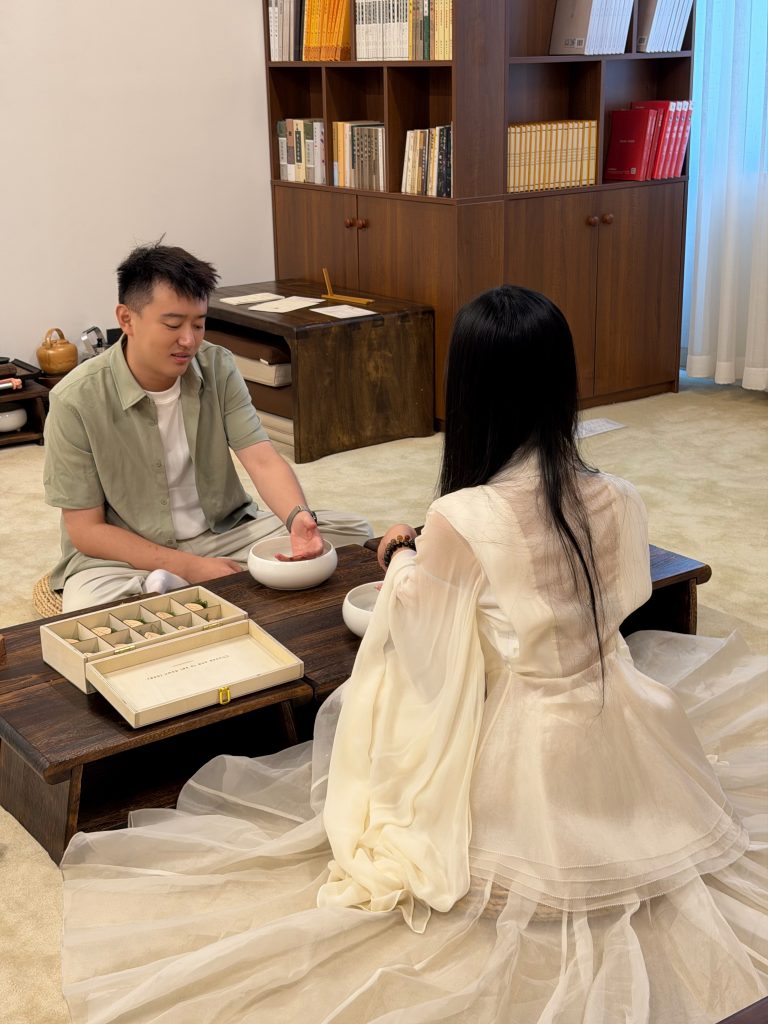
Figures 14–29. Photographs documenting the intervention process.
Beyond My Expectations
Although I had imagined many possible outcomes before the testing, the participants’ responses went far beyond my expectations.
Some participants described the experience as calming.
Some described it as healing.
Others felt that nothing particularly changed.
Interestingly, I realised that whether or not participants felt immediate change was not the most important outcome.
What surprised me most was something much deeper.
Many participants explained that the intervention did not end after the five-minute experience.
Instead, it continued afterwards.
They found themselves reflecting on the experience during the discussion, on their way home, and even imagining how they might remember these five minutes in their future daily lives.
At that moment, I realised that perhaps the value of this project does not lie in creating five minutes of stillness.
Its value may lie in creating a memory that people return to whenever life becomes too full.
This was an insight I had never anticipated before conducting the testing.
When Desire Meets Water
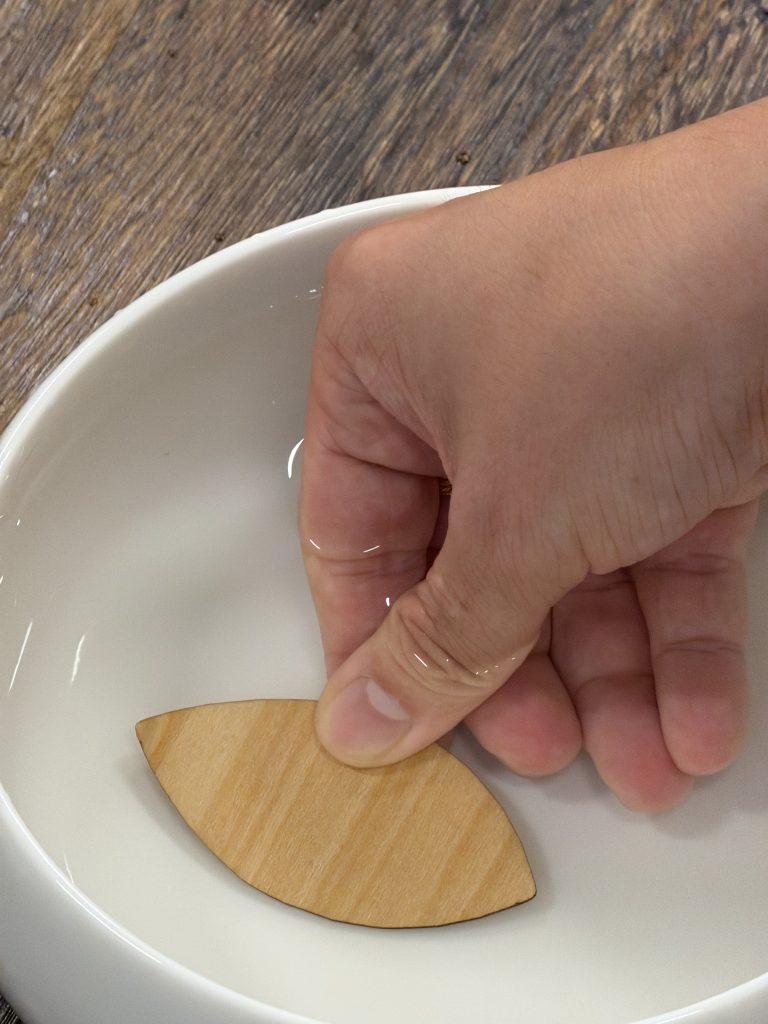
One of the strongest moments throughout the testing was witnessing the relationship that gradually formed between the wooden leaf, the water, and each participant.
Although every participant experienced exactly the same intervention, every story was completely different.
Participant 1 Control
One participant, a 38-year-old mother, chose the wooden leaf labelled “Control.”
She immediately thought about her daughter.
During the discussion she shared that she had always tried to control many aspects of her daughter’s life.
As she quietly watched the wooden leaf floating freely on the surface of the water, she suddenly paused.
She smiled and said,
“Maybe I don’t need to control her so much anymore.
She’s actually doing really well on her own.”
Nothing in the intervention explicitly suggested this reflection.
It emerged entirely from her own relationship with the material.
Participant 2 Noise
Another participant, a 26-year-old man, selected “Noise.”
Instead of simply watching the leaf float, he repeatedly pushed it to the bottom of the bowl.
Every time it floated back up, he pressed it down again.
Again.
And again.
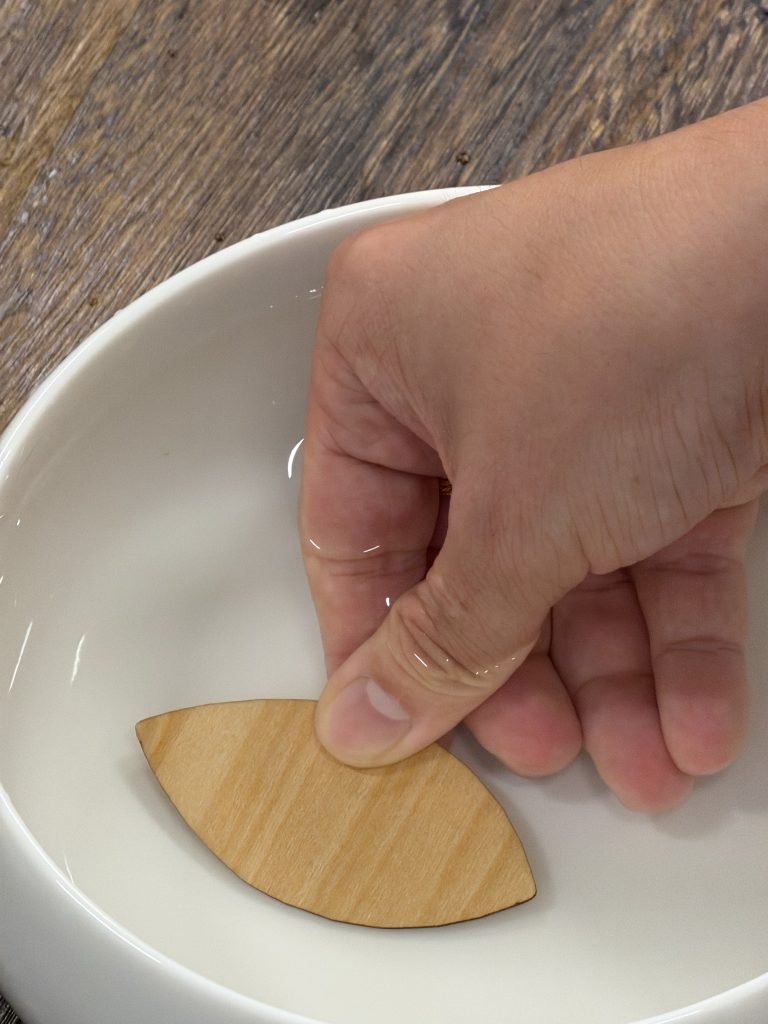
Later he explained,
“I didn’t want to see it.”
However, after repeating this action several times, he stopped.
He simply allowed the leaf to float.
Then he laughed and said,
“When I stopped trying to control it,
it didn’t feel as noisy anymore.”
This was a fascinating moment for me as a designer.
The intervention had never instructed participants how to interact with the leaf.
Yet his own behaviour became a metaphor for the relationship he had with “noise” in everyday life.
Participant 3 Work
A 27-year-old entrepreneur chose the word “Work.”
As soon as he placed the leaf into the water, it drifted quickly towards him.
He laughed and immediately said,
“Why is it coming towards me?
Why isn’t it floating towards you?
I’m already stressed enough.”
Everyone laughed.
However, after quietly sitting with the experience for a while, the water gradually became still, and the leaf slowly stopped drifting towards him.
Afterwards he described that brief moment as
“a rare moment of peace.”
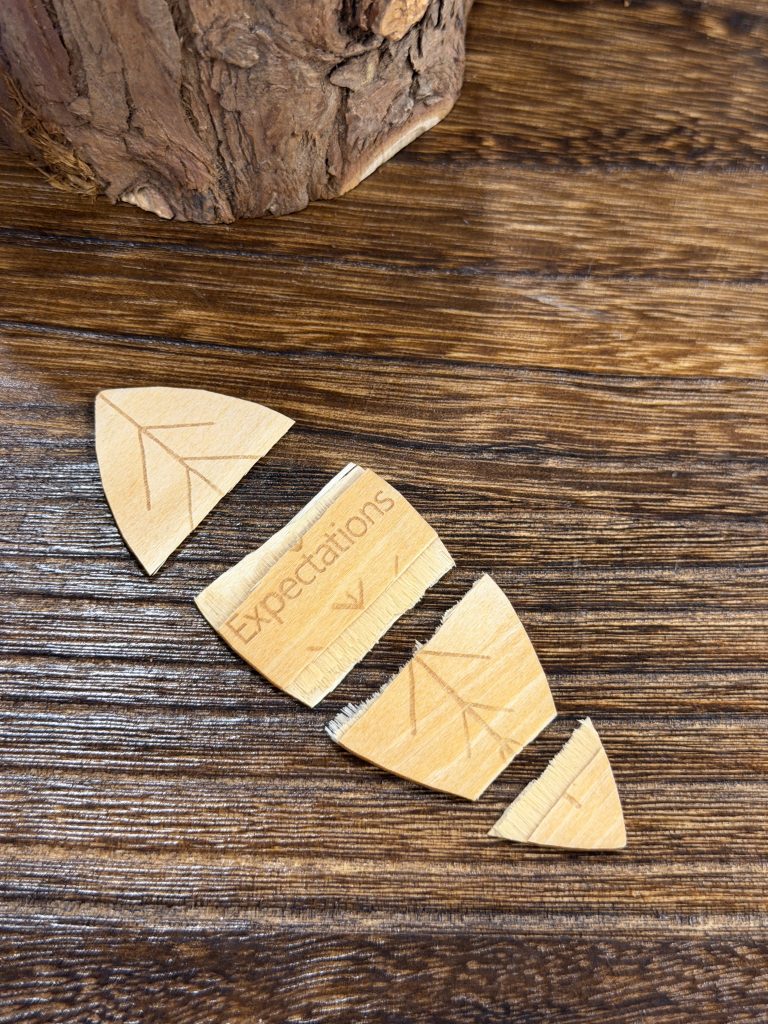
Participant 4 Expectations
Perhaps the most unexpected interaction came from a 30-year-old participant, who selected “Expectations.”
Instead of simply holding the leaf, he slowly broke it into smaller pieces.
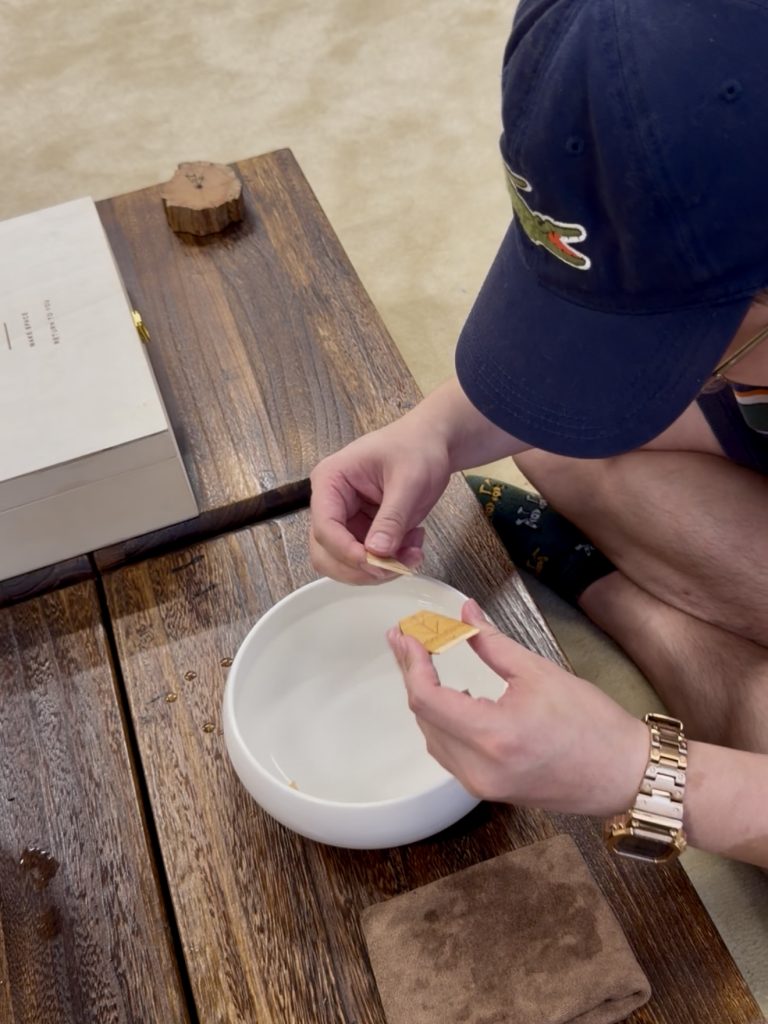
At first, I was surprised.
Later, during the discussion, he explained that he has always had the habit of keeping his hands busy by playing with objects whenever he thinks.
Interestingly, after breaking the wooden leaf, his body language became noticeably calmer.
When I later asked whether he felt more relaxed afterwards, he immediately answered yes.
We also discussed whether this reflected how strongly he had been carrying other people’s expectations.
He agreed.
Then he laughed and said,
“Honestly, I think I could sit here playing with water like this all day, it is a good way to relax!”
This reminded me that participants do not simply follow the intervention.
They also reshape it.
Their own behaviours become part of the design itself.
Leave or Carry
The final decision in the intervention invited participants to choose whether to take the wooden leaf with them or leave it behind on what I now call the Space Tree.
4 participants chose to take their leaf away; 7 participants chose to leave it on the Space Tree.
This decision became another unexpected moment of reflection.
Some participants chose to take their leaf home as a reminder of something they still wished to carry consciously in their future lives.
Others felt that, during the experience, they had already found enough space to temporarily let it go.
These participants left their leaf on the installation.
Interestingly, there was no single way of placing the leaves.
Some carefully positioned them in stable locations.
Some placed them high on the branches.
One participant balanced the leaf delicately between two branches.
Another turned the leaf upside down before placing it down.
Figures 30–34. The Space Tree after the intervention.
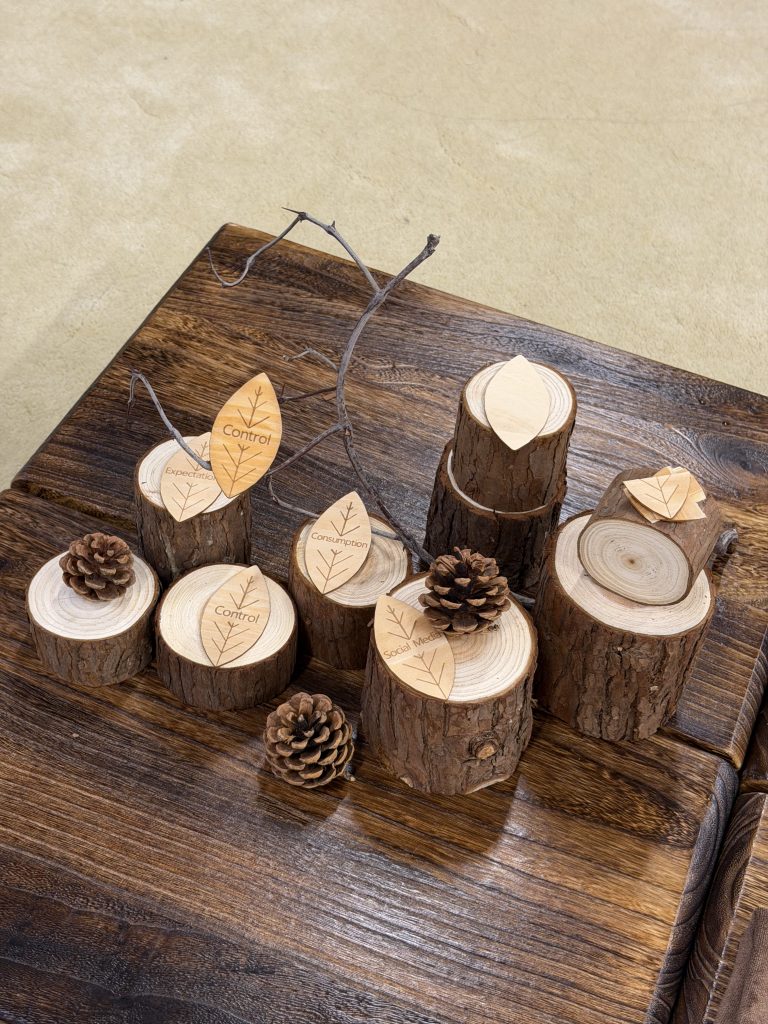
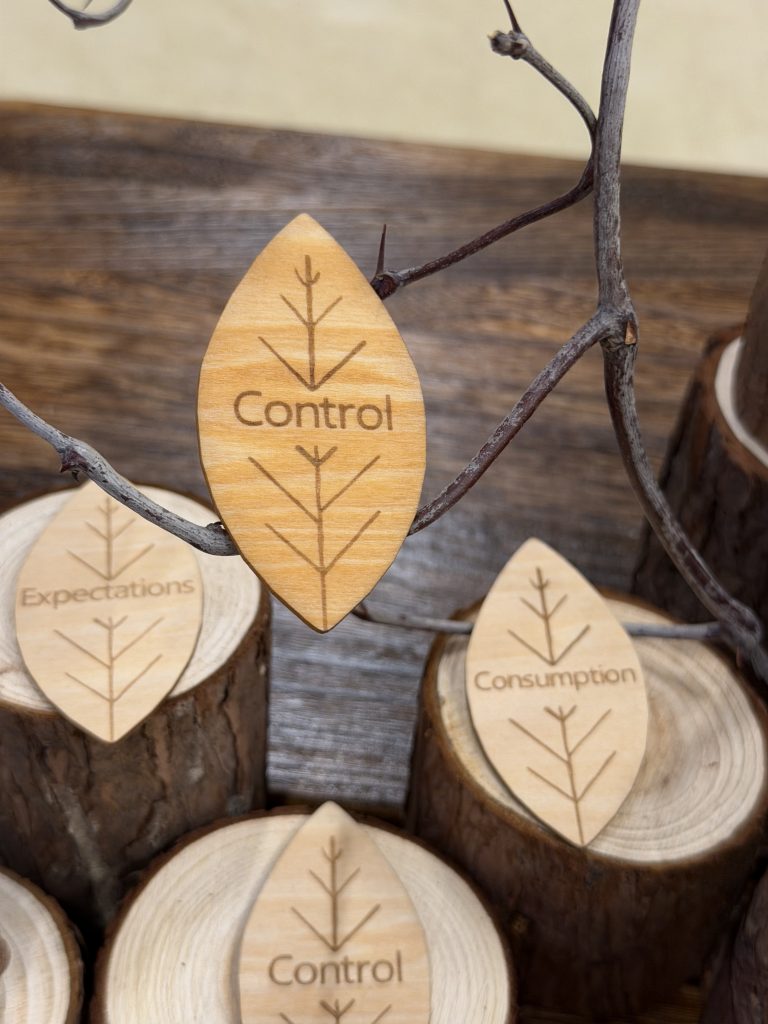
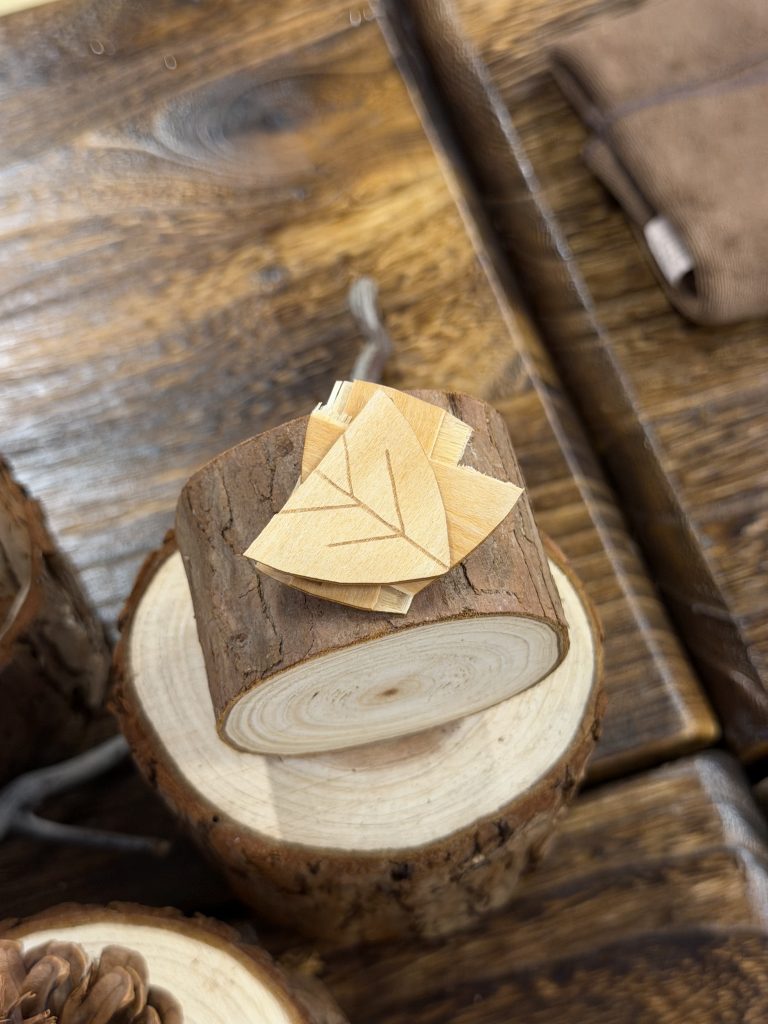

Although I deliberately avoid interpreting these gestures, I found them incredibly meaningful.
The installation gradually became a collective visual record of individual choices, each one reflecting a different relationship with “emptying.”
Insights from User Testing
Following the intervention, I invited all participants to join a one-hour group discussion and semi-structured interview. In addition, each participant completed a Reflection Card immediately after their individual experience.
Rather than evaluating whether the intervention was simply “successful” or “unsuccessful”, I focused on identifying recurring themes that emerged across participants’ experiences. While each participant interacted with the intervention differently, several shared patterns gradually became visible.
Figures 35–36. Group discussion, participant interviews, and the collected Reflection Cards.
1. Participants began to redefine “Emptiness”
Perhaps the most significant finding was that many participants described a different understanding of emptiness after the experience.
Before the intervention, several participants associated emptiness with “nothingness” or “absence”. However, afterwards, they began using words such as:
- Pause
- Acceptance
- Containment
- Relaxation
- Letting things flow naturally
- Reducing control
One participant wrote,
“Emptiness is not about becoming empty, but about pausing.”
Another described emptiness as
“a form of strength and a form of acceptance.”
Rather than explaining the concept of emptiness, the intervention appeared to create a space in which participants generated their own interpretations.
2. The experience continued beyond the five minutes
Another unexpected finding was that the intervention did not seem to end when participants left the table.
Many participants commented that they continued thinking about the experience afterwards.
Some reflected that they would remember these five minutes in their future daily lives.
Others described the intervention as:
“a way of stopping,”
“a reminder,”
or
“a method I can return to.”
This became one of the most meaningful insights for me.
Initially, I believed I was designing a five-minute embodied experience.
However, the testing suggested that what participants carried away was not simply the experience itself, but the memory of it. The intervention appeared to create a reflective reference point that could continue to influence everyday life after the session had ended.
3. Participants formed personal relationships with the materials
Although everyone experienced the same intervention, each participant interacted with the wooden leaf differently.
Some regarded the leaf as representing themselves.
Others saw it as representing a particular desire.
Several participants became fascinated by the movement of the leaf in the water, noticing how it gradually absorbed water, changed colour, drifted with the current, or slowly settled.
Some participants simply observed.
Others interacted physically with the leaf.
One participant repeatedly pressed the leaf beneath the water.
Another carefully broke the leaf into small pieces.
These behaviours were never instructed.
Instead, they emerged naturally from participants’ own relationships with the material.
This made me realise that the intervention is perhaps less about the wooden leaf itself than about the relationship people construct with it.
4. Reflection gradually shifted from the object to everyday life
As the discussion continued, participants increasingly stopped talking about the wooden leaf and started talking about themselves.
Many connected their chosen word with situations in their own lives.
Several reflected on reducing control over others.
Others discussed becoming less affected by external information, social media or expectations.
One participant commented that they hoped to become less influenced by external voices.
Another described learning to “let things flow naturally.”
These responses suggested that the intervention successfully shifted attention from the physical object towards participants’ own lived experiences.
5. There was no single “correct” experience
Not every participant described the intervention as relaxing or healing.
Some experienced a profound emotional response.
Others reported only a slight change.
One participant simply wrote “none.”
Rather than viewing this as a weakness, I see it as an important finding.
The intervention does not aim to produce a single emotional outcome.
Instead, it offers an open framework in which participants generate different meanings according to their own experiences, memories and emotional states.
6. The final decision became another layer of reflection
At the end of the intervention, participants were invited to decide whether they wished to take their wooden leaf away or leave it on the Space Tree.
Interestingly, this final decision became another reflective moment.
Some participants chose to take the leaf with them as an ongoing reminder in their daily lives.
Others felt they had already created enough space during the intervention and decided to leave it behind.
Among the eleven participants,
- four chose to take their leaf away;
- seven chose to leave it on the Space Tree.
What fascinated me even more was how participants positioned their leaves.
Some carefully placed them upright.
Some balanced them on branches.
Some positioned them high within the structure.
One participant even turned the leaf over before placing it.
Although I deliberately avoid assigning symbolic meanings to these gestures, the installation gradually became a collective visual record of individual decisions.
Rather than representing a “correct” way of letting go, it reflected eleven different relationships with the act of creating space.
7. Suggestions for future development
The discussion generated several valuable suggestions for the next iteration:
- Begin the experience before meals rather than afterwards, allowing participants to connect more directly with the philosophy of Bigu.
- Add a short guided body relaxation before the intervention, such as inviting participants to relax their shoulders and breathing.
- Strengthen the ending of the experience to create a more memorable closing moment.
- Create a more immersive environment through sound, lighting, or other sensory elements.
- Explore whether participants should choose one desire word or multiple words, as opinions differed on which approach created deeper reflection.
- Consider whether the different placements of the wooden leaves on the Space Tree should remain open to interpretation or become part of the reflective dialogue.
Reflection
This user testing changed the way I understand my own project.
Before the testing, I thought I was designing an experience about emptiness.
After listening to participants, I realised that perhaps I am actually designing conditions that allow people to pause, observe themselves, and construct their own meanings.
The intervention did not provide answers.
Instead, it created opportunities for questions to emerge.
That shift from designing an experience to designing the conditions for personal reflection has become one of the most important outcomes of this first round of testing.
Next Steps
The next iteration will focus on refining the guidance, strengthening the opening and closing of the experience, and exploring how the intervention can better support reflection while remaining open to different interpretations.
Leave a Reply