Starting Point
When I first started this project, my idea was much broader than it is now. I knew I was interested in labels, personality systems and the way young people try to understand each other quickly in social situations, but I was not yet sure what the real question was. Through feedback, making and reflection, I gradually realised that my main interest was not whether systems such as MBTI or astrology are scientifically correct, but what they actually do in first-time interaction. This led me to my current question: How can systems of labeling used by Chinese young people meeting for the first time be challenged to create deeper social connections?
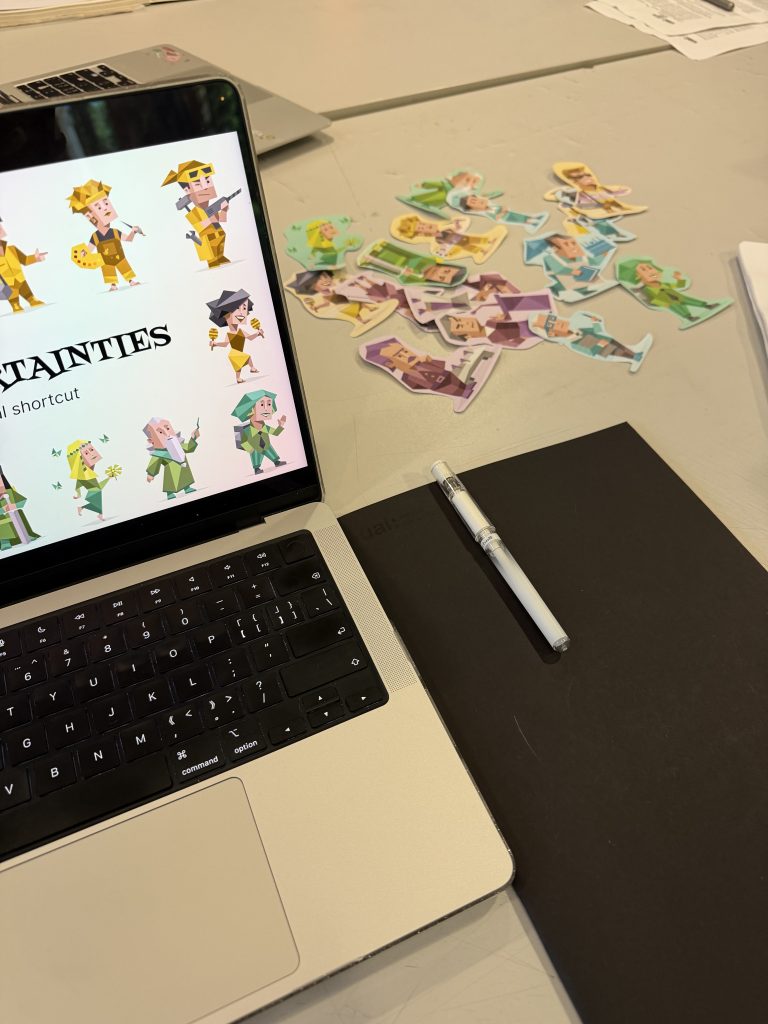
My BA background in broadcasting and hosting, interview-based storytelling has shaped the way I approached this topic. It has made me more sensitive to how people get to know each other through listening and questioning. Because of this, I am naturally drawn to interactions that allow understanding to build slowly, rather than reducing someone to a quick category.
Shifting the Question
Step 1 and Step 2 helped me become more aware of my own position and narrow the project more clearly. Bolton (2018) helped me see that reflection is not only about describing decisions, but also about questioning the assumptions behind them. This made me realise that I was not approaching the topic from a neutral position. I already valued slower and more open ways of knowing others. Smith (2012) also made me more aware that research itself can impose categories too quickly, which felt closely connected to my topic.
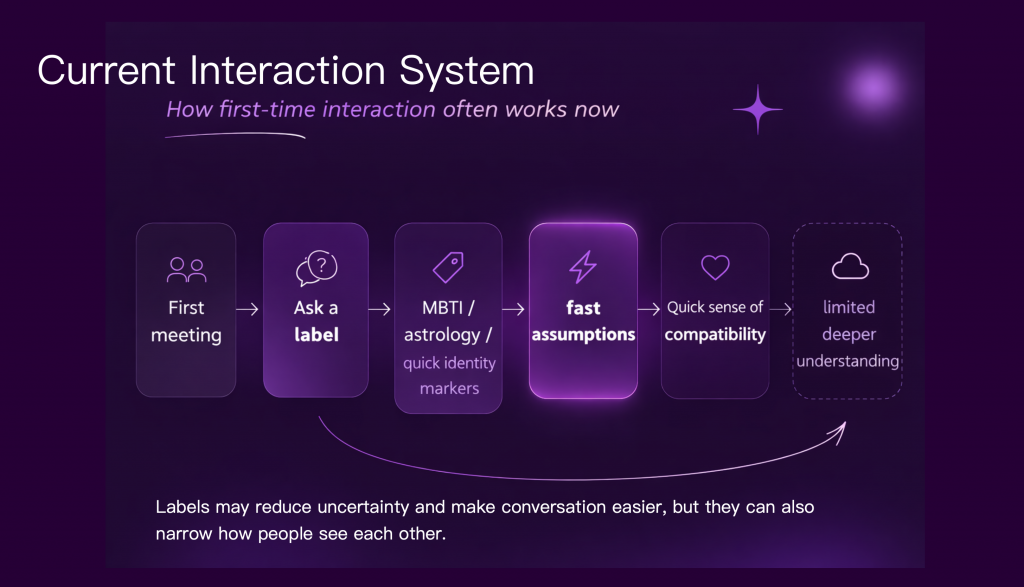
As the project developed, I moved away from a general interest in personality labels and focused more specifically on Chinese young people meeting for the first time in informal situations, such as parties or casual gatherings. I also became clearer about the research gap. A lot of discussion around MBTI focuses on whether it is valid or useful, but I became more interested in its social function. It can reduce uncertainty, encourage quick assumptions and create a feeling of understanding that may still remain shallow. hooks (2010) was especially useful here because it pushed me to question systems that feel normal or familiar. This also helped me see that the issue was more complicated than I first thought, because labels are not only limiting; for some people, they can also feel safe, efficient and socially helpful.
Understanding the Stakeholders
Step 3 made the project feel more grounded. Once I started identifying stakeholders, labels stopped being only an abstract idea. I began thinking more carefully about Chinese young adults in first-time encounters, people who rely on labels to reduce uncertainty, and organisers of informal social spaces. This made me realise that any intervention needed to be simple, realistic and not overly judgmental.
Feedback from my tutor was especially important at this stage. It helped me narrow the context, define the stakeholders more clearly, and turn a broad concern into a more workable research direction.
From Idea to Intervention
Step 4 pushed me to think about impact in a more practical way. Instead of only criticising labels, I started developing a small intervention through question cards and visual prompts. This process helped me imagine a question-based first-meeting tool that could be compared with label-based introductions . The aim is to explore whether different ways of starting a conversation create different feelings of comfort, understanding and connection. McNiff (2017) was helpful here because it encouraged me to think of the project as an iterative process of testing and adjustment rather than a fixed solution. Gladwell (2001) also made me reflect on how small shifts in interaction might still have meaningful effects over time.
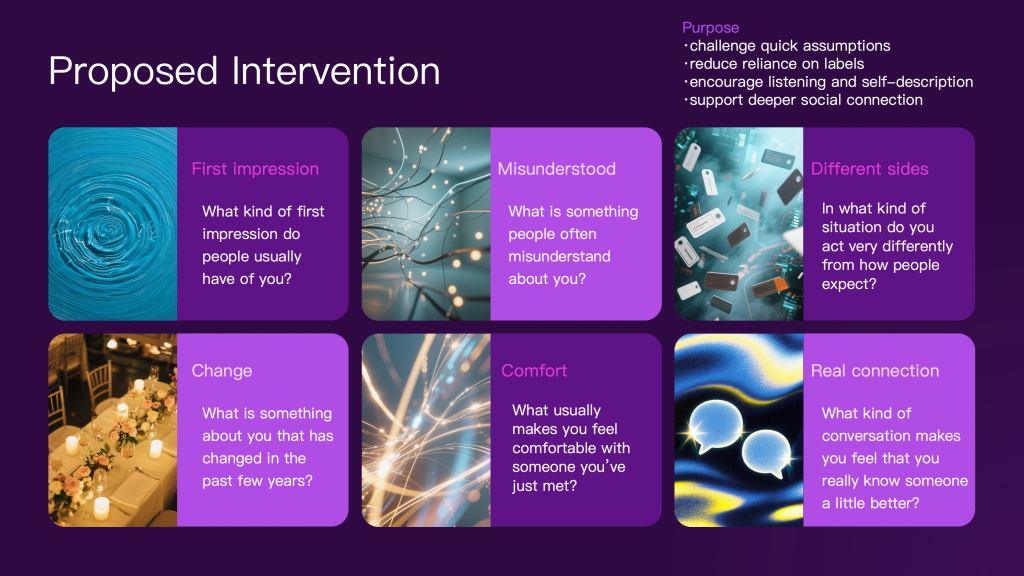
At this stage, I imagine testing this through short comparative interactions and brief participant feedback. Looking back, the project feels much clearer now than it did at the beginning. I have a more focused question, a clearer user group and a more realistic intervention. At the same time, I know the project is still limited. The intervention has not yet been tested, and I need to be careful not to assume that question-based interaction will always lead to deeper connection in every situation.
Bibliography
Berger, C.R. and Calabrese, R.J. (1975) ‘Some explorations in initial interaction and beyond: Toward a developmental theory of interpersonal communication’, Human Communication Research, 1(2), pp. 99–112. doi: 10.1111/j.1468-2958.1975.tb00258.x.
Bolton, G. (2018) Reflective Practice: Writing & Professional Development. London: Sage
Collins, N.L. and Miller, L.C. (1994) ‘Self-disclosure and liking: A meta-analytic review’, Psychological Bulletin, 116(3), pp. 457–475. doi: 10.1037/0033-2909.116.3.457.
Fiske, S.T. and Neuberg, S.L. (1990) ‘A continuum of impression formation, from category-based to individuating processes: Influences of information and motivation on attention and interpretation’, in Zanna, M.P. (ed.) Advances in Experimental Social Psychology. Vol. 23. San Diego: Academic Press, pp. 1–74. doi: 10.1016/S0065-2601(08)60317-2.
Gladwell, M. (2001). The Tipping Point: How Little Things Can Make a Big Difference. London: Abacus
hooks, b. (2010) Teaching Critical Thinking: Practical Wisdom. London: Routledge.
McNiff, J. (2017) Action Research: All You Need to Know. London: Sage.
Qin, Y., Cho, H., Li, P. and Zhang, L. (2021) ‘First impression formation based on valenced self-disclosure in social media profiles’, Frontiers in Psychology, 12, 656365. doi: 10.3389/fpsyg.2021.656365.
Smith, L.T. (2012) Decolonizing Methodologies: Research and Indigenous Peoples. 2nd edn. London and New York: Zed Books.
Towner, E., Grint, J., Levy, T., Blakemore, S.-J. and Tomova, L. (2022) ‘Revealing the self in a digital world: A systematic review of adolescent online and offline self-disclosure’, Current Opinion in Psychology, 45, 101309. doi: 10.1016/j.copsyc.2022.101309.
Tsankova, E. and Tair, E. (2021) ‘Meta-Accuracy of Very First Impressions: A Mini Review’, Frontiers in Psychology, 12, 736534. doi: 10.3389/fpsyg.2021.736534.
Wang, C., Gao, Y. and Xie, Y. (2024) ‘Analyzing the dissemination of the Myers-Briggs Type Indicator (MBTI) in China: A case study of Weibo and Xiaohongshu texts’, in Proceedings of the 4th International Conference on Public Management and Intelligent Society (PMIS 2024). doi: 10.4108/eai.15-3-2024.2346532.
Wu, W., Hao, W., Zeng, G. and Du, W. (2024) ‘From personality types to social labels: The impact of using MBTI on social anxiety among Chinese youth’, Frontiers in Psychology, 15, 1419492. doi: 10.3389/fpsyg.2024.1419492.
Leave a Reply