Developing Relationships Across Cultural Wellbeing, Healing Spaces, and Medical Perspectives
INTRODUCTION
This project focuses on building a research network around cultural wellbeing, healing practices, institutional perspectives, and medical viewpoints.
Rather than relying only on secondary research, I wanted to speak directly with people and spaces connected to different understandings of health and wellbeing.
The project explores how conversations, observation, and embodied participation may help develop more reflective ways of engaging with unfamiliar wellbeing practices.
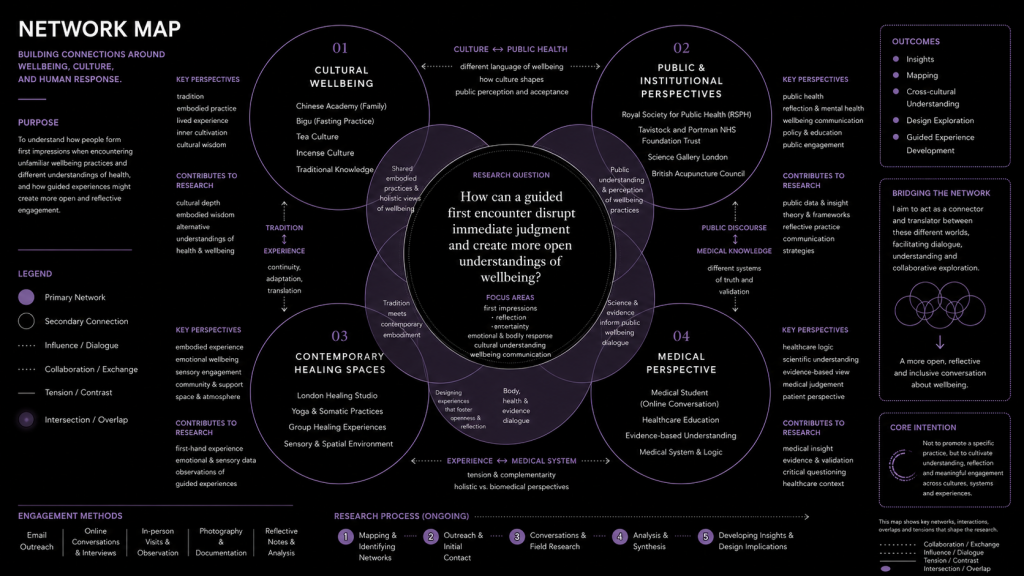
NETWORK MAP
The network developed across four main areas:
- institutional outreach
- cultural wellbeing practice
- healing spaces
- medical perspectives
These different connections helped shape the project’s understanding of curiosity, scepticism, legitimacy, atmosphere, and embodied wellbeing.
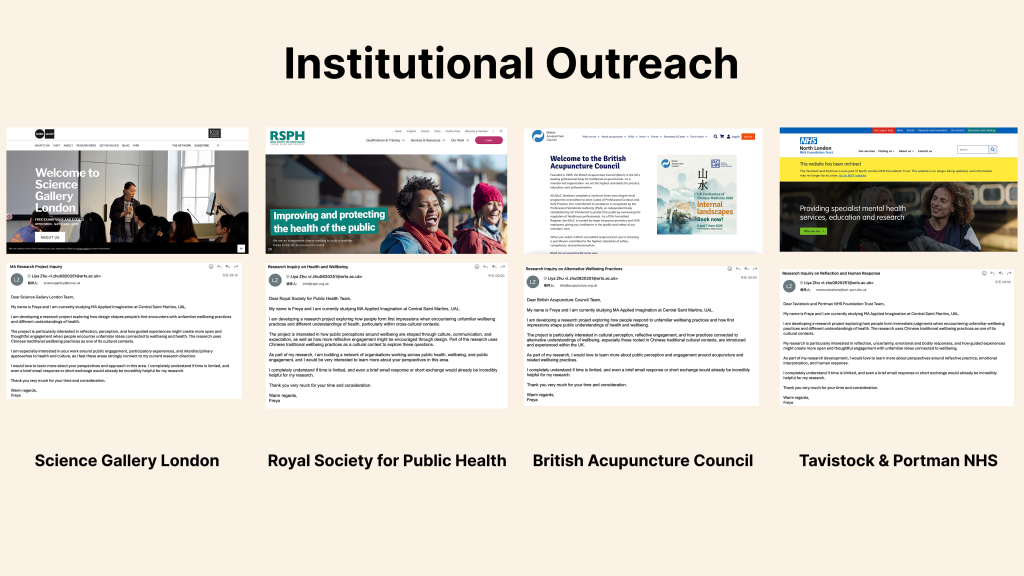
INSTITUTIONAL OUTREACH
I contacted several UK organisations connected to wellbeing, public health, and cultural engagement, including:
- British Acupuncture Council
- Royal Society for Public Health
- Science Gallery London
- Tavistock and Portman NHS Foundation Trust
Although I did not receive replies, the outreach itself became meaningful.
It raised questions around legitimacy, visibility, and how unfamiliar wellbeing practices are often positioned differently within institutional systems (Smith, 2012).
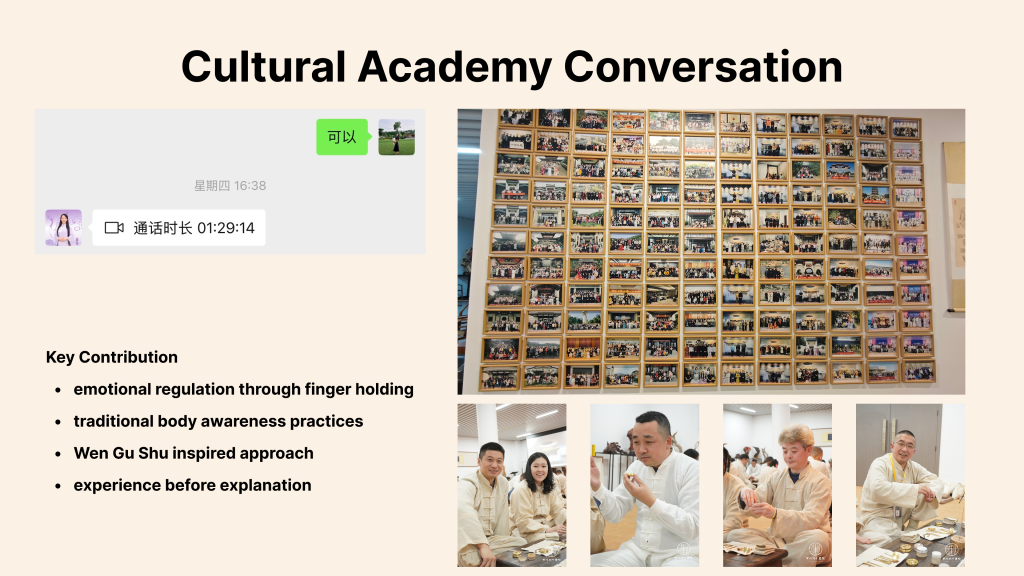
CHINESE CULTURAL ACADEMY
I also had ongoing conversations with my family’s Chinese cultural academy, including video calls with the academy director.
One important discussion focused on Wen Gu Shu, a traditional Chinese body practice involving emotional regulation through finger holding.
The academy emphasised the idea that the body may respond before intellectual understanding takes place.
This directly influenced the embodied interaction developed within my intervention.
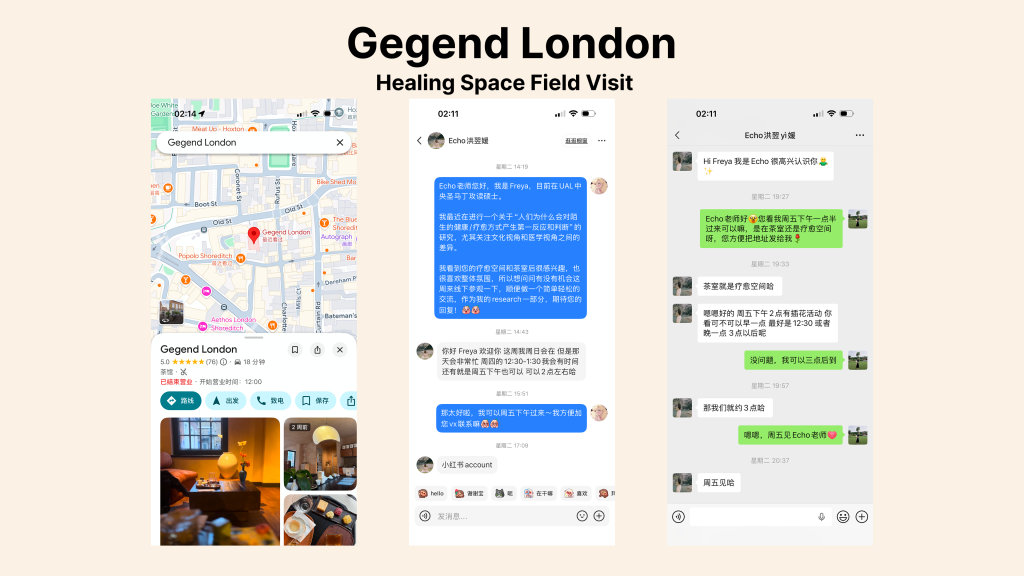
GEGEND LONDON
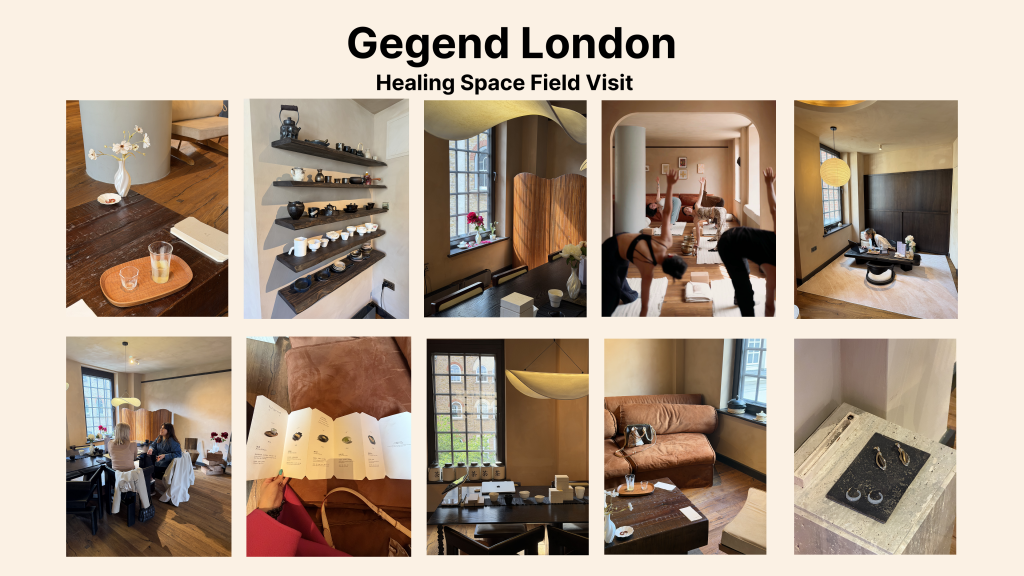
I visited Gegend London, a healing and tea space combining yoga, sensory experience, and Chinese inspired wellbeing practices.
I spent around two hours there conducting observation and informal conversations.
The founder described the space as attracting both Chinese and international visitors interested in slower and more reflective wellbeing experiences.
The interviewee mentioned that one of her impressed student friends was a Russian woman, and she strongly agreed with China’s way of maintaining health.
During the conversation, ideas like balance, regulation, atmosphere, and emotional wellbeing came up many times.From my observation, the space felt very active and welcoming, especially on a Friday afternoon, with many people staying for a long time and enjoying the environment.
Evidence of contact
CHANLE WELLNESS SERVICE
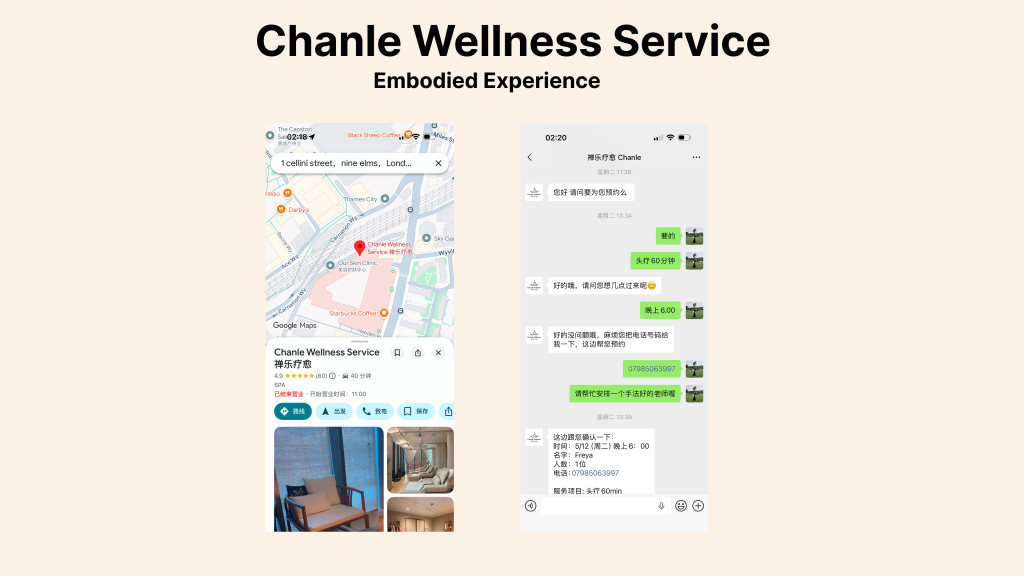
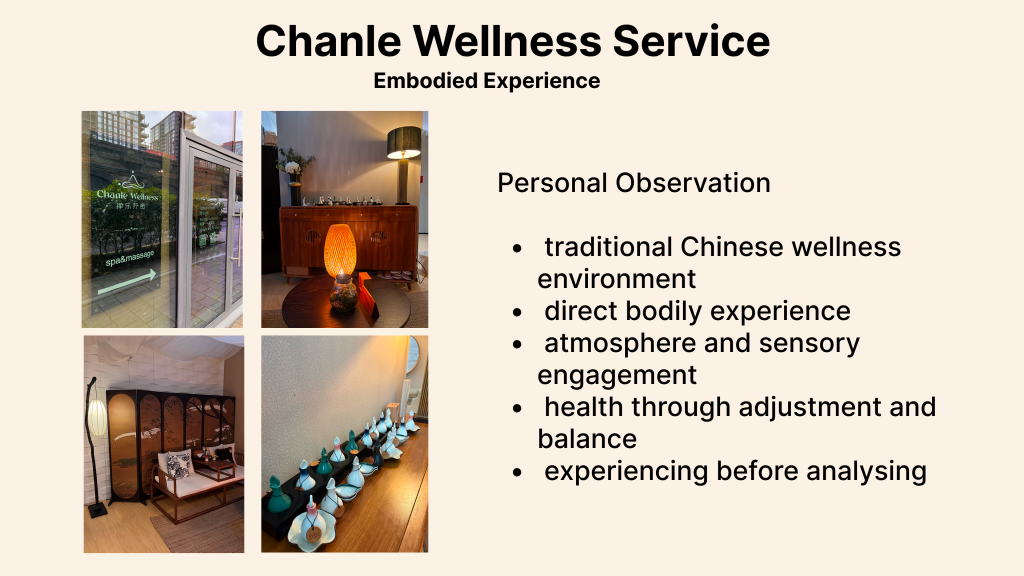
I also visited Chanle Wellness Service and personally experienced their treatment.
This became important because the project is not only about observing others, but also about embodied participation and sensory experience.
The experience made me think more carefully about atmosphere, bodily feeling, and how wellbeing practices are often understood through experience rather than explanation alone.
Evidence of contact
PHARMACY STUDENT INTERVIEW
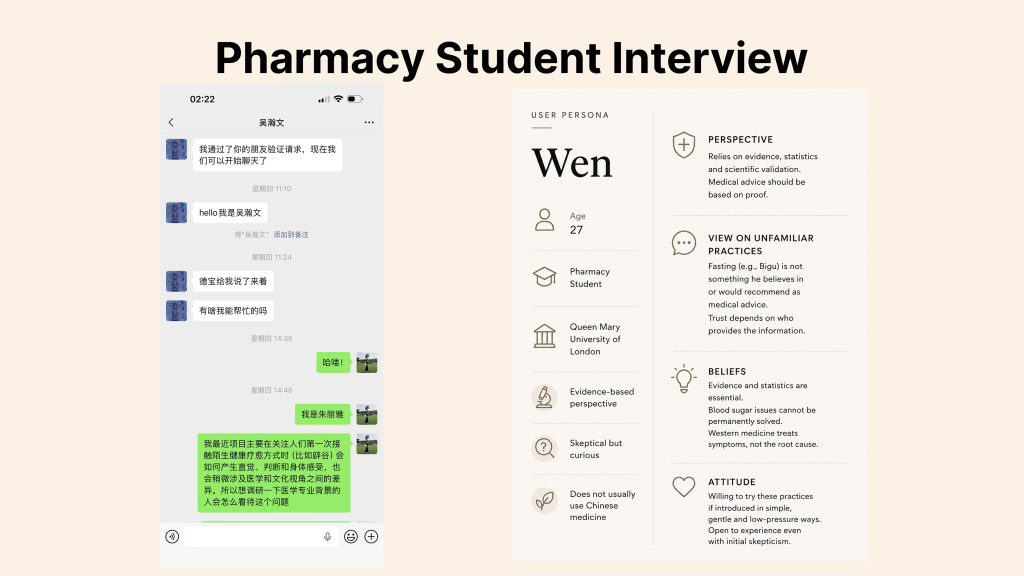
I conducted an in person interview with a pharmacy student from Queen Mary University of London.
His initial reaction towards Bigu fasting practices was scepticism, especially from an evidence based medical perspective.
He explained that healthcare systems are largely built around evidence, statistics, and scientific validation.
At the same time, after a longer conversation, he said he would still be willing to experience unfamiliar practices if introduced through simple and low pressure interaction.
This became an important insight within the research, suggesting that curiosity may still emerge even when scepticism exists (Freire, 2001).
Evidence of contact
REFLECTION
Building this network changed my understanding of the project itself.
Rather than positioning cultural wellbeing and medical systems as direct opposites, I became more interested in the space between scepticism, curiosity, embodied experience, and dialogue.
The project is not trying to prove whether unfamiliar wellbeing practices are scientifically correct or incorrect.
Instead, it explores how research, conversation, and design may create slower and more reflective first encounters between different understandings of health (Deardorff, 2006).
REFERENCES
Deardorff, D.K. (2006) ‘Identification and assessment of intercultural competence as a student outcome of internationalization’, Journal of Studies in International Education, 10(3), pp. 241–266.
Freire, P. (2001) Pedagogy of Freedom: Ethics, Democracy and Civic Courage. Lanham: Rowman & Littlefield.
McNiff, J. (2013) Action Research: Principles and Practice. London: Routledge.
Smith, L.T. (2012) Decolonizing Methodologies: Research and Indigenous Peoples. 2nd edn. London: Zed Books.
Leave a Reply