Reinterpreting the Philosophy of Bigu Through Contemporary Interaction Design
8 July 2026
Part1
Introduction
Over the past two weeks, my project has undergone a significant transformation. Looking back, I realised that the biggest change was not my intervention, but the question I was asking.
At the beginning of this project, I was interested in how people respond to unfamiliar Chinese wellbeing practices. My intervention explored whether a guided experience could encourage participants to become more open-minded towards practices such as Bigu (辟谷) and the Five Elements.
However, after reflecting on the feedback from my tutorial and spending more time reading Daoist philosophy, I realised that I was still approaching Bigu as something to explain.
Gradually, I found myself asking a different question.
Instead of asking:
How can people understand Bigu?
I began asking:
Why has Bigu existed for centuries?
Although this may seem like a small shift, it fundamentally changed the direction of my research and my role as a designer. Rather than explaining a traditional Chinese practice, I became interested in translating its underlying philosophy into a contemporary interactive experience.
Reflecting on the Tutorial
One of the most valuable pieces of feedback from my tutorial was that my project had become increasingly broad.
I was trying to include fasting, the Five Elements, tea culture, incense, breathing exercises and several other traditional practices within one intervention. While these examples all belonged to Chinese wellbeing traditions, together they lacked a clear conceptual focus.
My tutor encouraged me to simplify the project and develop one idea in greater depth, rather than introducing many cultural examples. More importantly, he reminded me that the project should not aim to educate people about Chinese traditions or persuade them that these practices are effective. Instead, the intervention should create opportunities for participants to experience, interpret and reflect for themselves.
Looking back, I realised that I had been focusing too much on the practices themselves.
The tutorial encouraged me to look underneath them.
Looking Beyond Fasting
Initially, I understood Bigu simply as fasting.
Like many English translations, I focused on the visible behaviour—choosing not to eat.
However, the more I read about Daoist philosophy, the more I realised that this translation only explains what people do, rather than why the practice exists.
This distinction became increasingly important.
Historically, Gu refers to grain, one of the most important sources of nourishment in ancient China.
Reducing grain consumption therefore represented much more than changing eating habits.
It reflected a particular relationship between the body, nature and desire.
This made me ask another question.
If grain represented what people consumed in the past, what represents “grain” today?
From Grain to Consumption
Today, very few people experience a shortage of food.
Instead, many of us experience something different.
An excess of information.
An excess of notifications.
An excess of comparison.
An excess of productivity.
An excess of expectations.
An excess of digital stimulation.
I realised that contemporary wellbeing might no longer be challenged by physical scarcity, but by cognitive and emotional overload.
At this point, I no longer saw Bigu as fasting.
Instead, I began interpreting it as the conscious practice of reducing unnecessary consumption.
This became the first major turning point in my research.
More importantly, it immediately changed my design thinking.
Rather than designing an experience about fasting, I started exploring how interaction design could communicate the experience of consciously creating space.
Creating Space as a Design Principle
As my interpretation of Bigu changed, so did my understanding of healing.
Many contemporary wellbeing products encourage people to improve themselves by adding more.
More mindfulness.
More exercise.
More productivity.
More self-optimisation.
However, while reading about traditional Chinese philosophy, I noticed a different pattern.
Tea culture values waiting.
Chinese painting values empty space.
Tai Chi values balance rather than force.
Daoism values restraint rather than accumulation.
Although these traditions appear very different, they repeatedly return to one shared idea.
They create space.
This observation gradually became the central design principle of my project.
Healing begins by creating space.
For me, this sentence is no longer simply an observation.
It has become a design principle.
Rather than asking participants to gain more knowledge, complete more activities or receive more information, I want the intervention itself to create moments of pause, reduction and bodily awareness.
In other words, the philosophy should not only be discussed.
It should be experienced.
Part 2
From Research to Design
As my understanding of Bigu developed, I realised that the project was no longer about introducing a traditional Chinese practice.
Instead, it became an exploration of how an ancient philosophy might be translated into a contemporary experience.
This distinction changed the role of design within my project.
Previously, I imagined the intervention as a way of explaining Chinese culture through different activities. Participants would encounter unfamiliar practices and then experience breathing exercises, sensory activities and reflection in the hope that their perceptions might change.
Now, I no longer see the intervention as an explanation.
Instead, I see it as a translation.
Rather than asking participants to understand Bigu intellectually, I want them to experience one of its underlying ideas through a sequence of carefully designed interactions.
This shift also changed my role as a designer.
Instead of asking “How can I explain this philosophy?”, I began asking:
“How can this philosophy be experienced?”
This became the foundation for every design decision that followed.
Current Research Question
As the project evolved, I found that my research question also needed to change.
Initially, my project focused on encouraging people to become more open-minded towards unfamiliar Chinese wellbeing practices.
However, this question gradually became less relevant as my understanding of Bigu deepened.
The project is no longer about changing people’s opinions.
Instead, it explores how a traditional philosophy can be translated into an interactive experience for contemporary life.
At this stage, my working research question is:
How can the philosophy of Bigu be translated into an interactive wellbeing experience for contemporary society?
I intentionally describe this as a working research question because I expect it to continue evolving through prototyping and participant feedback. Rather than fixing the direction too early, I want the research process to continue shaping the project.
Translating Philosophy into Experience
One of the biggest design challenges has been deciding how philosophy should be communicated.
My first instinct was to explain more.
I considered introducing historical information, cultural background and theoretical concepts before asking participants to interact with the intervention.
However, the more I reflected on my research, the more I realised that this approach contradicted the philosophy I was trying to communicate.
If the central idea of Bigu is creating space rather than accumulating more, then the intervention itself should also resist unnecessary complexity.
This became another important design decision.
Instead of explaining philosophy through information, I decided to communicate it through experience.
Instead of asking participants to read more, I wanted them to do less.
Instead of providing answers, I wanted to create moments of pause.
In this sense, the interaction itself becomes the message.
Developing the Intervention
My intervention is now organised as a sequence of simple interactions.
Rather than functioning as separate activities, each stage responds directly to a research insight that emerged during the development of the project.
Stage One — Recognising Overconsumption
The intervention begins by inviting participants to reflect on their everyday lives.
Rather than introducing Chinese philosophy immediately, I first want participants to recognise a condition that many of us already experience.
Information.
Notifications.
Comparison.
Constant productivity.
Endless scrolling.
These forms of consumption have become so ordinary that they are often invisible.
Participants are therefore invited to pause and consider a simple question:
What are you constantly consuming?
Design intention
I deliberately chose not to begin with Chinese culture.
If participants cannot first recognise overconsumption within their own lives, Bigu risks remaining an unfamiliar cultural concept rather than becoming personally meaningful.
Stage Two — Creating Space
Participants are then invited to write down one thing they would like to let go of.
It may be pressure.
Comparison.
Anxiety.
Digital distraction.
Perfectionism.
Or simply the feeling of always needing to do more.
After writing, they place the card into a wooden box.
The action is intentionally quiet and uncomplicated.
It does not symbolise permanently giving something up.
Instead, it represents making space, even if only temporarily.
Design intention
This stage is my interpretation of Bigu.
Rather than asking participants to stop eating, I reinterpret the philosophy as a conscious act of choosing what no longer needs to be carried.
The interaction therefore communicates the philosophy without asking participants to imitate the original practice.
Stage Three — Reconnecting with the Body
Once participants have symbolically created space, they are invited to reconnect with themselves.
At this point, I introduce the Five Elements.
However, the Five Elements are not presented as a medical system, nor as something participants are expected to believe in.
Instead, they function as a reflective framework.
Participants simply choose the element that resonates most with how they currently feel.
Each element is accompanied by a subtle sensory cue, such as colour, sound or texture.
Rather than diagnosing the body, these elements encourage participants to notice it.
Design intention
Earlier versions of my project used the Five Elements as cultural content.
Now, they function as a design language for embodied reflection.
This shift allows the philosophy to remain accessible regardless of participants’ cultural background.
Stage Four — Touch and Breath
The experience concludes with a simple finger-touch ritual combined with slow breathing.
The gesture is intentionally small.
Participants gently hold one finger while focusing on their breathing for a short period of time.
Nothing dramatic happens.
There is no instruction to achieve relaxation or transformation.
Instead, the interaction simply redirects attention back towards the body.
Design intention
Originally, I imagined ending the intervention with explanation.
Now, I deliberately end with silence.
Rather than leaving participants with information, I want them to leave with an experience that remains open to interpretation.
Part3
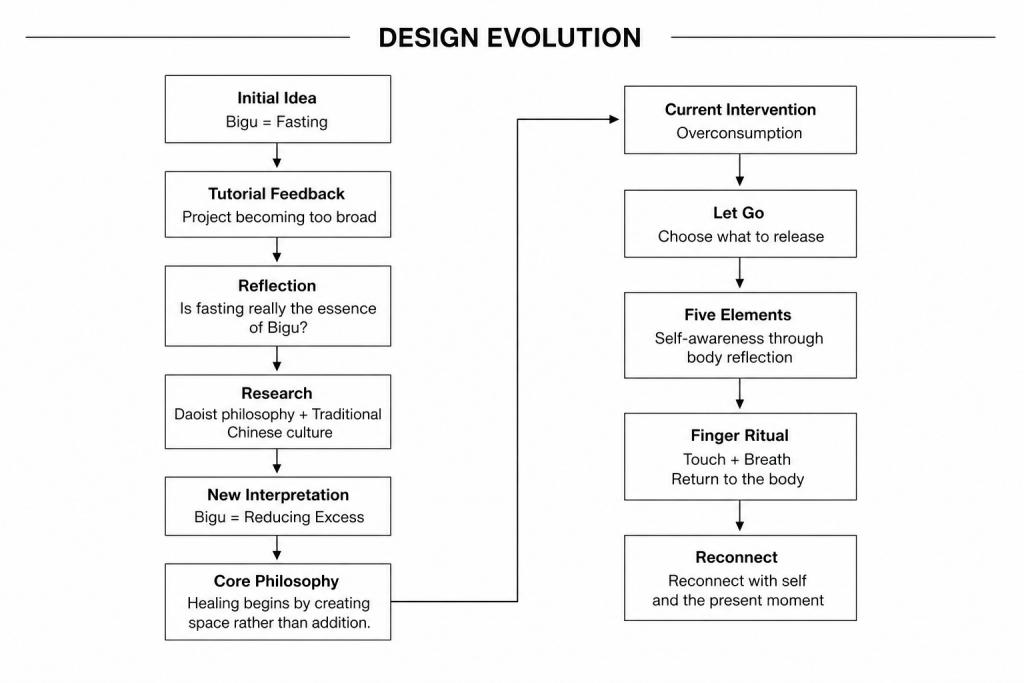
Design Evolution
Looking back over the past two weeks, I realised that the project has changed much more than I expected.
At the beginning, I believed I was designing an intervention about Bigu.
Now, I feel that Bigu has become a lens through which I explore a much broader design question.
The project is no longer centred on fasting.
Instead, it explores how traditional Chinese philosophy can be translated into contemporary interaction design.
One of the most significant changes has been recognising the difference between representing culture and translating philosophy.
Previously, I focused on introducing traditional practices such as Bigu, the Five Elements and breathing exercises. These practices themselves became the content of the intervention.
Now, I see these practices differently.
They are no longer the destination of the project.
Instead, they have become tools for communicating a much deeper philosophical idea.
This shift has helped me simplify the project considerably.
Rather than asking participants to understand Chinese culture, I now ask how interaction can communicate the experience of creating space.
This has become the central thread connecting every stage of the intervention.
Figure 1. Design evolution of the project.
Critical Reflection
One of the biggest lessons from this stage of the project has been learning to distinguish between research findings and design decisions.
Initially, whenever I discovered something interesting about Daoist philosophy or Chinese wellbeing traditions, my instinct was to include it in the intervention.
As a result, the project gradually became more complex.
Looking back, I realised that I was collecting ideas rather than designing an experience.
The tutorial feedback encouraged me to simplify the project, but it was only through continued reflection that I understood what simplification actually meant.
Simplification was not about removing content.
It was about identifying the one idea that should guide every design decision.
For me, that idea has become creating space.
Once this principle became clear, many design decisions became much easier.
For example, I no longer felt the need to explain the history of Bigu during the intervention.
Instead, I asked myself how participants might physically experience the philosophy through a series of small actions.
Similarly, I realised that the Five Elements did not need to function as a traditional medical framework.
Instead, they could become a reflective language for noticing the body.
Even the decision to avoid a large immersive installation came from this way of thinking.
Rather than building something visually overwhelming, I became interested in how a sequence of quiet interactions might communicate more effectively.
Looking back, I feel that the project has become less about designing objects and more about designing conditions.
Conditions that invite participants to pause.
Conditions that encourage self-awareness.
Conditions that leave room for personal interpretation rather than providing fixed answers.
I think this shift represents the most important development in my project so far.
Next Steps
The next stage of the project will focus on prototyping and participant testing.
Rather than developing the entire intervention at once, I plan to prototype each stage individually in order to understand how participants experience different moments of the journey.
Some of the questions I would like to explore include:
- Do participants recognise overconsumption in their own lives before encountering the idea of Bigu?
- Does the “Let Go” activity encourage genuine reflection, or does it feel merely symbolic?
- How do participants interpret the Five Elements when they are presented as a reflective framework rather than a medical theory?
- Can a simple finger-touch ritual create a meaningful shift in attention?
- How much explanation is actually necessary throughout the experience?
These questions will guide the next stage of development and allow participant feedback to continue shaping the intervention.
Rather than treating the current intervention as a finished outcome, I see it as an evolving prototype that will continue changing through testing and reflection.
Final Reflection
When I first began this project, I thought I was researching a traditional Chinese wellbeing practice.
Now, I realise that I have been researching something much broader.
Bigu has become the starting point for exploring how philosophy can be translated into interaction.
This has also changed how I understand the role of design.
Rather than communicating information, design can create situations in which people experience an idea for themselves.
Perhaps this is the most valuable lesson I have learned during this stage of the project.
The project is no longer about asking participants to understand Bigu.
Instead, it asks whether interaction design can create the conditions for people to slow down, create space, and reconnect with themselves.
At this point, I no longer see the intervention as a way of presenting Chinese culture.
Instead, I see it as an ongoing exploration of how traditional philosophy might inspire new forms of wellbeing experience within contemporary life.
References
Bell, C. (1992) Ritual Theory, Ritual Practice. Oxford: Oxford University Press.
Brown, K.W. and Ryan, R.M. (2003) ‘The benefits of being present: Mindfulness and its role in psychological well-being’, Journal of Personality and Social Psychology, 84(4), pp. 822–848.
Dourish, P. (2001) Where the Action Is: The Foundations of Embodied Interaction. Cambridge, MA: MIT Press.
Kabat-Zinn, J. (1994) Wherever You Go, There You Are: Mindfulness Meditation in Everyday Life. New York: Hyperion.
Kaptchuk, T.J. (2000) The Web That Has No Weaver: Understanding Chinese Medicine. 2nd edn. New York: McGraw-Hill.
Laozi (1963) Tao Te Ching. Translated by D.C. Lau. Harmondsworth: Penguin Books.
Norman, D.A. (2004) Emotional Design: Why We Love (or Hate) Everyday Things. New York: Basic Books.
Pine, B.J. and Gilmore, J.H. (1999) The Experience Economy. Boston, MA: Harvard Business School Press.
Stickdorn, M., Hormess, M., Lawrence, A. and Schneider, J. (2018) This Is Service Design Doing. Sebastopol, CA: O’Reilly Media.
Zhuangzi (2009) The Complete Works of Zhuangzi. Translated by B. Watson. New York: Columbia University Press.
Leave a Reply