From Promoting Understanding to Investigating Judgement
This week’s tutorial became an important turning point in my project. Rather than focusing solely on the intervention itself, the discussion encouraged me to reconsider the assumptions behind my research question and think more critically about what exactly I am trying to investigate.
My project has gradually shifted away from questions of health outcomes and towards questions of perception, experience, and wellbeing. I am becoming increasingly interested in how people respond to unfamiliar wellbeing practices before they have experienced them, and whether design can create a space where immediate judgement is temporarily suspended.
This led me to refine my research question towards:
How can a guided first encounter be designed to suspend immediate judgement and encourage more open engagement with unfamiliar wellbeing practices?
Chinese cultural wellbeing traditions remain an important part of the project, but I now see them more as a cultural lens through which I can explore this question.
Growing up, practices such as tea, incense, fasting, breathing exercises and ideas related to the Five Elements were familiar to me. However, I have become increasingly interested in how people react when they encounter these ideas without having the same cultural background.
Thinking About the Audience
One of the most useful discussions during the tutorial was about my target audience.
Initially, I questioned whether there was really resistance towards unfamiliar wellbeing practices. Many young adults today are willing to try yoga, meditation, mindfulness and other alternative wellbeing experiences. If people are already open to new ideas, then who exactly is my project for?
Reflecting on this question brought me back to one of the key examples that inspired the project: Bigu, a traditional Chinese fasting practice.
From my observations and conversations, many young people are curious about wellbeing, but their reactions vary greatly depending on the practice. Activities such as tea drinking, breathing exercises or mindfulness are often accepted quite easily. However, when fasting practices such as Bigu are mentioned, the response is often much more sceptical. People may immediately describe them as dangerous, extreme or unscientific.
At the same time, I have noticed an interesting contradiction. Many people who are sceptical about traditional practices are highly willing to consume supplements, vitamins or various commercial wellness products. This does not necessarily mean one approach is right and the other is wrong, but it raises questions about how trust is formed and why certain wellbeing practices are accepted more readily than others.
This observation is also connected to my own understanding of wellbeing. My project is not about promoting supplements or persuading people to stop using them. I do not think it is realistic or appropriate to try to change people’s personal choices in that way. Instead, I am interested in understanding how people evaluate different wellbeing approaches and what influences their judgement.
Because of this, I am currently considering focusing on adults between approximately 25–35 years old. This age group is often actively engaged with wellbeing culture, whether through fitness, self-care, supplements, mindfulness or alternative health practices. They are also at a stage where they are making independent decisions about their lifestyles and wellbeing habits.
Rather than targeting people who are completely resistant, I am becoming more interested in people who are already engaged with wellbeing but may hold strong assumptions about what feels trustworthy, scientific or acceptable.
This helped me realise that my project is not about whether people are generally open-minded or closed-minded. Instead, it is about understanding how judgement is formed when people encounter practices that challenge their existing beliefs about wellbeing.
Rather than trying to convince people to accept something, I am interested in what happens between first impression and final opinion.
Developing the Intervention
My current intervention continues to focus on this process of judgement and reflection.
Participants first encounter a series of unfamiliar wellbeing practices and respond to them through a reflection wall. They are invited to share their initial reactions using labels such as “interesting”, “strange”, “dangerous”, “trustworthy” or “spiritual”.
After this, they take part in a number of simple sensory and embodied activities inspired by Chinese cultural wellbeing traditions. These currently include breathing exercises, finger emotion practices and other small activities designed to encourage awareness and reflection.
Finally, participants return to the reflection wall and reconsider their initial responses.
At this stage, I am less interested in whether their opinions become positive or negative. Instead, I want to understand whether experience creates space for reflection before judgement becomes fixed.
Exploring More Creative Forms of Reflection
Another exciting part of this week’s discussion was thinking about how the experience could become more engaging and reflective.
At the moment, most of the intervention relies on verbal responses and discussion. However, I have started exploring whether other forms of expression could reveal different kinds of insights.
One idea is to invite participants to draw before and after the experience. Rather than asking them to explain everything through words, drawing could provide another way of expressing feelings, associations and emotional responses. Comparing these drawings might reveal changes that participants themselves are not immediately aware of.
I am also interested in experimenting with sound and atmosphere. Music, scent and sensory elements already play an important role in many cultural wellbeing practices. Rather than presenting these elements as treatments, I want to explore how they might help create a slower and more reflective environment.
At the moment these ideas are still in an exploratory stage, but I feel they could help transform the intervention from a simple testing activity into a richer participatory experience.
Next Steps
My next step is to continue testing the intervention while gathering stronger evidence about where judgement actually occurs.
I would also like to speak with wellbeing practitioners and people from different cultural backgrounds to better understand which practices generate resistance and why.
Alongside this, I want to continue experimenting with drawing, sound, sensory elements and embodied activities to see how they might support reflection and participation.
I also want to further refine my audience profile and investigate how people aged 25–35 make decisions about wellbeing, particularly how they navigate between traditional practices, commercial wellness products and contemporary wellbeing trends.
Reflection
This week’s tutorial reminded me that research is not only about developing solutions. Sometimes it is about questioning the assumptions behind the project and asking whether the problem has been properly understood.
The discussion encouraged me to move beyond the idea of introducing Chinese cultural wellbeing traditions and towards a broader exploration of how people form judgements when encountering unfamiliar practices.
I still have many questions to explore, but I now feel that the project direction is becoming clearer and more focused.
Planing Table
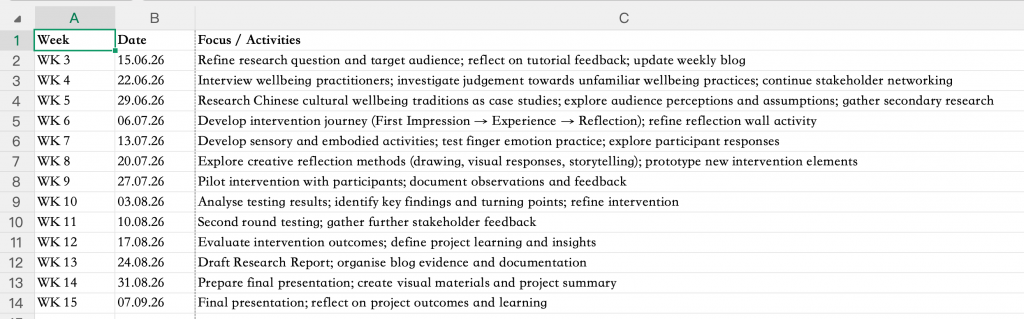
This timeline is expected to evolve as further testing and stakeholder feedback shape the direction of the project.
Leave a Reply