Translating the Philosophy of Bigu into an Embodied Wellbeing Experience
17 July 2026
Research Question
How can the philosophy of Bigu be translated into an embodied experience of emptiness that creates space for reflection and wellbeing in contemporary society?
1. Looking Back: The Beginning of My Exploration
At the beginning of this project, I was interested in unfamiliar wellbeing practices and the way people form immediate judgements towards practices that are culturally different from their own.
Coming from a Chinese cultural background, I became curious about why some traditional practices are easily accepted by certain communities, while others may be questioned, misunderstood or considered unfamiliar.
I initially explored the question:
How can a guided first encounter disrupt immediate judgement and open up alternative understandings of health?
Through my early experiments, I explored different ways of creating a more open first encounter, including sensory activities, Five Elements-inspired embodied practices and reflection exercises.
These experiments made me realise that understanding does not always begin with explanation.
Sometimes, it begins through experience.
A person may not immediately understand a cultural practice intellectually, but through their body, senses and emotions, they may become more curious and willing to explore.
This led me to become more interested in how design can create a space where people can experience rather than simply receive information.
2. First Transformation: From Explaining Bigu to Translating Its Philosophy
As my research developed, I began to focus more specifically on Bigu (辟谷), a traditional Chinese practice that is often translated into English as fasting.
At first, I was interested in how Bigu could be introduced to people unfamiliar with Chinese culture.
However, I gradually realised that translating Bigu simply as “fasting” only describes the visible action, rather than the deeper philosophy behind it.
In contemporary Western contexts, fasting is often understood as a temporary restriction of food intake.
However, historically, the meaning of Bigu was more complex.
The word “谷” refers to grains and food.
Therefore:
BIGU = temporarily reducing or stopping food consumption.
But through my exploration, I began to question:
What does “consumption” mean in contemporary society?
Today, we are not only consuming physical food.
We are constantly consuming:
- Information
- Social media
- Work
- Expectations
- Comparison
- Noise
- Anxiety
- Desire
The forms of “consumption” around us have expanded.
This led me to reinterpret Bigu not simply as stopping food intake, but as a philosophy of pausing unnecessary consumption.
The question behind my project shifted from:
What is Bigu?
to:
What are we continuously consuming, and what happens when we pause?
3. From Stopping Consumption to Experiencing Emptiness
At this stage, my focus was mainly on the idea of “stopping”.
I was exploring the possibility of a contemporary interpretation of Bigu:
a moment where people could temporarily step away from constant consumption.
However, through further reflection, I realised that the more meaningful question was not only:
What should we stop consuming?
but:
What happens after we stop?
This became the turning point of my project.
The difference between Bigu and fasting led me to think more deeply about the concept of emptiness.
Fasting often focuses on absence:
the absence of food.
However, in Daoist philosophy, emptiness does not simply mean having nothing.
Instead, emptiness creates possibility.
A space becomes meaningful because it allows something else to exist.
As described in the Dao De Jing:
A vessel becomes useful because of its empty space.
This changed my understanding of Bigu.
Bigu is not only about removing something.
It is about creating space.
A space for:
- reflection
- awareness
- reconnection
This became the foundation of my new intervention.
4. Field Research: Conversations That Shaped My Understanding of Emptiness
To further explore how traditional Chinese philosophies can be translated into contemporary experiences, I conducted two conversations with people who have different perspectives on wellbeing and traditional wisdom.
These conversations did not provide a fixed solution for my project.
Instead, they opened new questions about how internal experiences, emotions and states of being could become something people can encounter through design.
Conversation 1: Shenzhen Healing Specialist
Making Invisible Inner States Visible
During my conversation with a healing specialist in Shenzhen, I explored the relationship between sound, body and internal states.
One idea that strongly influenced my project was his perspective on singing bowl practices.
He described how sound and vibration can encourage people to become more aware of their own physical and emotional states.
Although I decided not to use singing bowls as the final medium of my intervention, this conversation raised an important design question:
How can an invisible internal state become something people can notice through their senses?
This shifted my thinking away from simply explaining wellbeing concepts and towards creating an embodied experience.
Revealing What We Carry Before Letting Go
Another important insight from this conversation was the idea that before transformation can happen, people first need to recognise what they are carrying.
Rather than immediately asking someone to “let go”, the first step is to make invisible experiences visible.
This inspired my later exploration of wooden leaves carrying words such as:
- Comparison
- Expectation
- Control
- Productivity pressure
These words are not presented as negative things that people should eliminate.
Instead, they represent different forms of contemporary “consumption” that individuals may consciously choose to reflect on.
The purpose is not to judge these experiences, but to create an opportunity for awareness.
Conversation 2: A professor of Chinese Philosophy and Traditional Wisdom in Taian
Understanding the Relationship Between Inner State and Experience
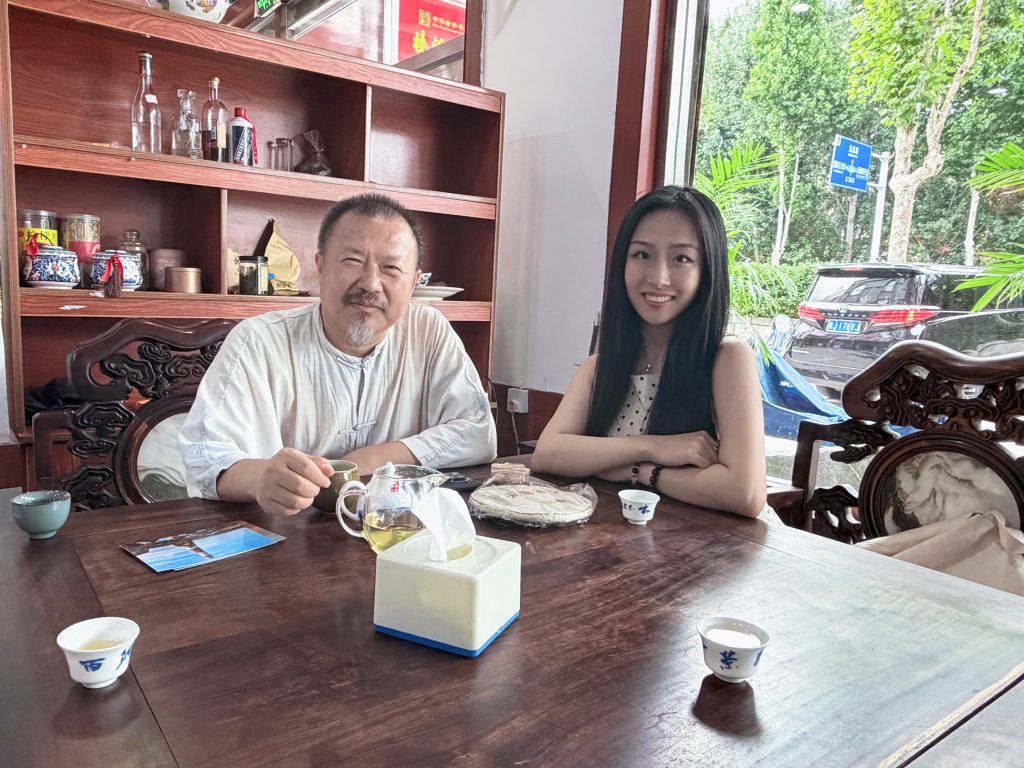
A second conversation with a teacher in Taian, who has deep knowledge of Chinese philosophy and traditional wisdom, further developed my understanding of emptiness.
One idea that particularly influenced me was:
External situations may remain unchanged, but our experience of them can change.
This challenged my previous assumption that wellbeing requires changing external circumstances.
Perhaps the purpose of this experience is not to remove difficulties or eliminate certain emotions.
Instead, it creates a temporary space where people can observe their relationship with what they are experiencing.
Moving Beyond Binary Thinking
During this conversation, I also reflected on how modern life is often structured through oppositions:
- good / bad
- success / failure
- more / less
- right / wrong
This connected strongly with my exploration of emptiness.
Emptiness is not about choosing one side or rejecting another.
Instead, it creates a pause before judgement.
A moment where people can observe rather than immediately react.
This understanding became an important foundation for my final intervention.
5. Material Evolution: Searching for a Way to Experience Emptiness
Through these conversations and reflections, I began exploring how the abstract concept of emptiness could become a physical experience.
My material exploration developed through several stages.
Stage 1: Sound — Singing Bowl
Initial question:
Can sound reveal internal states?
The inspiration came from my conversation with the Shenzhen healing specialist.
Sound offered a way to explore invisible experiences through the body.
However, I realised that sound-based interaction remained mainly auditory.
I wanted to create a more participatory experience where participants could actively engage with the transformation process.
Stage 2: Words — Making Invisible Consumption Visible
New question:
How can internal experiences become tangible?
Inspired by the idea of recognising what people carry before transformation, I explored the use of words.
Words such as:
- Comparison
- Expectation
- Noise
- Control
became symbolic representations of contemporary forms of consumption.
This stage helped me connect the abstract idea of “letting go” with a physical action.
Stage 3: Wood and Water — Experiencing Emptiness
The current intervention combines:
- wooden leaves
- water
- touch
- silence
The wooden leaf becomes a temporary carrier of something participants feel they are carrying.
When placed into water, the action does not represent destruction or removal.
Instead, it represents a moment of pause.
Water was chosen because of its relationship with Daoist philosophy.
Inspired by:
上善若水 (Shàng shàn ruò shuǐ) — The highest goodness is like water
Water represents qualities including:
- acceptance
- flexibility
- openness
- non-resistance
Water does not force transformation.
It receives, adapts and allows things to settle.
This reflects my reinterpretation of Bigu:
transformation does not come from forcing change, but from creating the conditions for awareness.
6. Final Intervention: EMPTYING
Creating an Embodied Experience of Emptiness
After exploring Bigu through philosophical reflection, conversations and material experiments, I began to ask a final design question:
How can emptiness become something people experience, rather than simply understand?
This question shaped my final intervention:
EMPTYING
Rather than explaining Daoist philosophy through information, this intervention creates a quiet and participatory experience where participants can explore the process of noticing, temporarily setting down and creating space.
The aim is not to provide a solution or to encourage participants to remove certain emotions or behaviours.
Instead, it creates a moment of pause where individuals can reflect on what they are carrying in their everyday lives.
The Experience Space
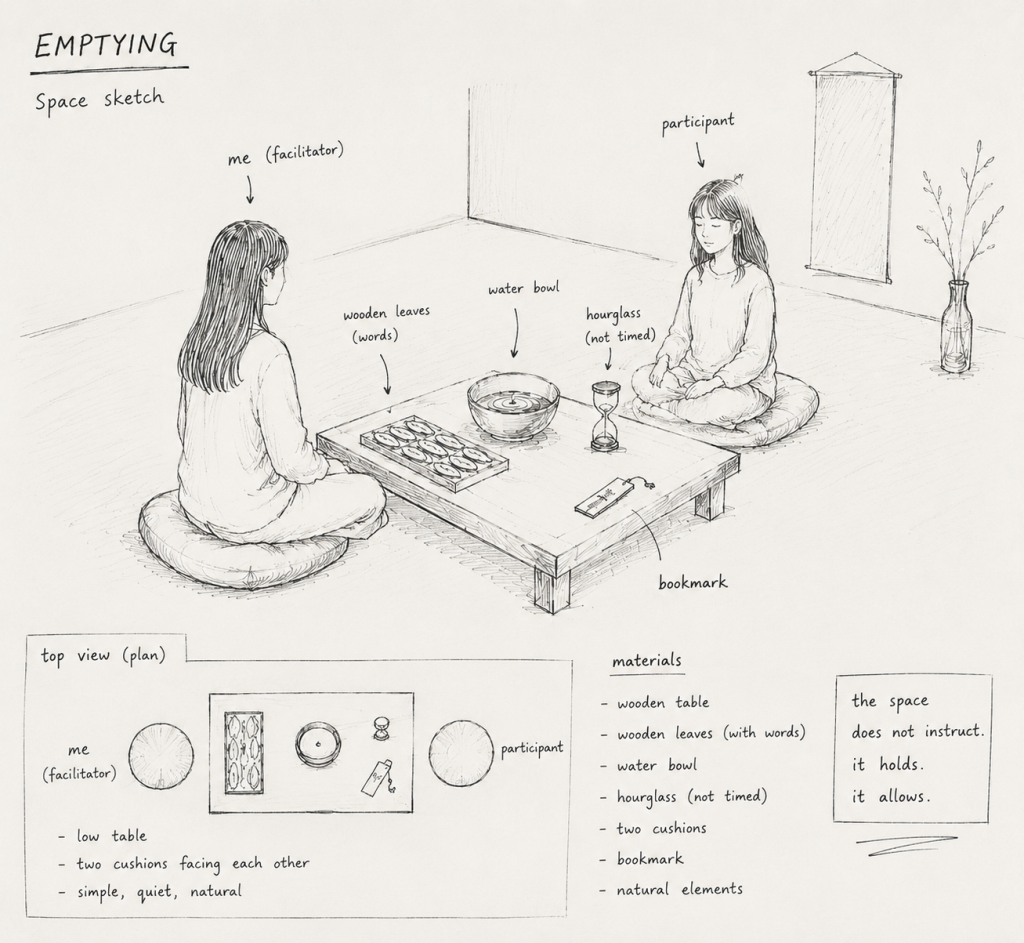
The intervention is designed as a small, intimate encounter rather than a large installation.
The space includes:
- two cushions for the participant and facilitator
- a natural wooden surface
- a ceramic bowl filled with water
- handmade wooden leaves
- a small hourglass
The simplicity of the environment is intentional.
Rather than adding more visual information, the space itself creates a sense of slowing down.
The facilitator does not act as a teacher or therapist.
Instead, my role is to hold the space and guide the participant through the experience.
Stage 1: Recognising What We Carry
At the beginning of the experience, participants encounter a collection of wooden leaves.
Each leaf contains a word representing a contemporary form of “consumption”:
- Comparison
- Expectation
- Control
- Productivity
- Information
- Noise
- Perfection
A blank leaf is also available for participants to write their own response.
The participant is invited to consider:
What are you carrying today?
This question is intentionally open.
The purpose is not to suggest that these things are negative or should be removed.
For example, comparison can sometimes motivate growth, and work can bring meaning.
Instead, the question creates an opportunity to notice the relationship between ourselves and these experiences.
Stage 2: Temporarily Setting Down
After choosing a wooden leaf, participants place it into the water.
This action represents a temporary pause.
Importantly, the action is not framed as:
“letting go”
or
“removing something unwanted”.
Instead, it is:
setting something down for a moment.
This reflects my reinterpretation of Bigu.
Traditional Bigu is not a permanent rejection of food.
It is a temporary practice of reducing intake.
Similarly, this intervention does not ask participants to permanently abandon anything.
It simply creates a moment of distance.
Stage 3: Experiencing Water Through the Body
After placing the wooden leaf into the water, participants are invited to interact with the water through touch.
This decision came from my exploration of embodied experience.
Reflection does not only happen through thinking.
The body can also become a way of understanding.
Participants may notice:
- the temperature of water
- the movement of water
- the softness and resistance
- the relationship between their hand and the material
The interaction with water is inspired by the Daoist concept:
The highest goodness is like water.
Water represents qualities such as:
- acceptance
- flexibility
- openness
- non-resistance
Water does not force change.
It receives, adapts and allows things to settle.
Through this interaction, participants are invited to experience the qualities of water rather than simply learn about them.
Stage 4: The Moment of Pause
A small hourglass is placed beside the water.
However, it is not used as a countdown or a requirement.
This is important because the project itself questions modern society’s constant focus on efficiency and productivity.
The hourglass becomes a visual invitation:
a reminder that time can be experienced rather than measured.
Participants can choose:
- how long they stay
- whether they sit silently
- whether they observe the water
- when they feel ready to finish
During this moment, nothing is required to happen.
The absence of action becomes part of the experience.
This is where the concept of emptiness becomes embodied.
Stage 5: Leaving with “Empty”
At the end of the experience, participants receive a wooden leaf bookmark.
Unlike the previous leaf, this object does not contain a word representing something they are carrying.
Instead, it contains:
Empty
The wooden bookmark has a natural leaf shape with different patterns and textures.
Each participant receives one randomly, reflecting the uniqueness of natural forms.
The purpose of this object is not to provide a solution, a belief, or a promise of transformation.
It acts as:
a reminder of a moment of pause.
Participants do not take away the thing they temporarily set down.
They take away the memory of creating space.
Why a Wooden Bookmark?
The bookmark was chosen because it allows the experience to continue beyond the exhibition.
Unlike a souvenir that simply represents a past event, a bookmark can return into everyday life.
It may appear when someone opens a book, writes notes or pauses during a busy day.
The object does not ask:
“Have you changed?”
Instead, it quietly reminds:
“You have the ability to pause.”
7. Prototype Development and Testing Plan
To evaluate the experience, I plan to create a low-fidelity prototype using:
Materials:
- birch plywood wooden leaves
- laser engraving
- ceramic water bowl
- natural wood surface
- hourglass
The choice of materials continues the project’s exploration of natural elements and embodied interaction.
Participant Testing
The intervention will be tested with:
10 participants aged 20–30
Including:
- 5 Chinese participants
- 5 international participants
The mixed cultural backgrounds aim to explore how people from different cultural contexts interpret Bigu, emptiness and wellbeing.
Research Questions During Testing
Before the experience:
1.
What comes to mind when you hear Bigu?
Purpose:
To understand whether participants associate Bigu only with fasting.
2.
What do you feel you are consuming too much of in your everyday life?
Purpose:
To explore contemporary interpretations of “GU”.
During the experience, I will observe:
- How participants choose their leaf
- Their hesitation or reflection
- Their interaction with water
- Their response to silence
- Whether the experience encourages personal interpretation
After the experience:
Participants will be invited to reflect:
1.
Has this experience changed your understanding of Bigu?
2.
What did the moment of pause mean to you?
3.
How did interacting with water influence your experience?
4.
What does the wooden leaf you received represent for you?
Reflection
Through this project development, I moved from exploring Bigu as a traditional practice towards understanding it as a philosophy of creating space.
The final intervention does not attempt to reproduce Bigu.
Instead, it translates its underlying principle into a contemporary experience:
from consuming → pausing
from holding → setting down
from emptiness as absence → emptiness as possibility
References
Baumer, E.P.S., Khovanskaya, V.D., Matthews, T., Reynolds, L., Schwanda Sosik, V. and Gay, G.K. (2014) ‘Reviewing Reflection through the Lens of Personal Informatics’, Proceedings of the 2014 ACM International Joint Conference on Pervasive and Ubiquitous Computing, pp.109–120. doi:10.1145/2632048.2632052.
Campany, R.F. (2002) To Live as Long as Heaven and Earth: A Translation and Study of Ge Hong’s Traditions of Divine Transcendents. Berkeley: University of California Press.
Giaccardi, E. and Karana, E. (2015) ‘Foundations of Materials Experience: An Approach for HCI’, Proceedings of the 33rd Annual ACM Conference on Human Factors in Computing Systems, pp.2447–2456. doi:10.1145/2702123.2702337.
Kabat-Zinn, J. (1994) Wherever You Go, There You Are: Mindfulness Meditation in Everyday Life. New York: Hyperion.
Kohn, L. (1991) The Taoist Body. Cambridge, MA: Three Pines Press.
Sanders, E.B.-N. and Stappers, P.J. (2008) ‘Co-creation and the New Landscapes of Design’, CoDesign, 4(1), pp.5–18. doi:10.1080/15710880701875068.
Stickdorn, M., Hormess, M.E., Lawrence, A. and Schneider, J. (2018) This Is Service Design Doing: Applying Service Design Thinking in the Real World. Sebastopol, CA: O’Reilly Media.
Varela, F.J., Thompson, E. and Rosch, E. (1991) The Embodied Mind: Cognitive Science and Human Experience. Cambridge, MA: MIT Press.
Zhuangzi (2009) Zhuangzi: The Essential Writings with Selections from Traditional Commentaries. Translated by B. Ziporyn. Indianapolis: Hackett Publishing Company.
Leave a Reply