One question continued to stay with me after the prototype testing:
What remains after the experience ends? After two weeks?
Rather than evaluating EMPTYING only through participants’ immediate responses, I wanted to understand whether reflection continued beyond the intervention itself.
To explore this, I revisited two forms of evidence:
reflection cards completed immediately after the experience
a two-week follow-up conducted through social media
The follow-up is still ongoing, so the observations below represent emerging patterns rather than final conclusions.
1. Immediate reflections: Different understandings of EMPTYING
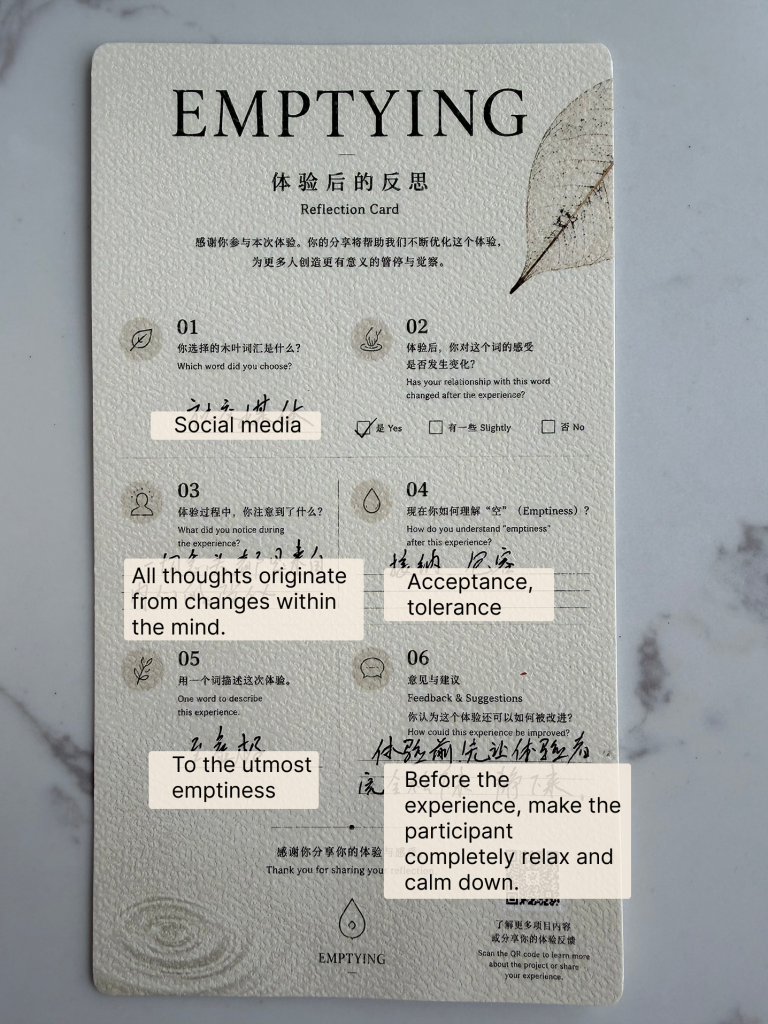
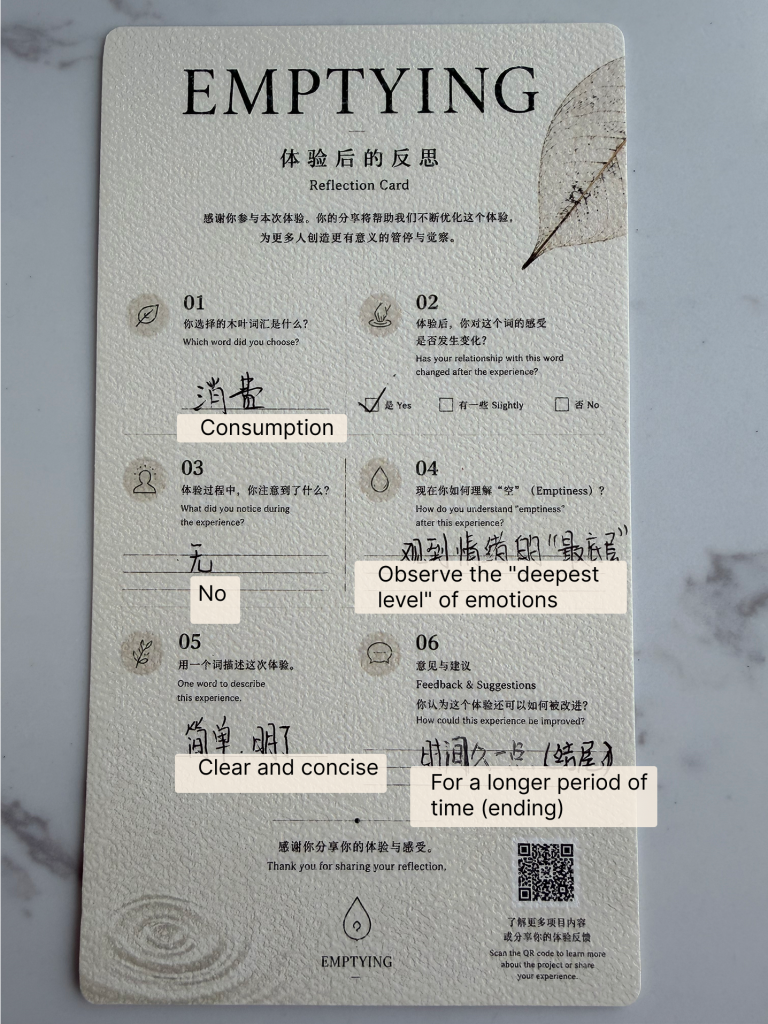
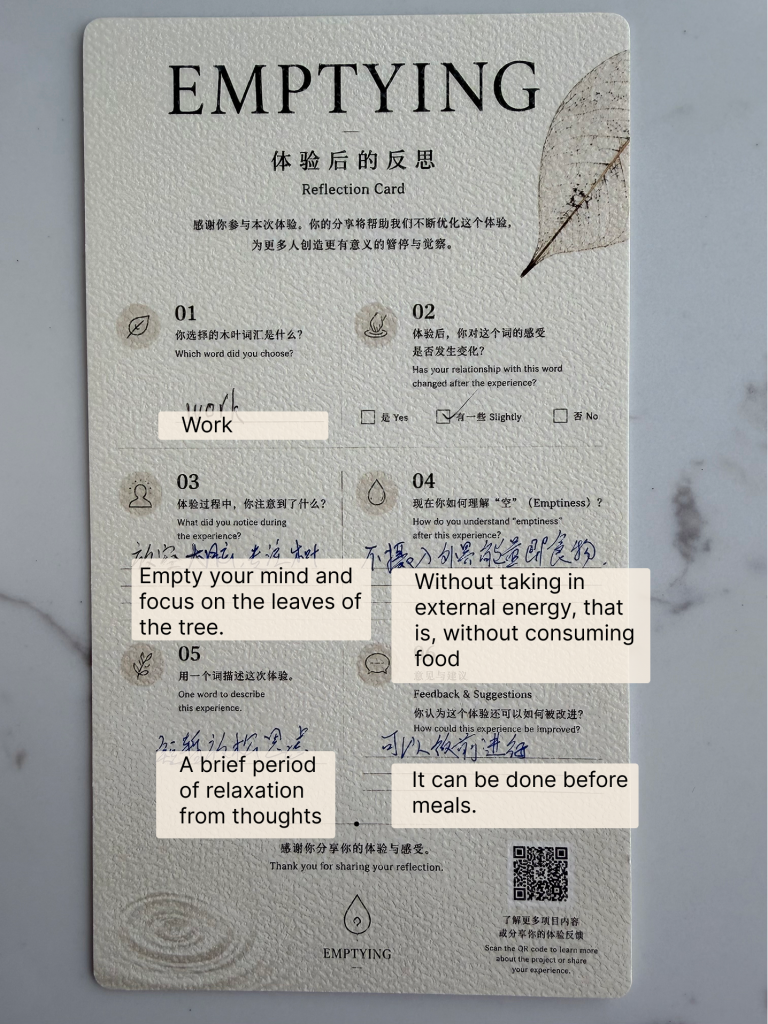
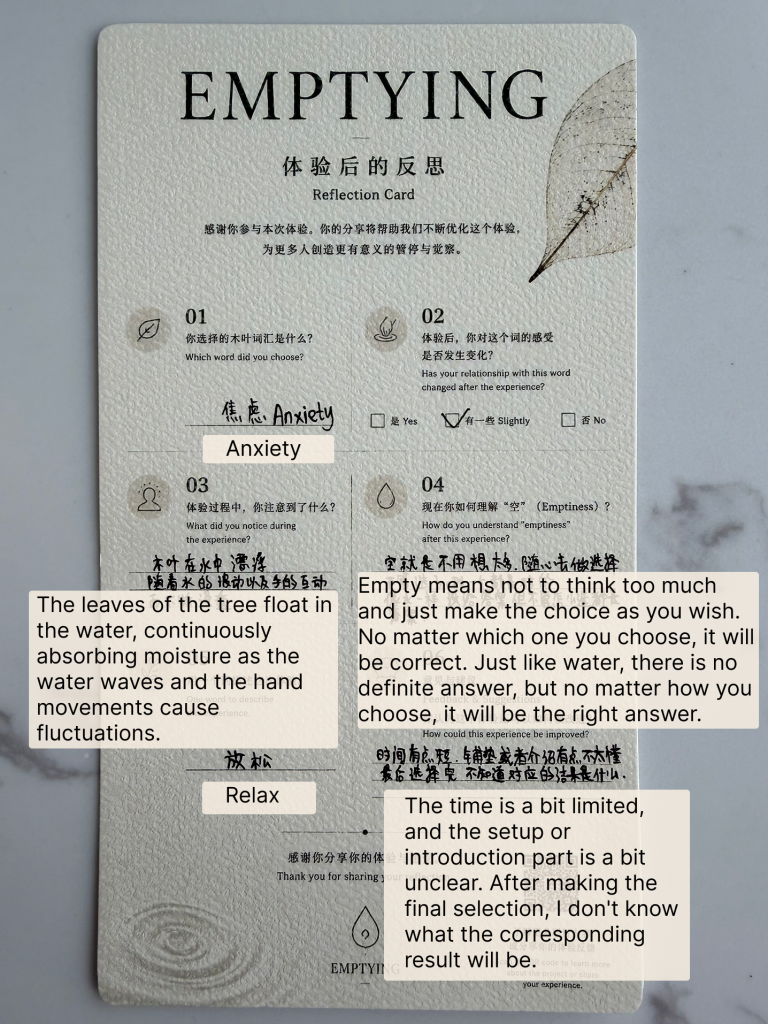
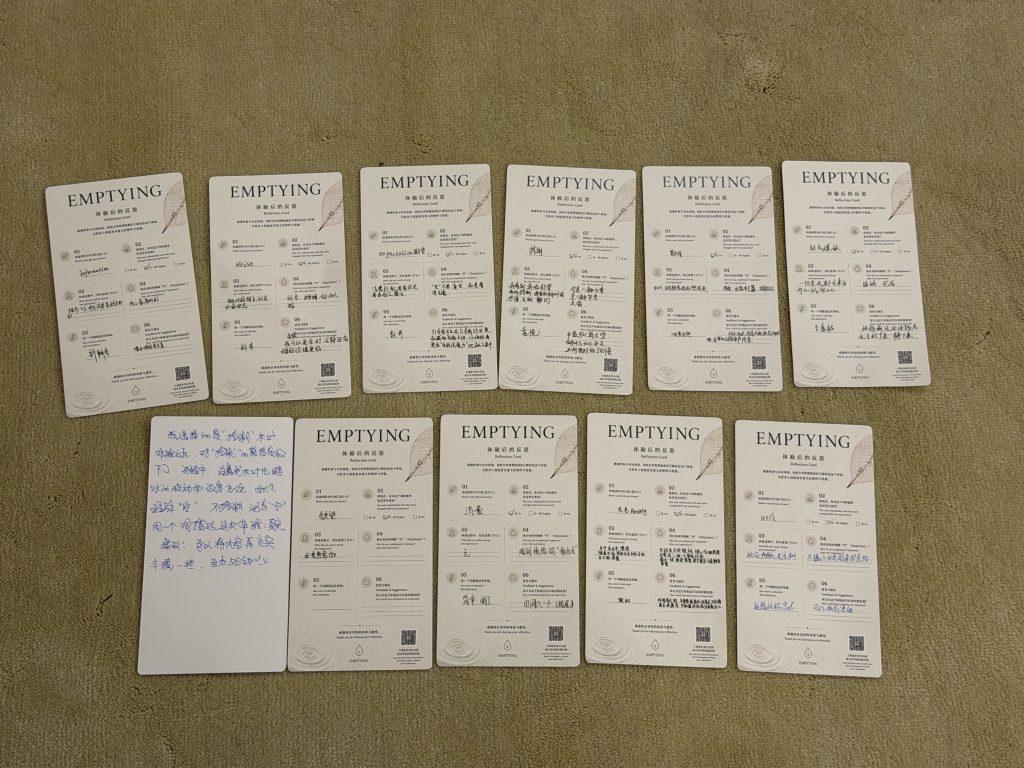
Figure 1–8. Selected participant reflection cards completed immediately after the intervention.
The reflection cards revealed that participants understood EMPTYING in highly personal ways. Rather than arriving at one shared definition of emptiness, participants described it as acceptance, tolerance, love, letting go, lightness and a pause.
Some responses reflected emotional awareness:
“Emptiness is a kind of power, a kind of tolerance, and a kind of love.”
Others described the experience through a change of perspective:
“‘Empty’ does not mean to clear; rather, it is the pause button.”
Several participants also wrote about observing their own thoughts instead of trying to change them, suggesting that the intervention encouraged reflection rather than providing answers.
Most encouragingly, several participants anticipated that the experience would continue to prompt reflection and return to them in everyday life. This suggested that EMPTYING had created a space for reflection that extended beyond the intervention itself.
The reflection cards also generated valuable suggestions for future development. Participants consistently recommended:
a longer experience
a quieter environment
breathing guidance before beginning
a clearer introduction to the project
2. Two weeks later: What remained?
To explore whether reflection continued beyond the intervention, I conducted a two-week follow-up with participants through WeChat.
Participants were invited to reflect on:
what they still remembered
whether the wooden leaf had come to mind in everyday life
whether their relationship with the word they had chosen had changed
The follow-up is still ongoing, and the responses below represent emerging themes rather than final findings.
The conversations revealed a more varied picture. For some participants, the experience continued to influence everyday life.
Several described recalling the wooden leaf when they noticed themselves trying to control others.
One participant wrote:
“When I want to control other people at work, I immediately think of the wooden leaf and let go.”
Another reflected:
“I have let go of much of my desire to control others and feel much more relaxed.”
Others connected the experience with different aspects of daily life, including responses to noise, relationships and emotional awareness.
However, not every participant reported lasting change.
Some remembered the experience but did not describe any behavioural difference, while one participant simply replied:
“Two weeks later, it hasn’t left any particular influence on me.”
Rather than seeing these different responses as success or failure, they suggest that EMPTYING creates the possibility for reflection without determining what that reflection should become.
3. Reflections for the next iteration
Although the follow-up is still in progress, it has already become an important part of the project.
It shifted my attention away from what happens during the intervention towards what, if anything, continues afterwards.
The findings also reinforced an idea that emerged throughout the project:
Participants do not experience EMPTYING in the same way.
Instead, each person constructs meaning through their own memories, relationships and everyday situations.
In this sense, the intervention is less about producing a fixed outcome than creating the conditions in which different forms of reflection may emerge.
The follow-up conversations will continue beyond this blog and will inform the future development of EMPTYING.
Final Reflection
Looking back over this summer, I realise that the most valuable outcome of this project is not simply the intervention itself, but the questions it has continued to open.
Through EMPTYING, I have explored how the Daoist philosophy of Bigu can be reinterpreted beyond fasting and translated into a contemporary embodied wellbeing experience.
The project explores how design can create the conditions for personal reflection through materials, interaction and space.
The testing and follow-up conversations also reminded me that meaningful experiences do not produce identical outcomes. Instead, each participant brings their own memories, relationships and interpretations into the experience.
So far, the intervention has only been tested with Chinese participants, and the follow-up study is still ongoing.
I hope future iterations will involve participants from different cultural backgrounds and continue exploring what remains after the experience ends.
Thank You
As this summer comes to an end, I would like to express my sincere gratitude to everyone who has accompanied this project.
Thank you to my tutors for your guidance, encouragement and thoughtful feedback throughout this journey. Every conversation challenged me to think more deeply and helped shape the project in ways I could not have imagined at the beginning.
Thank you to my family for believing in me, supporting every idea and always encouraging me to keep going.
Thank you to the Chinese professors who generously shared their knowledge of Daoist philosophy and Bigu, helping me build a stronger theoretical foundation for this project.
Most importantly, thank you to every participant who chose to spend time with EMPTYING. Thank you for your trust, your honesty, your patience and your willingness to share your reflections—not only during the intervention, but also in the weeks afterwards. Your experiences have shaped this project far more than I ever could have done alone.
If you’ve read all the way here… thank you. I hope our paths cross again somewhere, with another wooden leaf, another conversation, or simply another quiet moment. Until then, thank you for making space with me.
Video excerpts from the emptying first intervention testing (7 August 2026)
26 August 2026
All participants provided written informed consent before taking part, including permission for photography, video recording and the use of research documentation.
This post shares a short supplementary video documenting selected moments from the first prototype testing of EMPTYING, conducted on 7 August 2026. The complete testing session lasted approximately 4.5 hours; therefore, this video includes only brief excerpts rather than the full process.
For a more detailed record of the intervention, including the testing environment, photographs, participant reflections and design process, please refer to my previous blog posts.
Following my first intervention testing, I found myself thinking less about the intervention itself and more about how it ends. Although participants responded positively to the overall experience, I realised that the final stage still feels unresolved. Rather than simply improving individual details, I began questioning what the ending of EMPTYING should actually achieve.
One of the changes I plan to introduce in the next iteration is a more intentional opening. Several participants suggested that it was difficult to fully settle into the experience immediately after arriving. This made me consider adding a short guided relaxation before the intervention begins, inviting participants to slow their breathing, release tension in their shoulders and become more aware of their bodies. Rather than functioning only as preparation, this could become the first step of emptying itself. This idea also aligns with embodied approaches to interaction, which emphasise that bodily engagement shapes perception and experience rather than simply supporting it (Merleau-Ponty, 2012; Svanæs, 2013).
However, the biggest question for me concerns the ending of the participant journey.
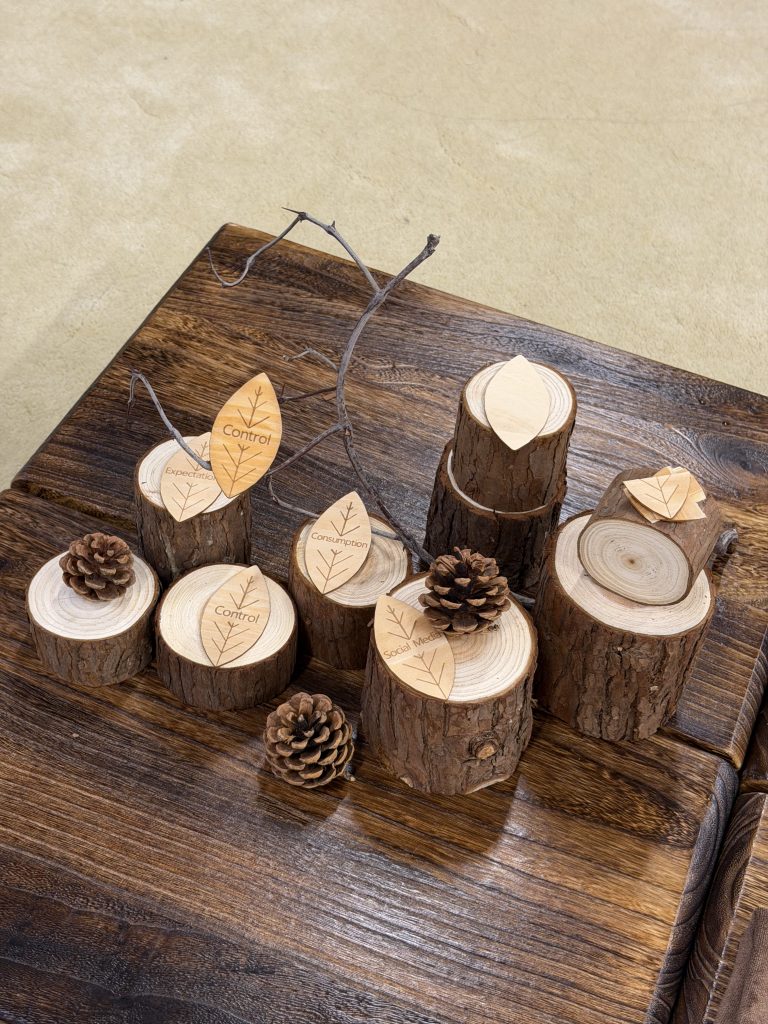
During the testing, participants were invited to decide whether they wanted to take their wooden leaf away or leave it on the Space Tree. Although the tree was designed as a sculptural installation with a strong visual presence, its practical function was simply to hold the wooden leaves. Surprisingly, I observed something that I had not anticipated. Every participant placed their leaf differently. Some chose a high branch, others carefully selected a hidden position, while some balanced the leaf delicately or even turned it upside down. These choices appeared deeply personal.
At first, I wondered whether these different placements should be interpreted. Could the position of the leaf reveal something about the participant’s emotional state or personality? However, I quickly became uncomfortable with this idea. Providing fixed interpretations would risk turning the intervention into a psychological test, whereas the intention of EMPTYING has always been to create an open space for personal reflection rather than offering predetermined meanings.
This uncertainty led me to imagine a completely different possibility.
Instead of ending with a sculptural Space Tree, what if the intervention continued through a living tree?
Rather than existing only within the testing environment, the tree could become part of nature. Participants who choose to leave their wooden leaf could attach it to a real tree using string or another reversible method. The tree would remain in the same location over time, while the wooden leaves gradually changed through weather, sunlight and the passing of seasons.
I began imagining what might happen after one week, one month, one year or even ten years. Some leaves might fade, crack or disappear completely. Others might remain. I realised that I do not actually know what will happen, and perhaps that uncertainty is meaningful in itself. If a leaf eventually falls from the tree or disappears into nature, could that also become a poetic expression of emptiness?
To support this idea, I imagined creating a simple website where participants could find the tree’s location and occasionally revisit it. Rather than functioning as the intervention itself, the website would simply record the continuing life of the tree. Participants could return whenever they wished, observe its changes and perhaps reflect on whether what they had chosen to release still felt important.
Figure 1. Early concept sketch of a living Space Tree.
At the same time, I am uncertain whether this idea moves too far away from the original intervention.
One concern is that introducing a living tree, a website and long-term documentation may shift the focus from the embodied experience itself towards an ongoing public artwork. Another practical concern is maintenance. If I eventually leave London, who would care for the tree? Would the intervention become dependent on continuous management, or would that contradict the philosophy of emptying?
These questions brought me back to a much simpler possibility.
Perhaps the ending does not need another object at all. Perhaps what needs to change is not the tree itself, but the meaning of leaving the wooden leaf behind.
Instead of suggesting that participants are leaving something behind, perhaps the intervention could invite them to entrust it to the space.
If you choose to leave it, you are not abandoning it.
You are entrusting it to this space.
This subtle shift in language changes the role of the Space Tree. It is no longer a display object or a place for storage, but a temporary holder of what participants no longer wish to carry. Rather than providing a final answer, the ending becomes an invitation to continue reflecting beyond the intervention itself. This also resonates with Turner’s (1969) idea that meaningful experiences often remain open and liminal, rather than ending with a fixed conclusion.
At this stage, I have not yet decided which direction to pursue. Rather than rushing towards a solution, I hope to discuss these possibilities with my tutor and consider how the ending can better support the central idea of EMPTYING without becoming overly prescriptive or unnecessarily complex. As Norman (2013) argues, people remember experiences as complete journeys rather than isolated interactions. My current challenge is therefore not only how participants let go, but also how they leave the experience.
References
Merleau-Ponty, M. (2012) Phenomenology of Perception. Translated by D.A. Landes. London: Routledge.
Norman, D.A. (2013) The Design of Everyday Things. Revised and Expanded Edition. New York: Basic Books.
Svanæs, D. (2013) ‘Interaction Design for and with the Lived Body: Some Implications of Merleau-Ponty’s Phenomenology’, ACM Transactions on Computer-Human Interaction, 20(1), Article 8.
Turner, V. (1969) The Ritual Process: Structure and Anti-Structure. Chicago: Aldine Publishing.
Following my first intervention testing, I had a one-to-one tutorial to discuss both the participant feedback and the future direction of the project. Rather than focusing only on refining the prototype, the discussion encouraged me to think more critically about the conceptual positioning of EMPTYING within contemporary wellbeing practices. This shifted my attention from asking “How can I improve the experience?” to a more fundamental question: “What unique contribution does my intervention make?”
One of the most valuable pieces of feedback was to always begin my presentation with the research question:
How can an embodied experience of emptiness create space for reflection and wellbeing in contemporary society?
My tutor reminded me that every design decision, prototype and testing outcome should contribute to answering this question, rather than simply documenting participant experiences. This helped me realise that the intervention itself is not the final outcome, but a research method through which I can investigate how embodied interaction encourages reflection.
Another important discussion centred on mindfulness. My tutor pointed out that there are already many established wellbeing practices that encourage people to slow down, observe their thoughts and cultivate awareness. Kabat-Zinn (1994) describes mindfulness as intentionally paying attention to the present moment without judgement, a concept that has become highly influential within contemporary wellbeing practice. This prompted me to ask not whether EMPTYING is another mindfulness exercise, but how it differs from these existing approaches.
Following the tutorial, I explored Leaves on a Stream, a well-known exercise in Acceptance and Commitment Therapy (ACT). The exercise invites individuals to imagine placing each thought onto a floating leaf and watching it drift downstream, encouraging cognitive defusion by observing thoughts without becoming attached to them (Hayes, Strosahl and Wilson, 2012). I also explored practical versions of this exercise produced by Therapist Aid (n.d.) and the East London NHS Foundation Trust (2023), which demonstrate how the leaf metaphor is applied within therapeutic and mindfulness practice.
While researching these examples, I recognised both similarities and important differences with my own project. Both Leaves on a Stream and EMPTYING use the metaphor of a leaf to externalise inner experiences. However, Leaves on a Stream is primarily an imagined cognitive exercise, whereas EMPTYING transforms this metaphor into an embodied interaction.
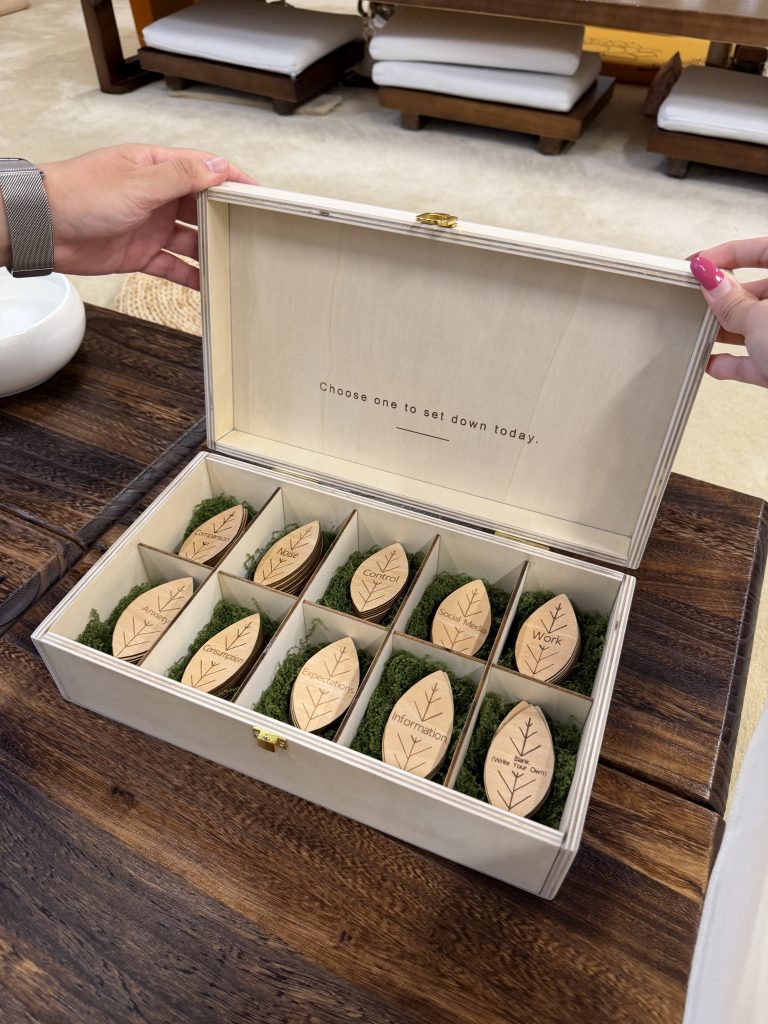
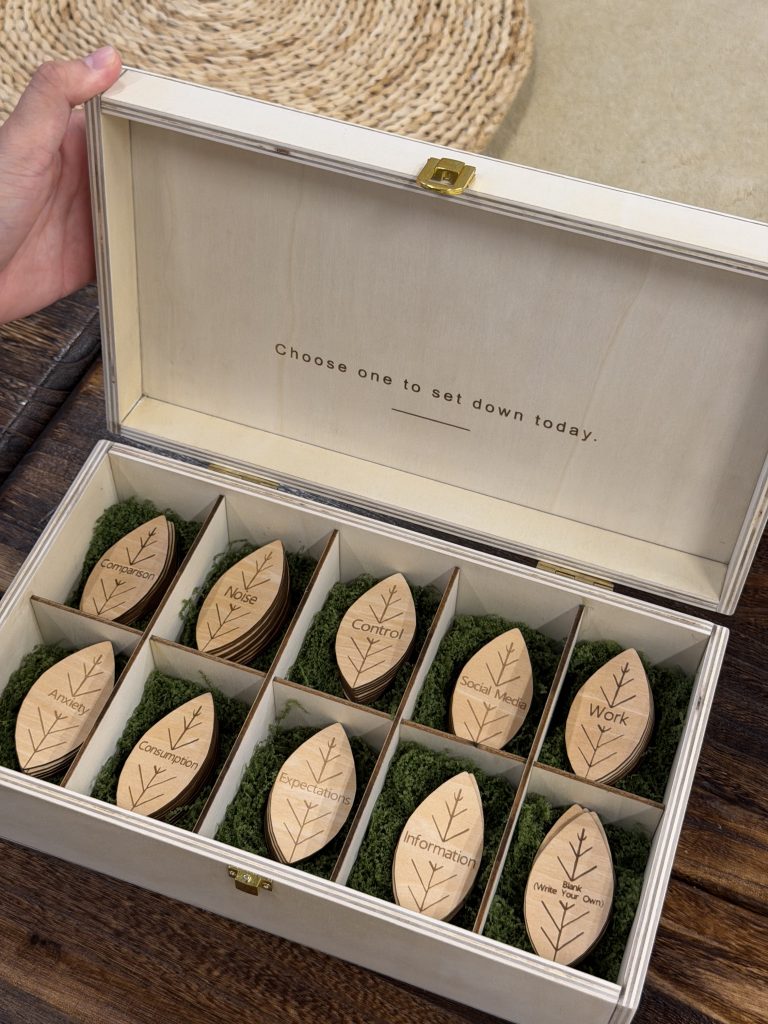
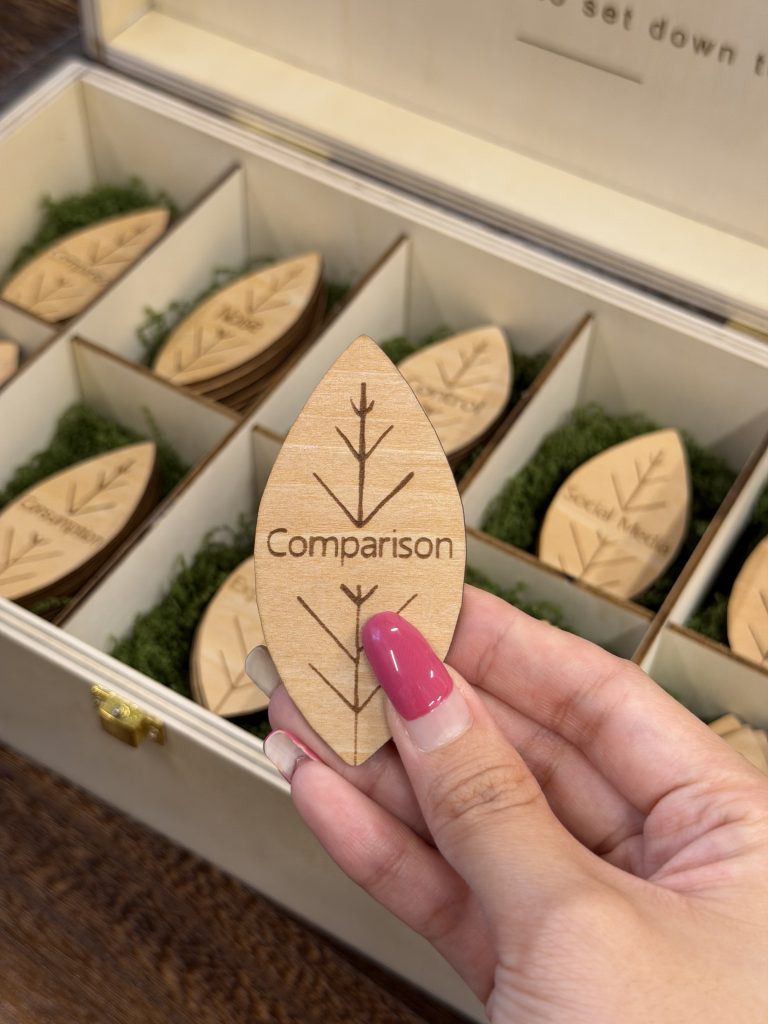
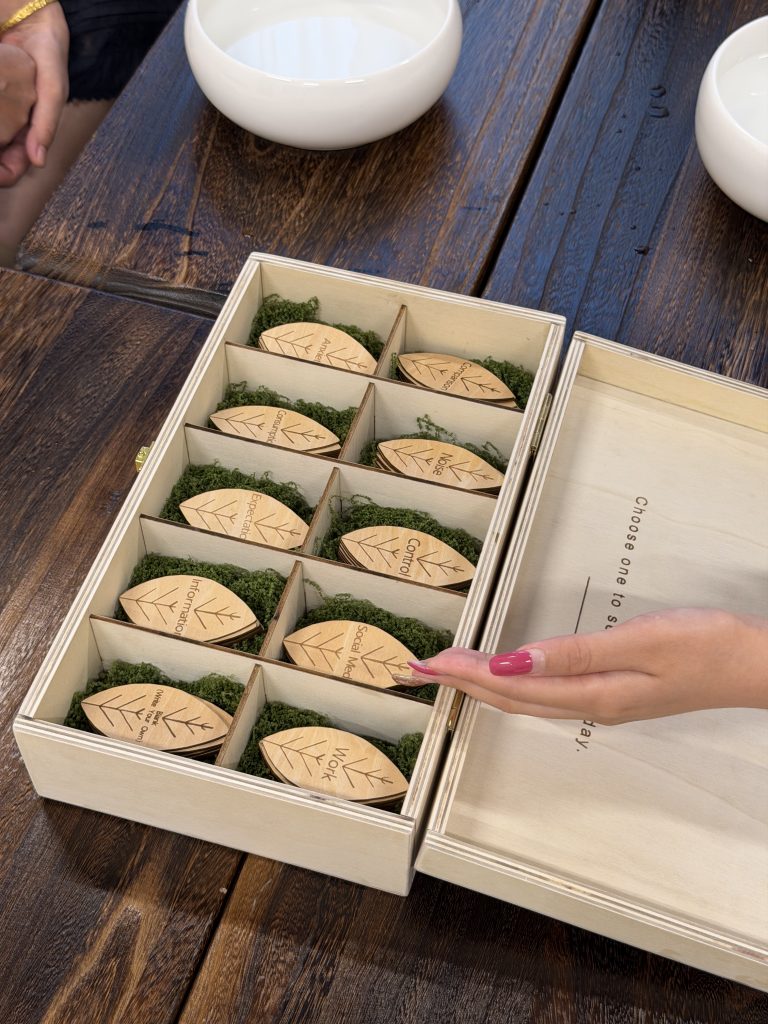
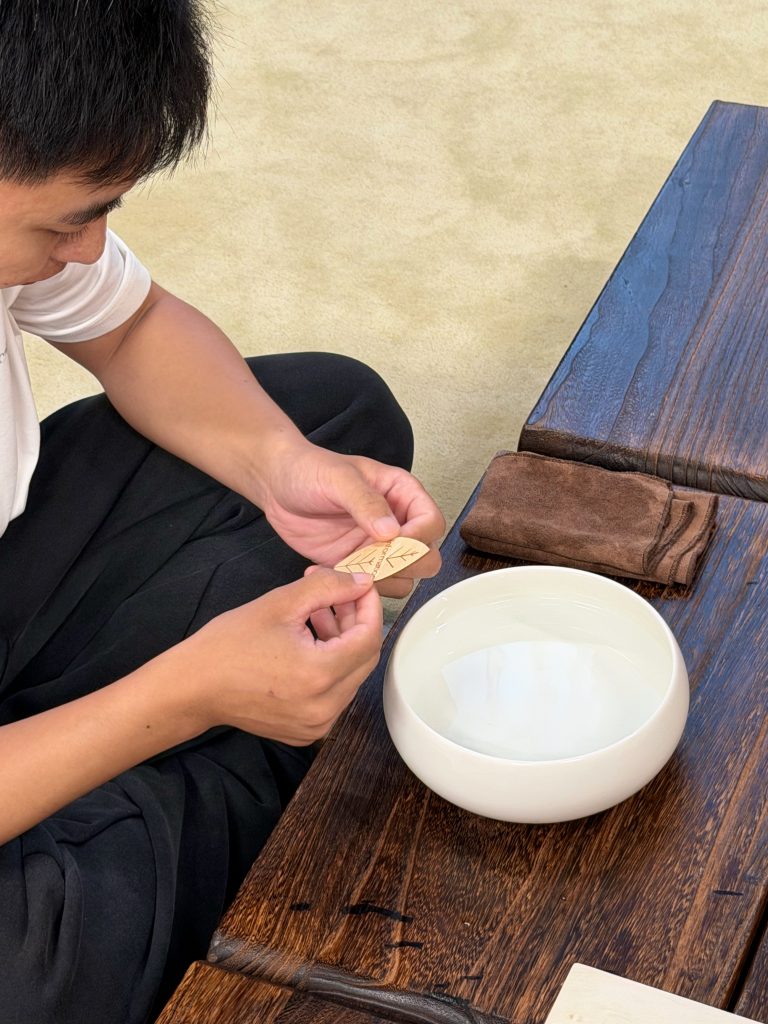
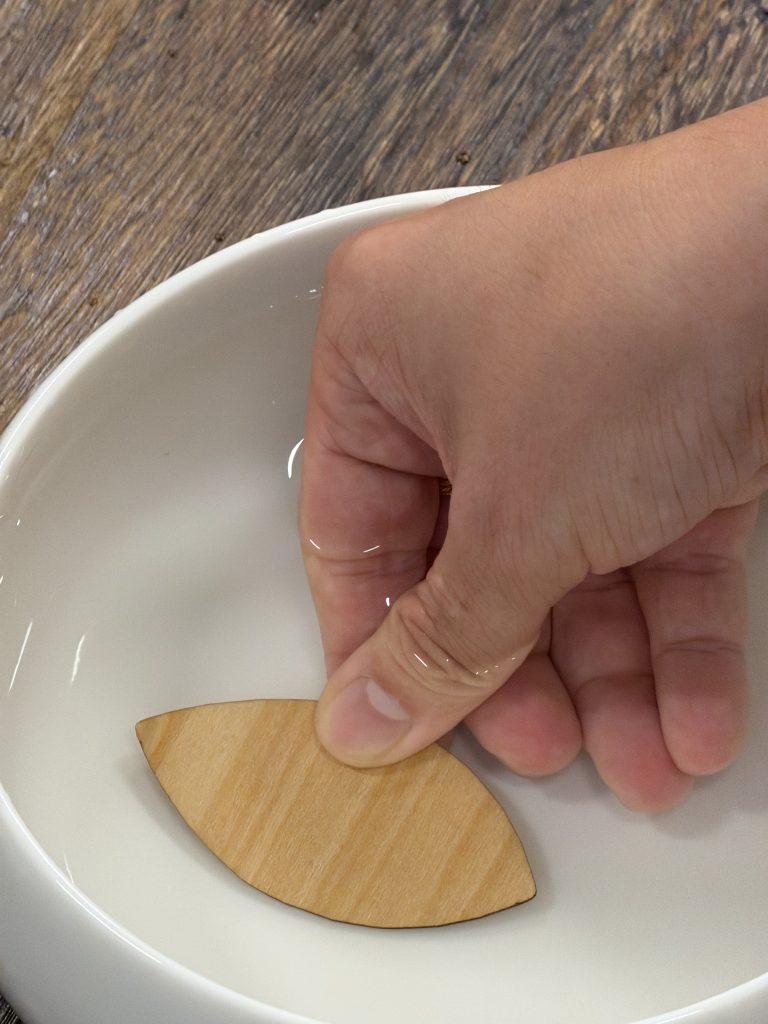
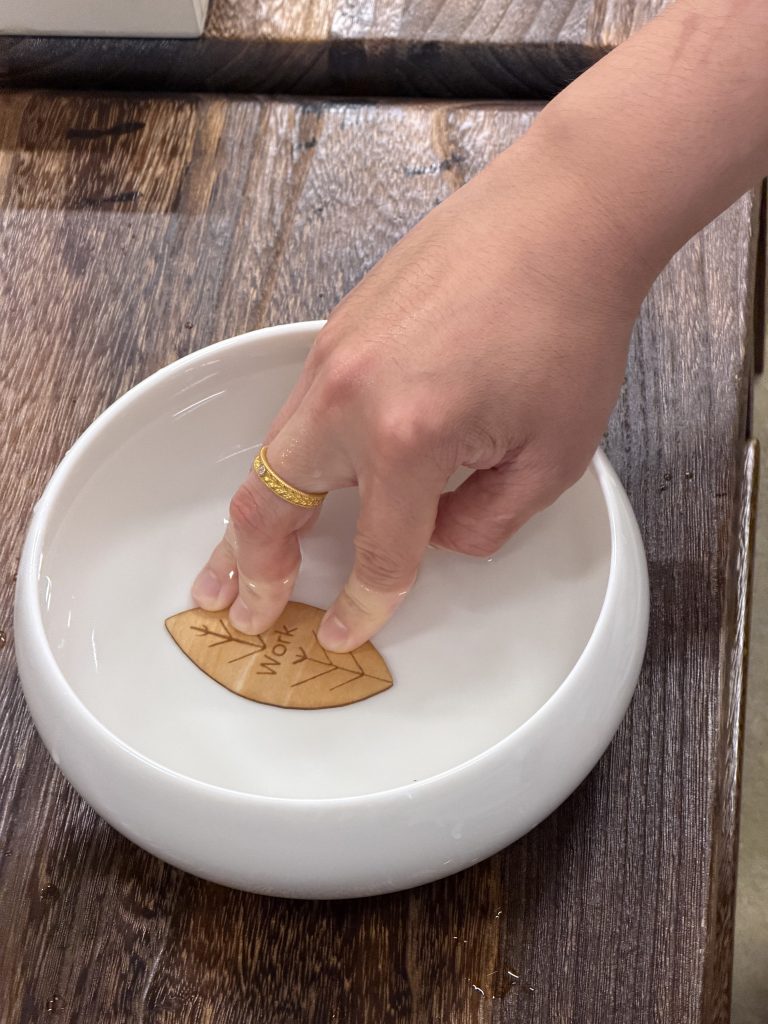
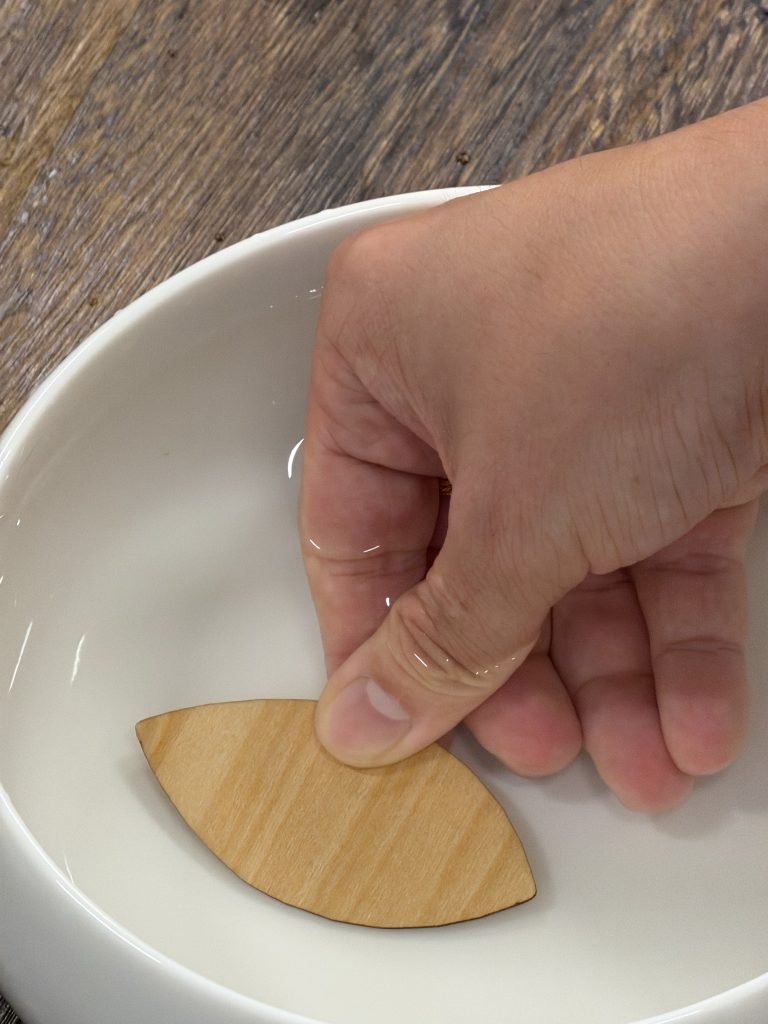
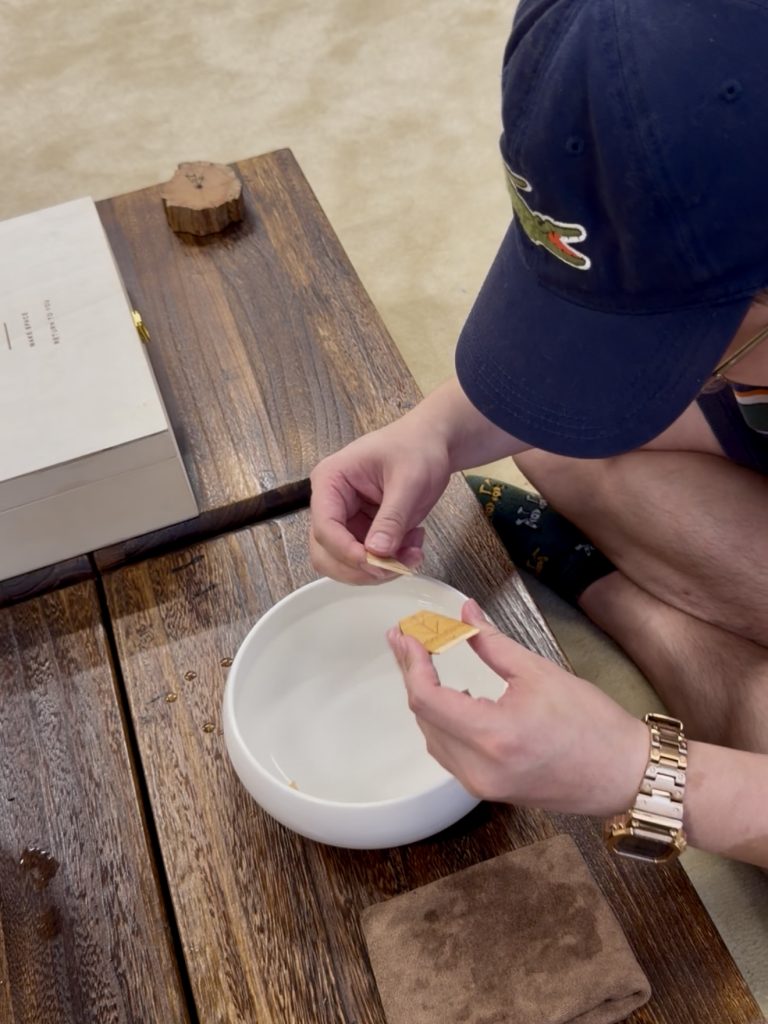
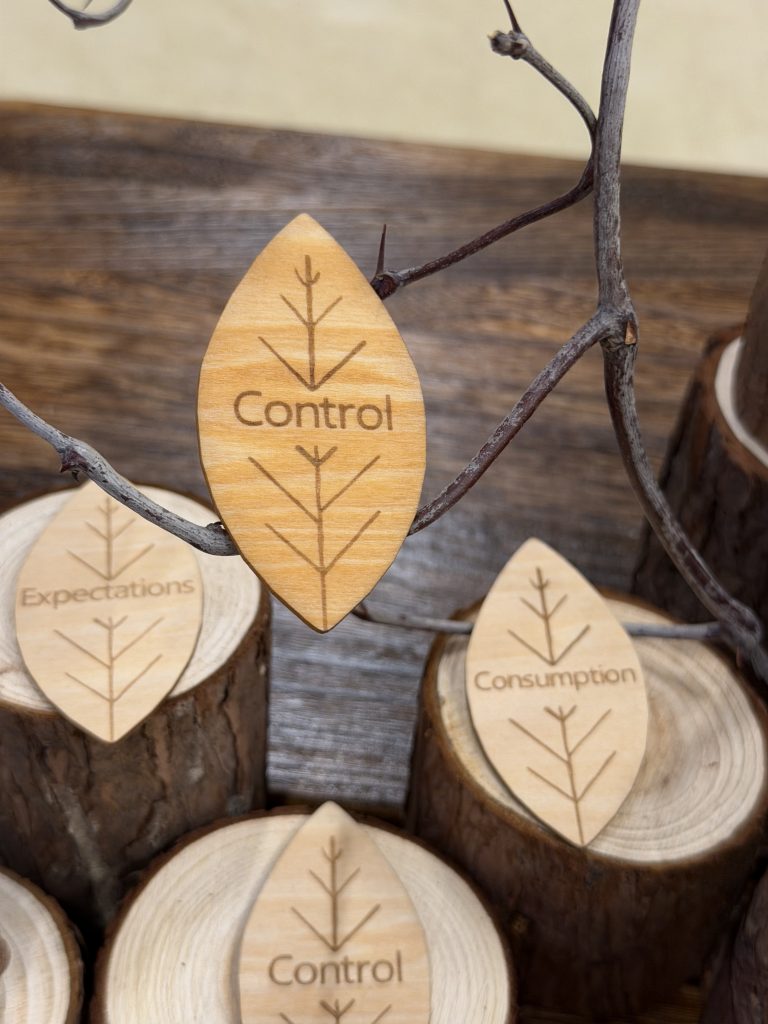
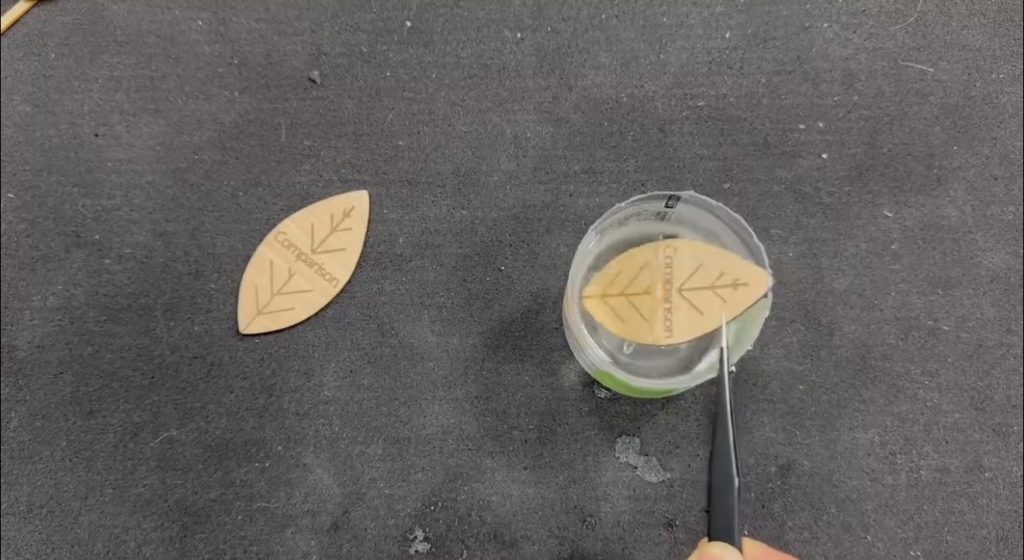
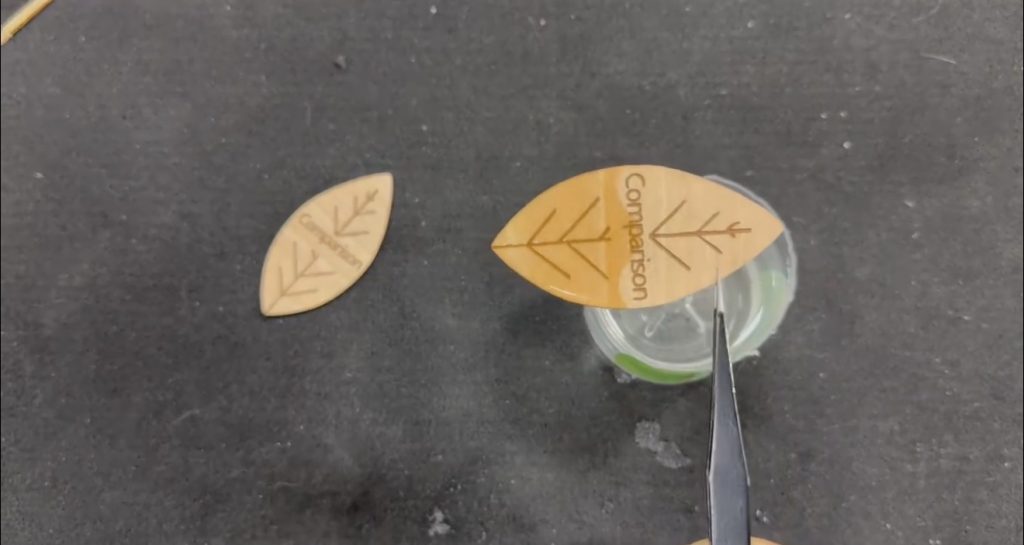
Participants physically choose a wooden leaf representing a specific burden or desire, such as Comparison, Anxiety, Work, Expectations, Social Media or Control, rather than observing thoughts in general. Instead of imagining thoughts floating away, participants hold the wooden leaf, place it into water, observe its gradual movement and material transformation, and engage with it through touch.
Furthermore, the material choices are deeply rooted in Chinese philosophy rather than functioning solely as symbolic objects. The relationship between wood and water is inspired by the Dao De Jing, particularly the concept of “The highest goodness is like water” , which emphasises acceptance, adaptability and flowing rather than resisting (Laozi, trans. Ames and Hall, 2003). At the same time, the intervention draws inspiration from the philosophy of the Five Elements, in which Wood, Fire, Earth, Metal and Water exist in a dynamic relationship of mutual generation and transformation. Rather than incorporating all five elements literally, I intentionally focused on wood and water, as these two elements most directly support the embodied experience of emptying through movement, transformation and sensory interaction.
This comparison helped me articulate the distinctive contribution of EMPTYING. Rather than attempting to replace existing mindfulness practices, the project explores how embodied interaction, Chinese philosophical thinking, and natural materials can work together to create an alternative pathway towards reflection and wellbeing. This perspective also resonates with Merleau-Ponty’s (2012) phenomenology, which argues that meaning is generated through bodily engagement with the world rather than detached observation.
Finally, the tutorial reminded me that the intervention does not end when the participant places the wooden leaf into the water. The first intervention testing revealed that the ending of the participant journey is also an important moment for reflection. Based on participants’ feedback, I have started redesigning the concluding stage of the experience. The next iteration of this intervention, and the design changes informed by user testing, will be documented in my following blog.
Overall, this tutorial fundamentally changed how I position my project. Rather than viewing EMPTYING simply as an interactive wellbeing experience, I now understand it as an exploration of how Chinese philosophical concepts, embodied interaction and natural materials can contribute a distinctive perspective to contemporary discussions of mindfulness and wellbeing. My next stage will therefore focus not only on refining the participant journey, but also on strengthening the theoretical dialogue between philosophy, embodied interaction and design practice.
Hayes, S.C., Strosahl, K.D. and Wilson, K.G. (2012) Acceptance and Commitment Therapy: The Process and Practice of Mindful Change. 2nd edn. New York: Guilford Press.
Kabat-Zinn, J. (1994) Wherever You Go, There You Are: Mindfulness Meditation in Everyday Life. New York: Hyperion.
Laozi (2003) Dao De Jing: A Philosophical Translation. Translated by R.T. Ames and D.L. Hall. New York: Ballantine Books.
Merleau-Ponty, M. (2012) Phenomenology of Perception. Translated by D.A. Landes. London: Routledge.
From designing an experience to finding real human responses
10 August 2026
August 7 marked the first full intervention testing session of EMPTYING, and it became one of the most meaningful moments in my project so far. Until now, the intervention had existed mainly as sketches, prototypes, and my own imagination. For the first time, it entered the real world and became an experience shared between people.
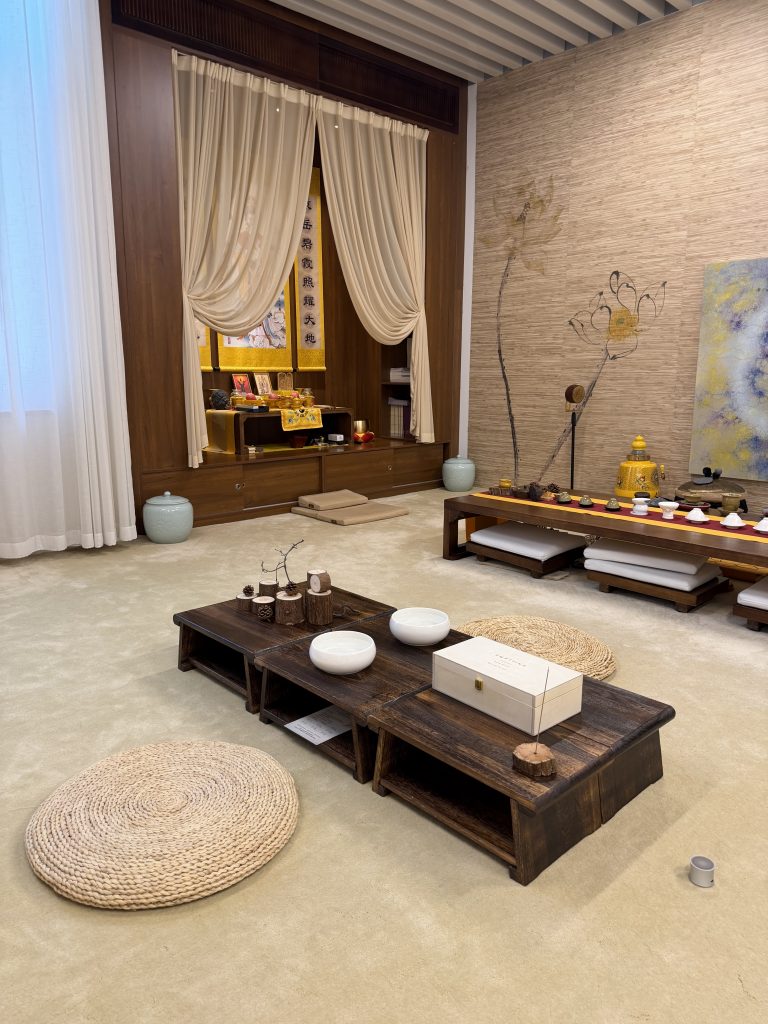
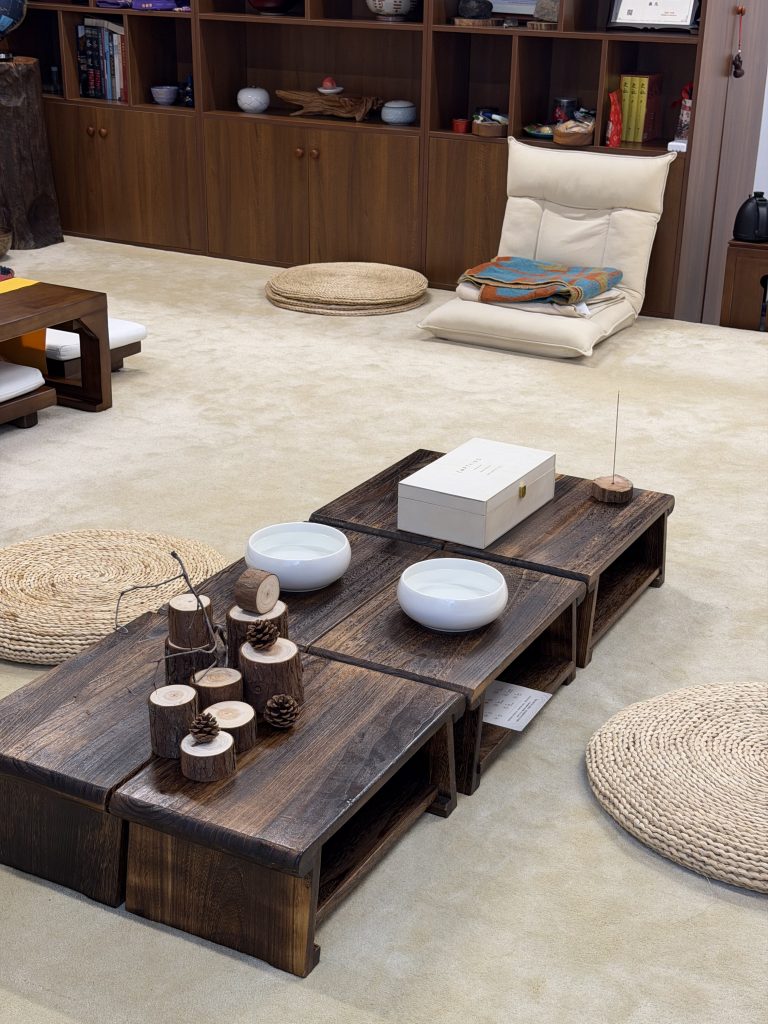
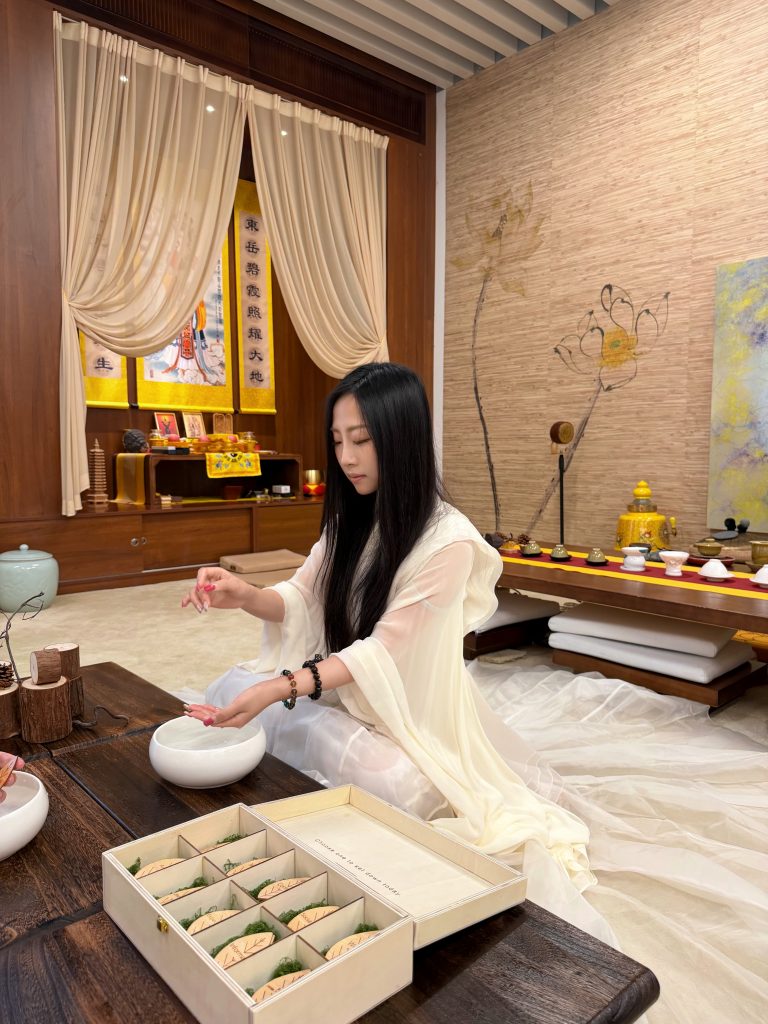
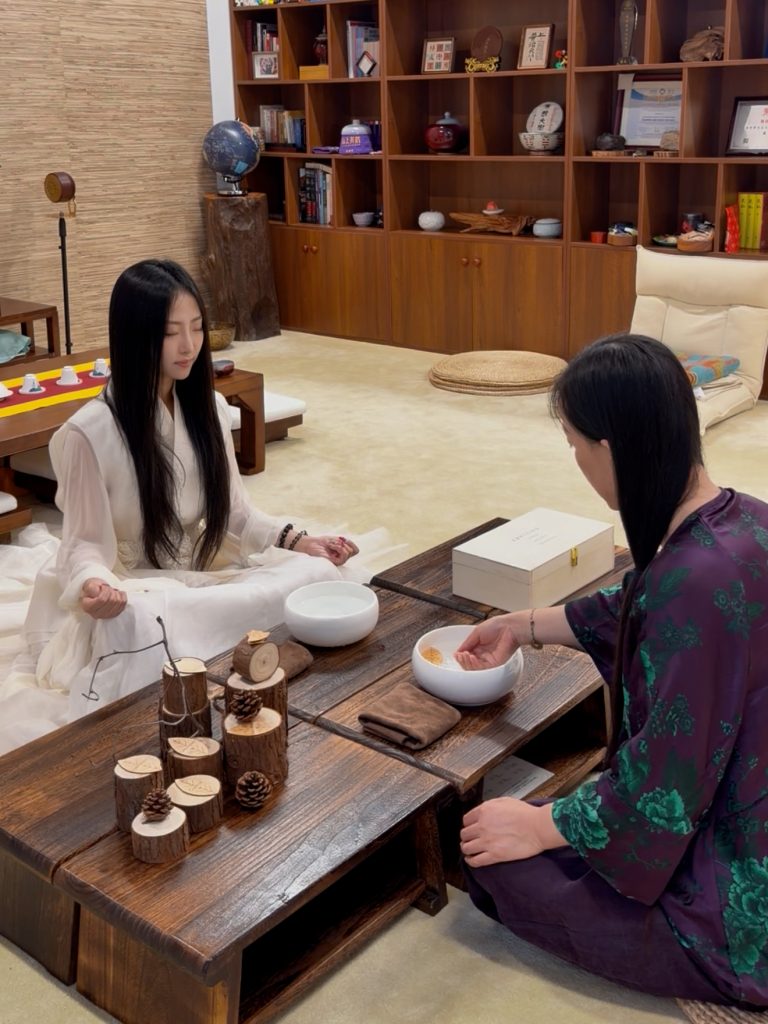
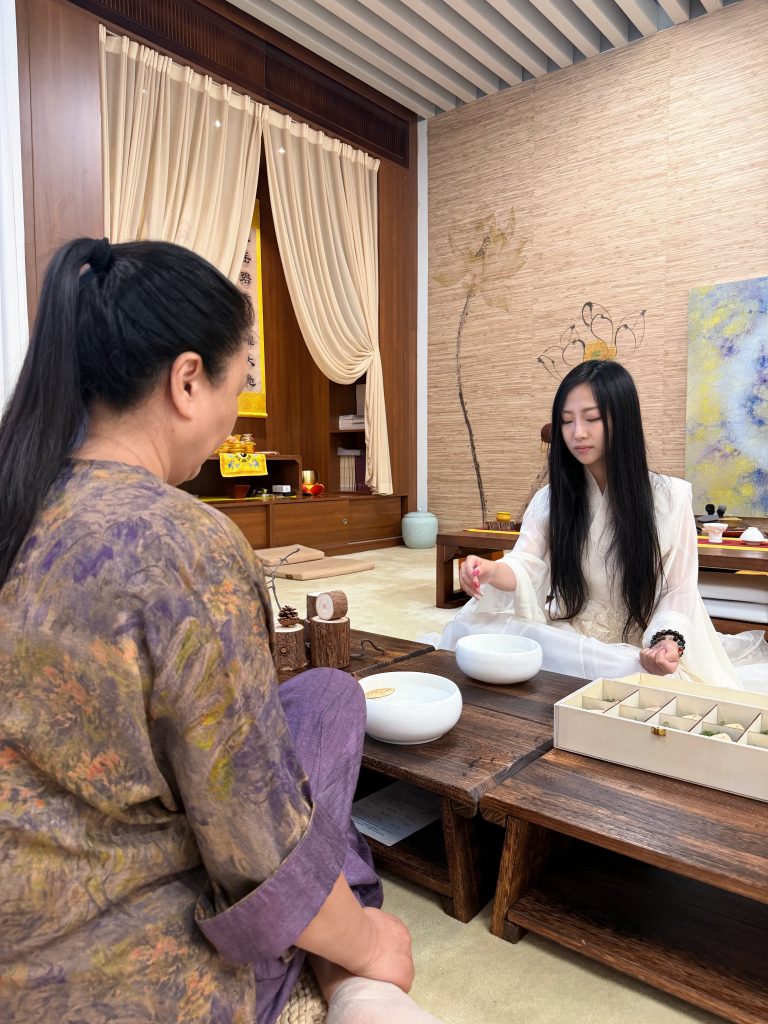
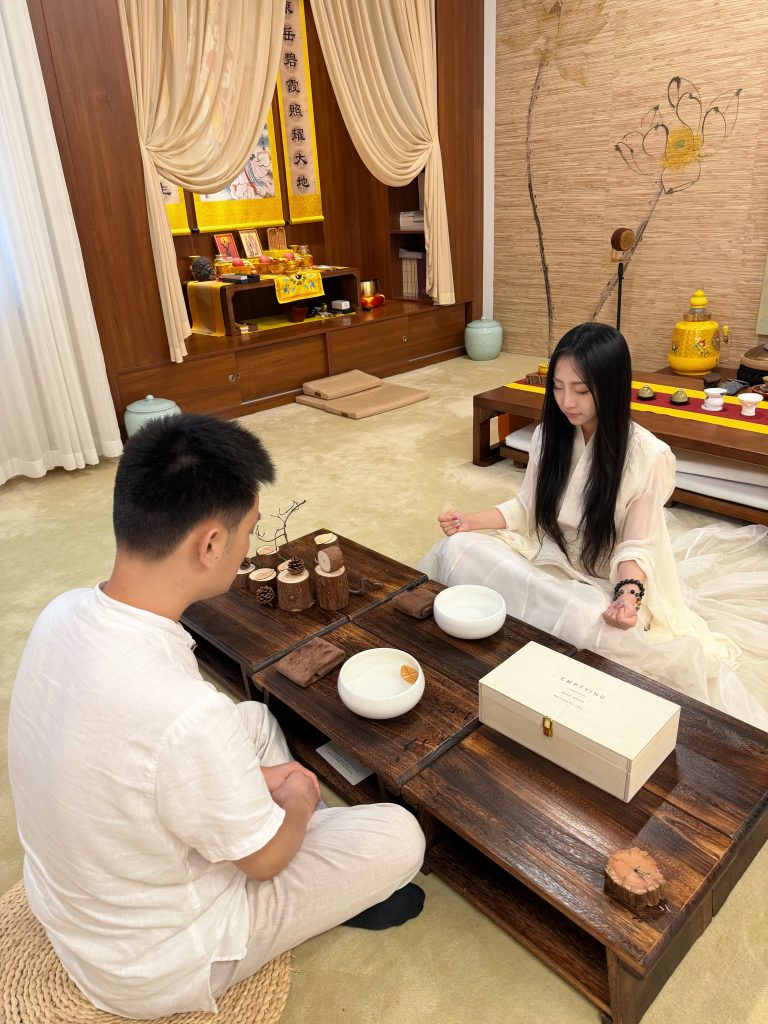
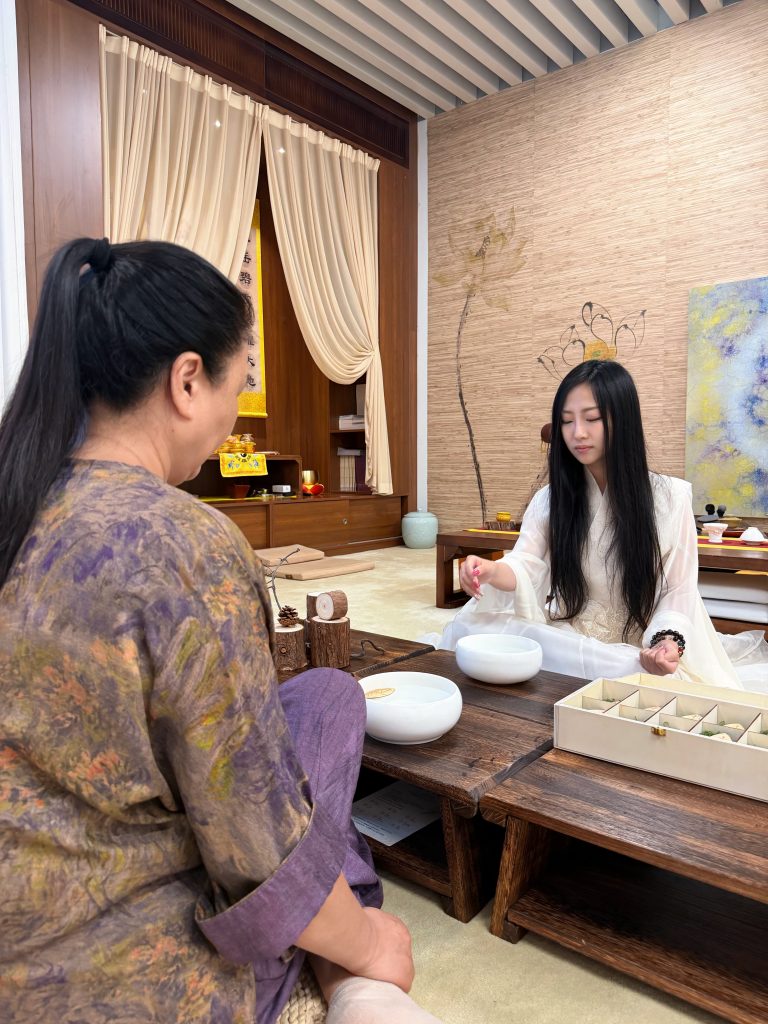
The testing took place in a quiet and beautiful indoor space in China, surrounded by books, natural materials and a peaceful atmosphere. I intentionally chose this environment because it reflected the calmness and sense of pause that the intervention hopes to create.
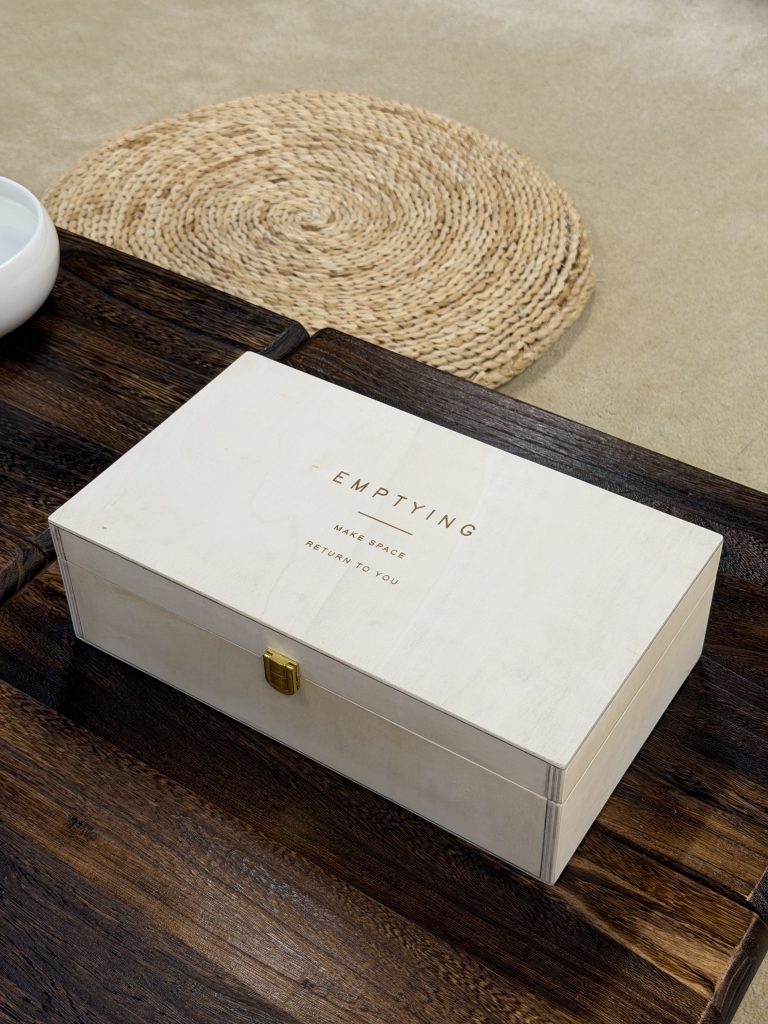
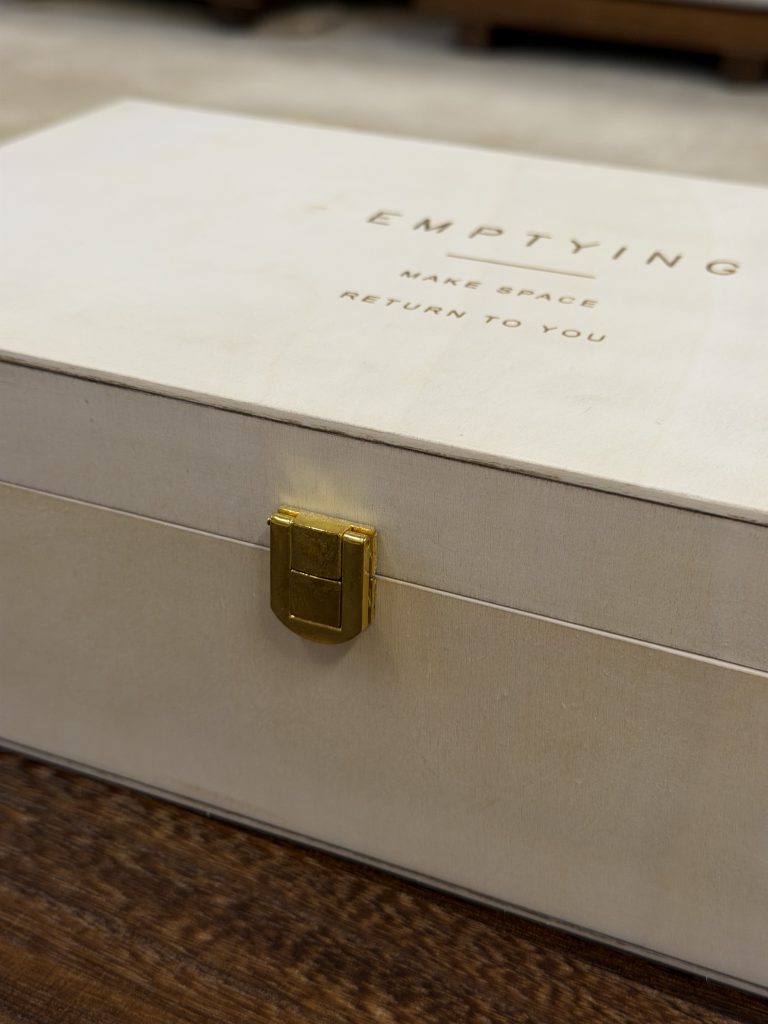
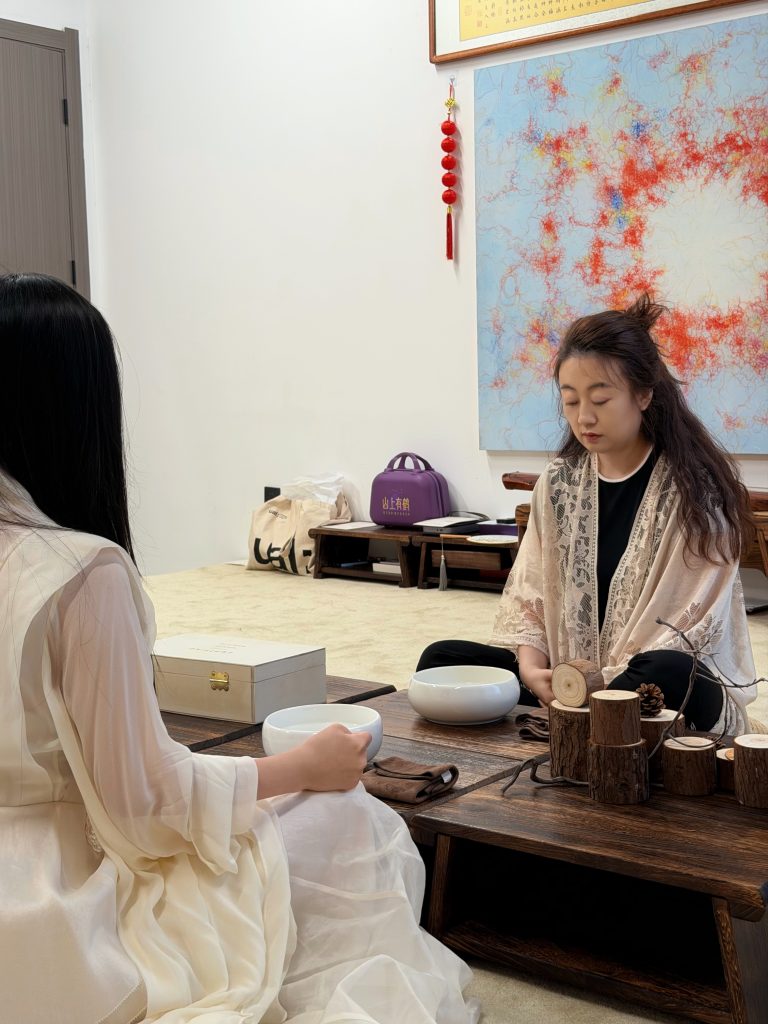
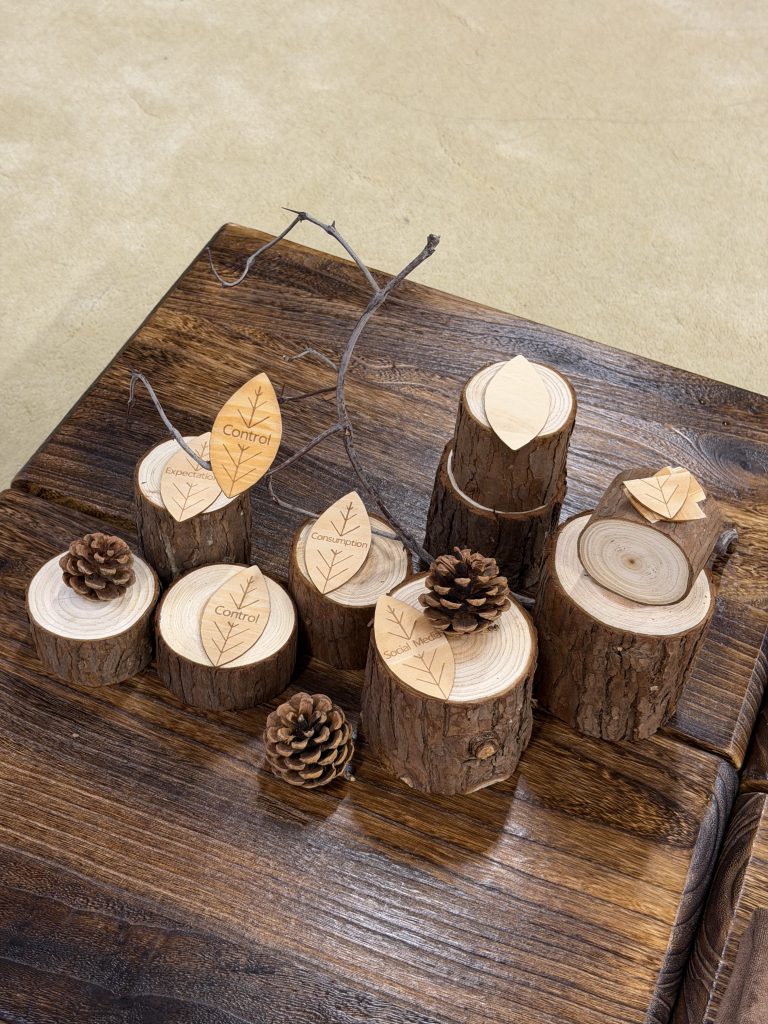
Figures 1–10. Intervention setup and prototype before user testing.
A total of 11 participants (all of Chineseparticipants around 25-40 years old) took part in the testing. Together with myself as the facilitator and researcher, there were 12 people involved in the session.
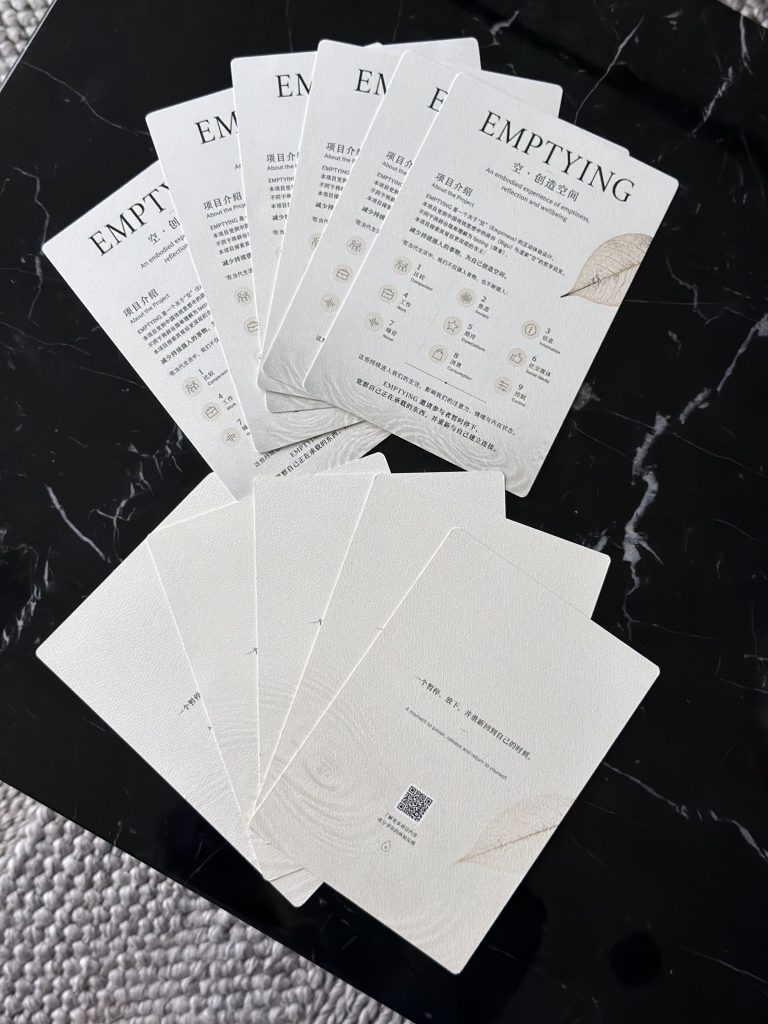
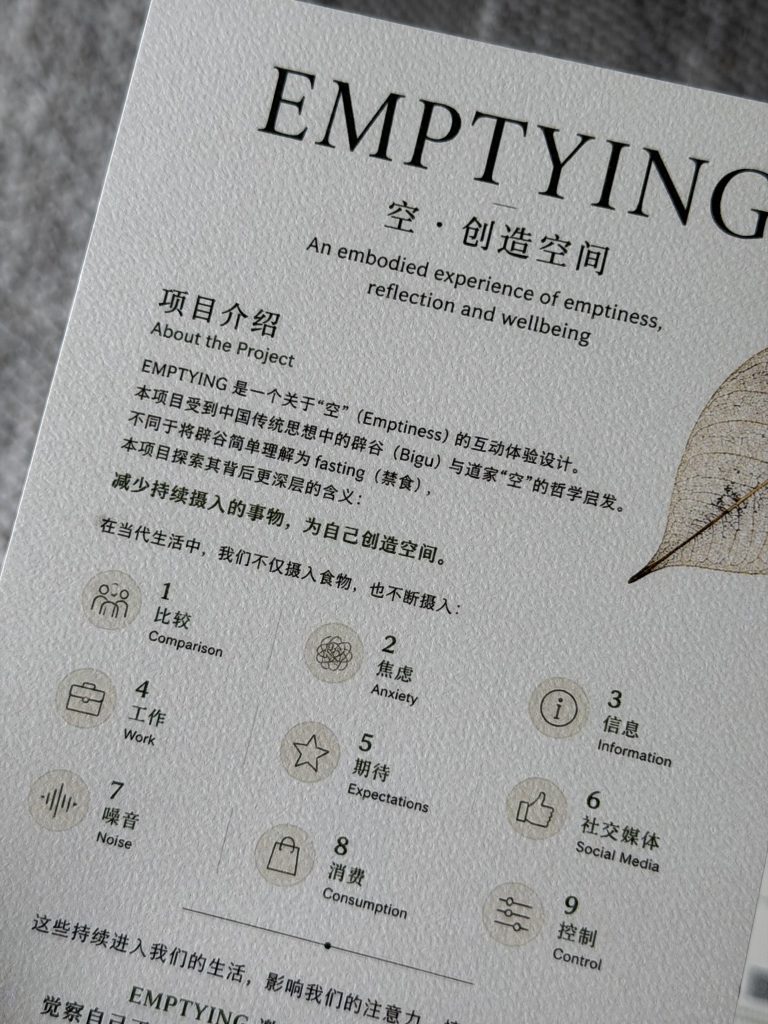
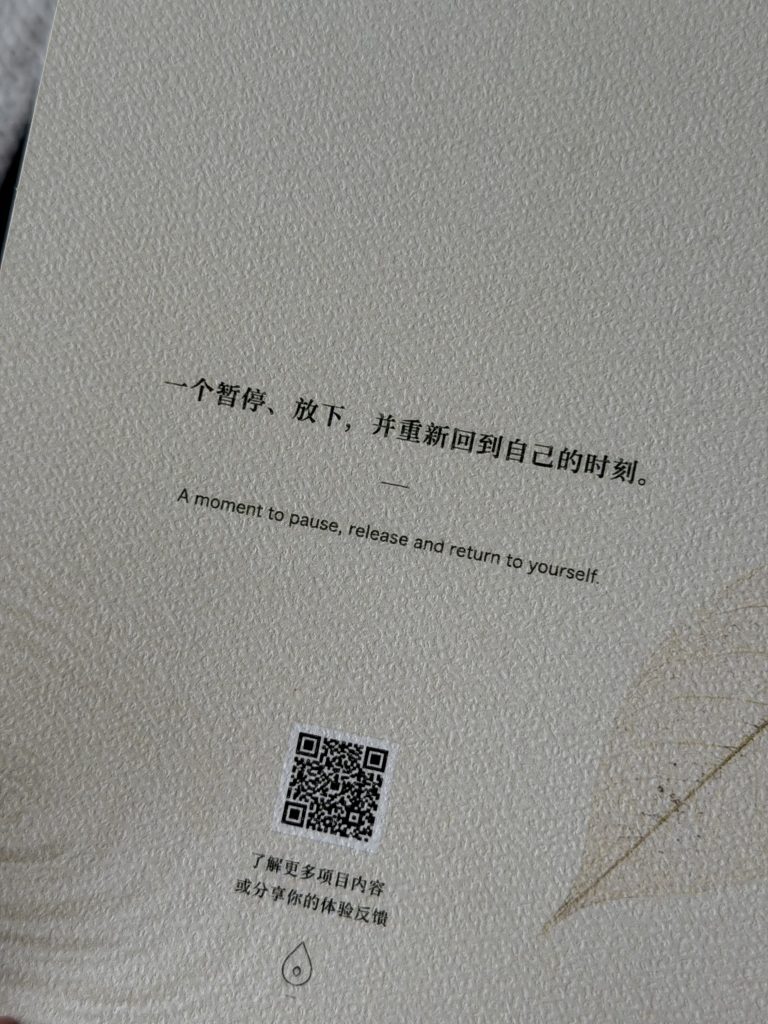
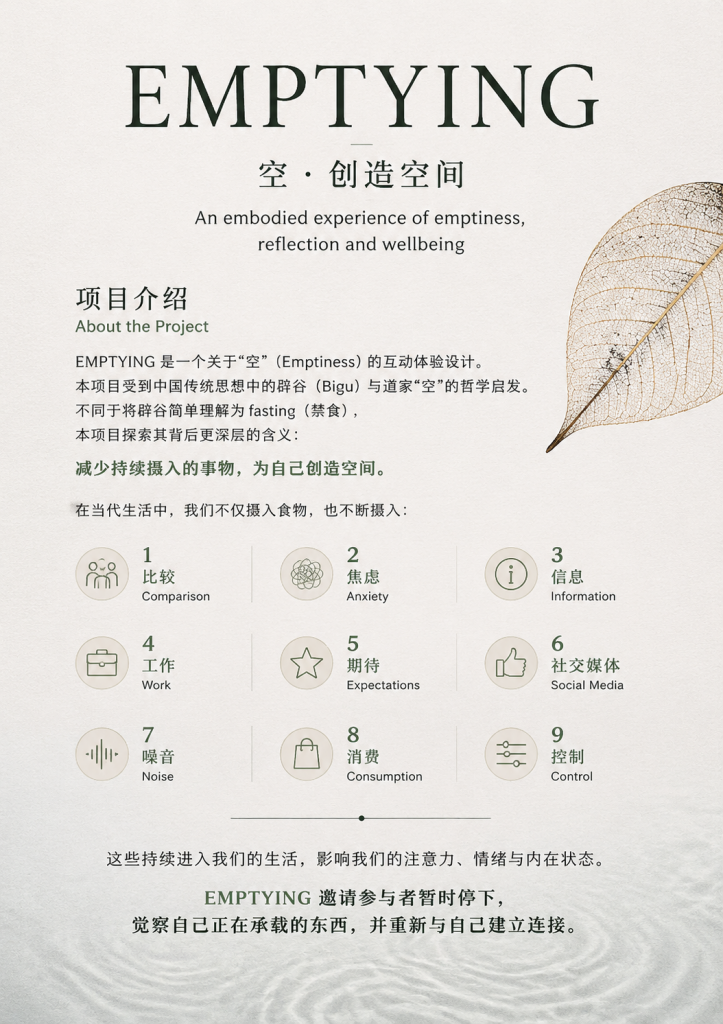
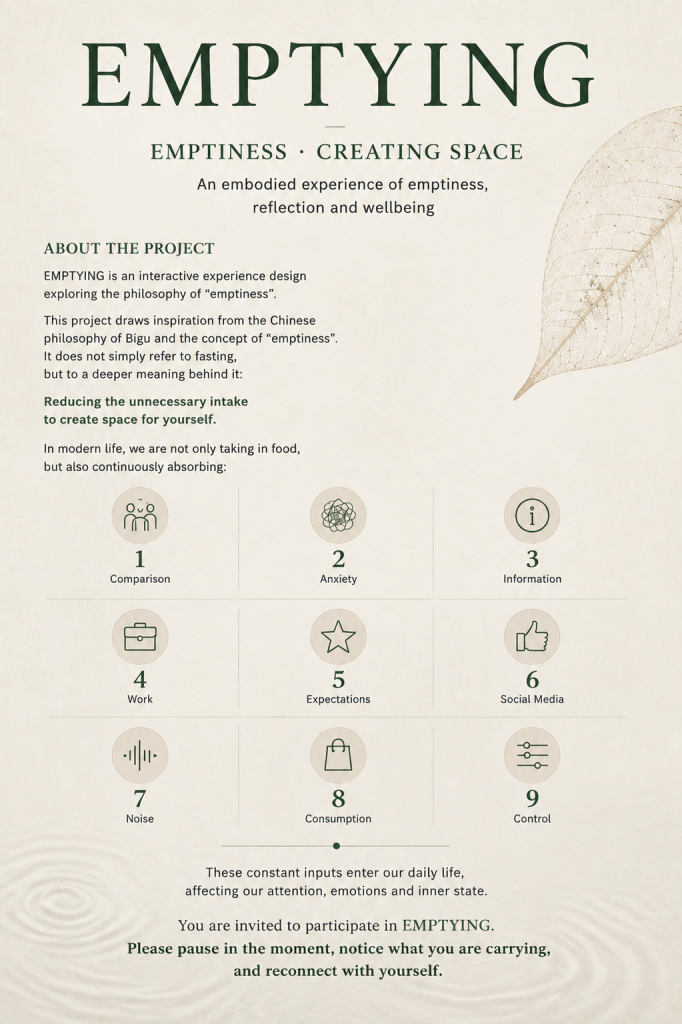
Before the testing began, I introduced the project and briefly explained the purpose of today’s research. Each participant received a Project Introduction Card (I printed the cards in an A5 format with double-sided printing on textured art paper to enhance the tactile quality of the experience.), followed by reading and signing the Participant Information Sheet and Consent Form. Rather than simply asking people to “experience an artwork”, I wanted every participant to understand that they were contributing to the development of this research.
Figures 11–13. Project Introduction Cards.
One-to-One Intervention
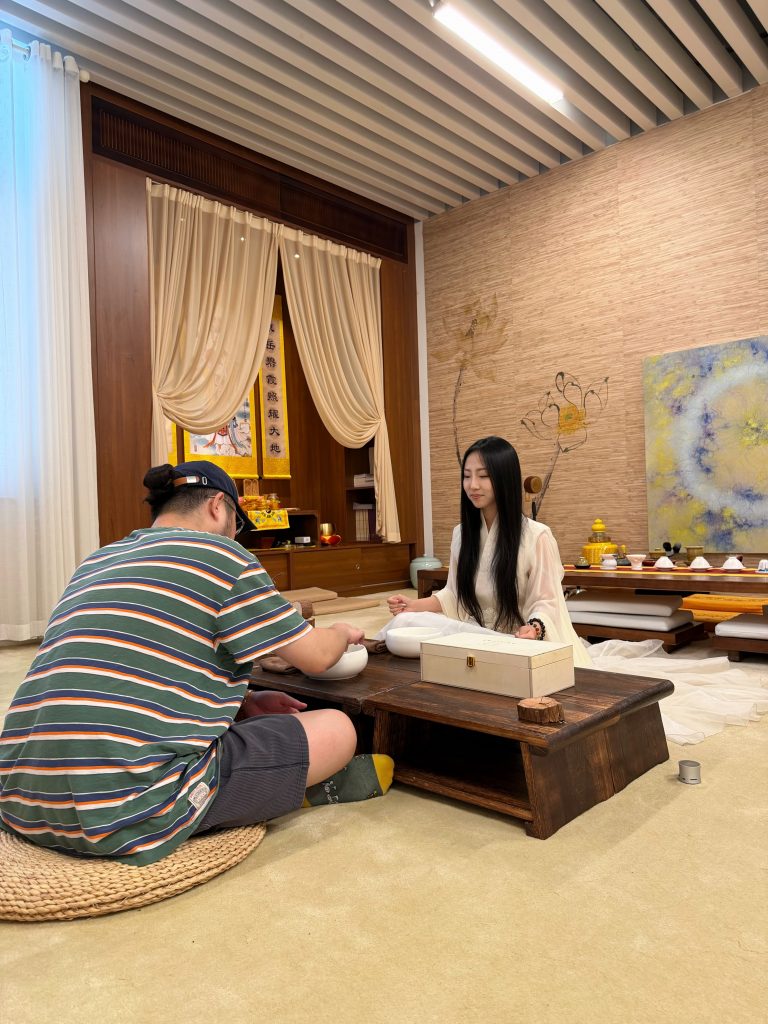
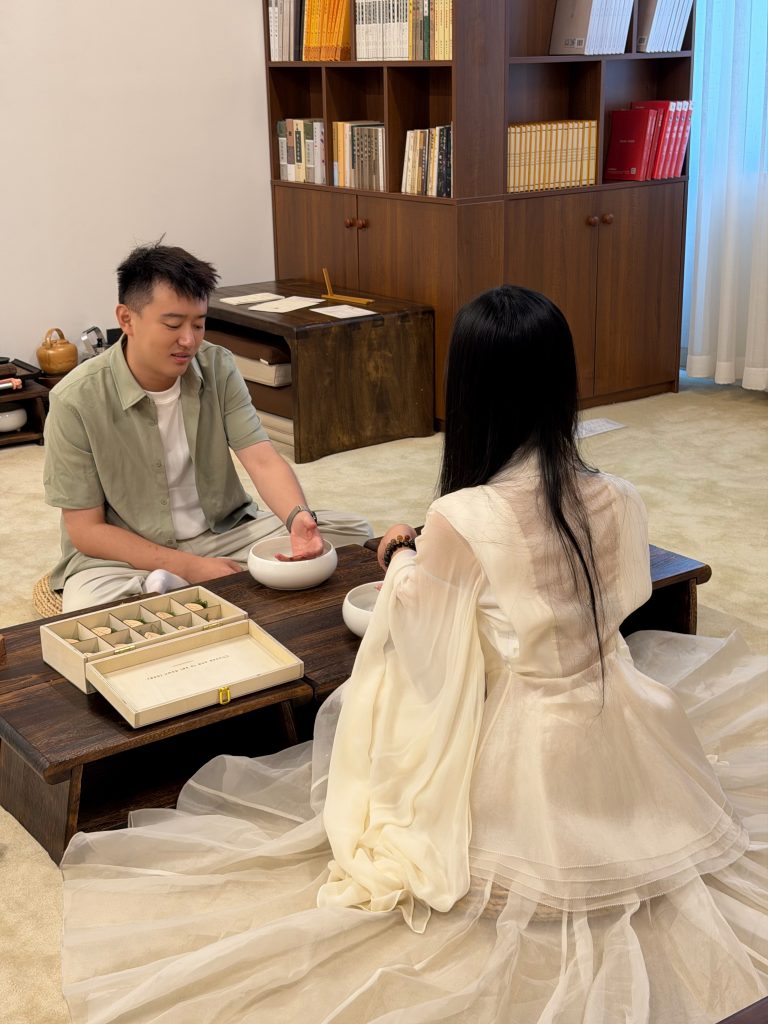
The intervention was carried out individually.
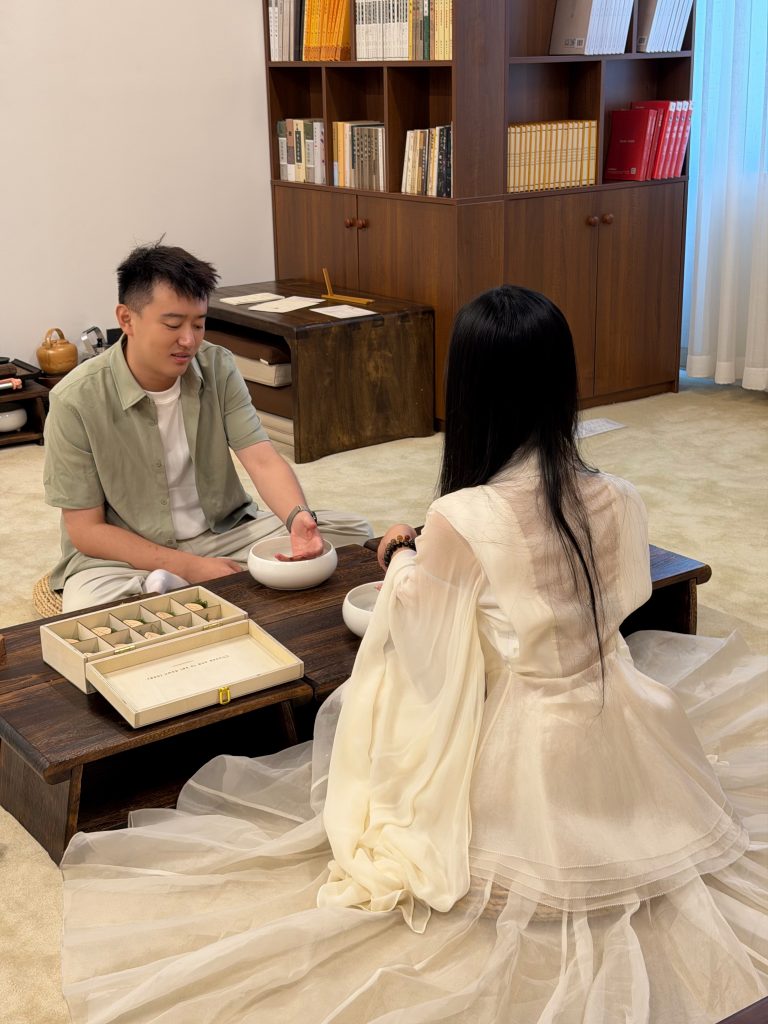
Each participant experienced EMPTYING in a one-to-one session with me, lasting approximately 5–10 minutes, although the duration naturally varied from person to person.
Throughout the intervention, my role was not to explain or interpret, but to accompany each participant through the experience. I guided them gently while allowing enough silence for their own thoughts to emerge.
After each participant completed the intervention, they received a Reflection Card to record their immediate thoughts and feelings.
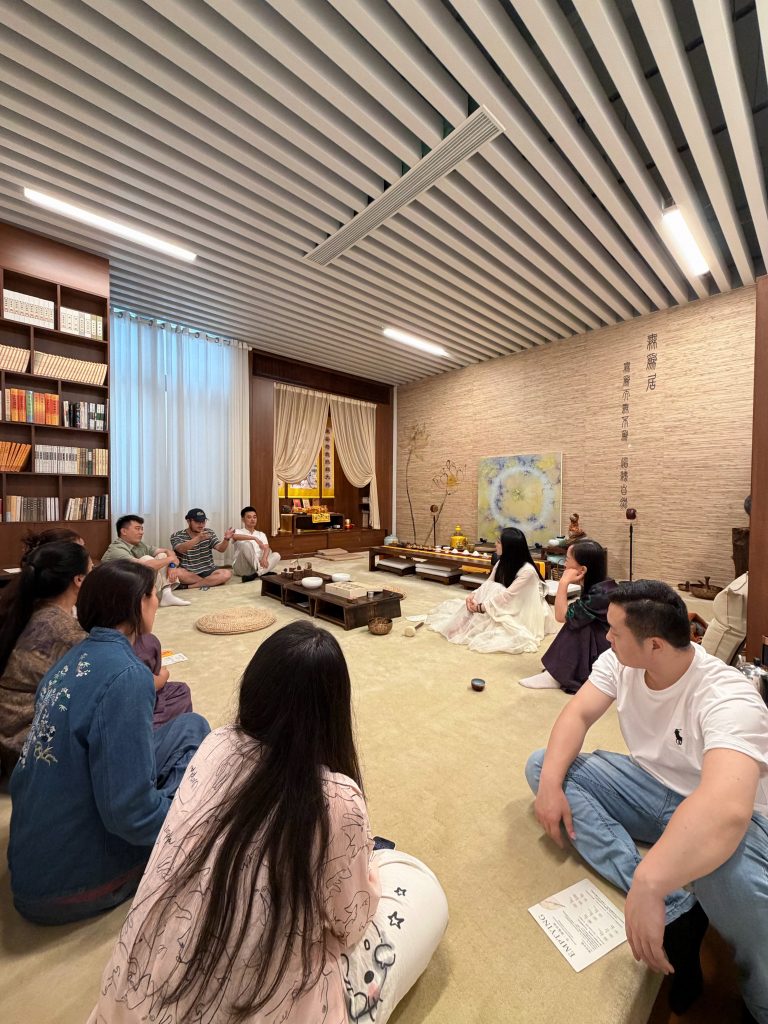
Once everyone had finished the individual experience, all participants gathered together again for an approximately one-hour group discussion and interview. This became an unexpectedly valuable part of the testing, allowing participants to openly share their interpretations, emotions and suggestions while also responding to each other’s experiences.
I also documented the testing through photographs and video recordings, and I plan to edit these into a short documentary montage for my next tutorial.
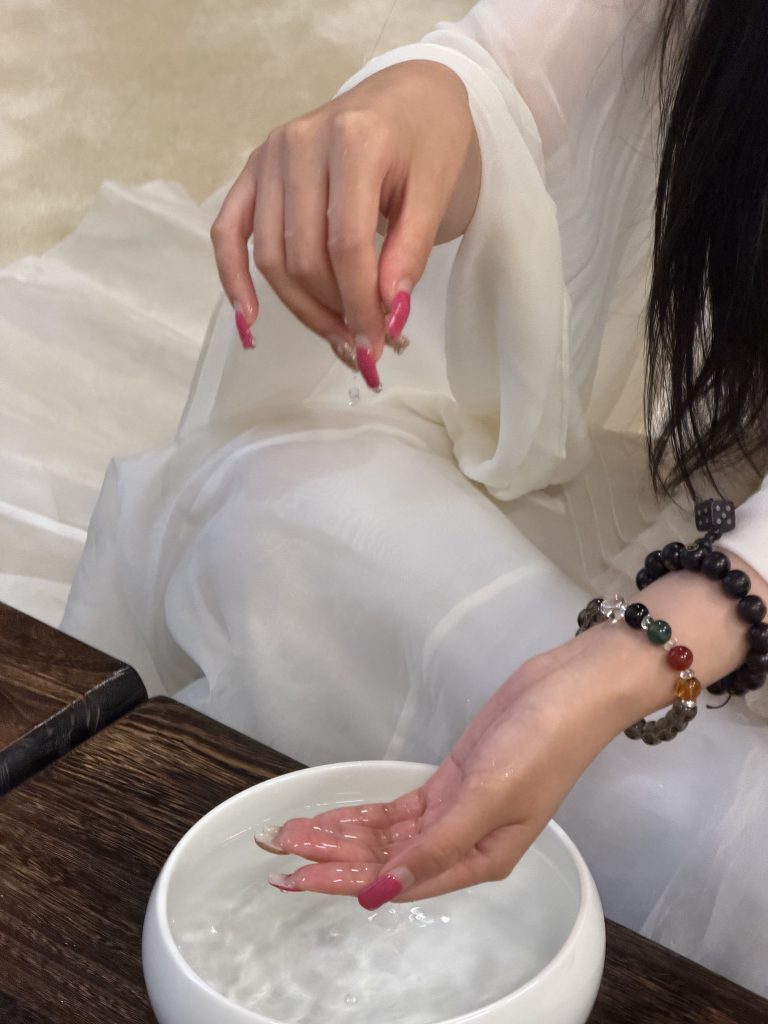
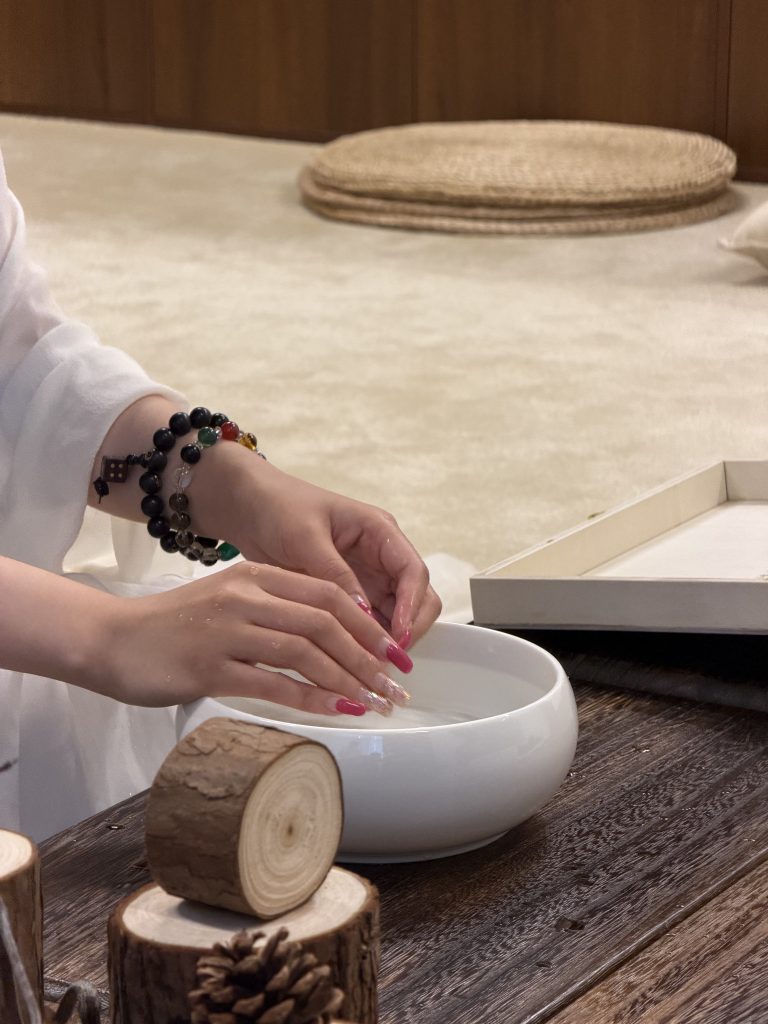
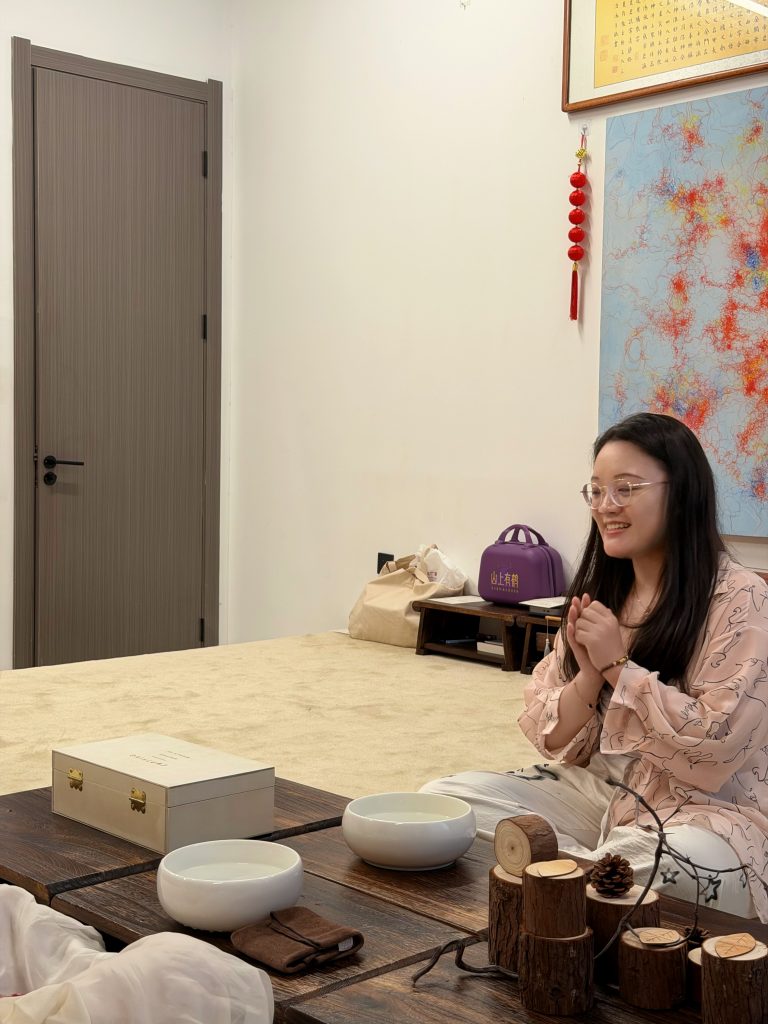
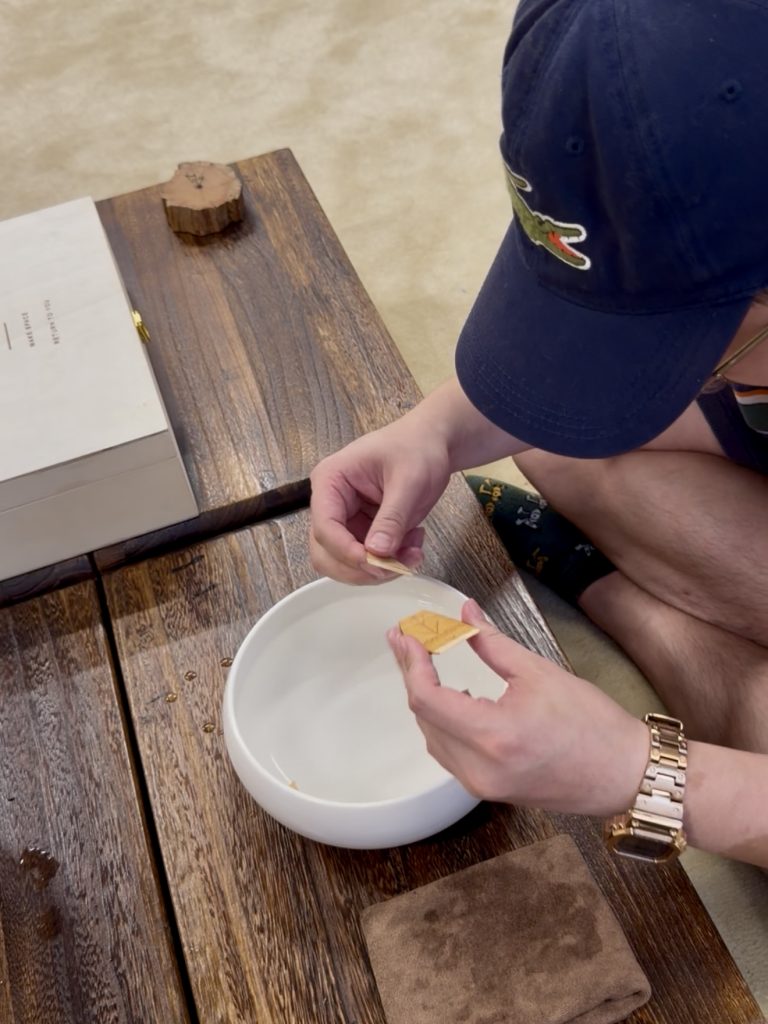
Figures 14–29. Photographs documenting the intervention process.
Beyond My Expectations
Although I had imagined many possible outcomes before the testing, the participants’ responses went far beyond my expectations.
Some participants described the experience as calming.
Some described it as healing.
Others felt that nothing particularly changed.
Interestingly, I realised that whether or not participants felt immediate change was not the most important outcome.
What surprised me most was something much deeper.
Many participants explained that the intervention did not end after the five-minute experience.
Instead, it continued afterwards.
They found themselves reflecting on the experience during the discussion, on their way home, and even imagining how they might remember these five minutes in their future daily lives.
At that moment, I realised that perhaps the value of this project does not lie in creating five minutes of stillness.
Its value may lie in creating a memory that people return to whenever life becomes too full.
This was an insight I had never anticipated before conducting the testing.
When Desire Meets Water
One of the strongest moments throughout the testing was witnessing the relationship that gradually formed between the wooden leaf, the water, and each participant.
Although every participant experienced exactly the same intervention, every story was completely different.
Participant 1 Control
One participant, a 38-year-old mother, chose the wooden leaf labelled “Control.”
She immediately thought about her daughter.
During the discussion she shared that she had always tried to control many aspects of her daughter’s life.
As she quietly watched the wooden leaf floating freely on the surface of the water, she suddenly paused.
She smiled and said,
“Maybe I don’t need to control her so much anymore. She’s actually doing really well on her own.”
Nothing in the intervention explicitly suggested this reflection.
It emerged entirely from her own relationship with the material.
Participant 2 Noise
Another participant, a 26-year-old man, selected “Noise.”
Instead of simply watching the leaf float, he repeatedly pushed it to the bottom of the bowl.
Every time it floated back up, he pressed it down again.
Again.
And again.
Later he explained,
“I didn’t want to see it.”
However, after repeating this action several times, he stopped.
He simply allowed the leaf to float.
Then he laughed and said,
“When I stopped trying to control it, it didn’t feel as noisy anymore.”
This was a fascinating moment for me as a designer.
The intervention had never instructed participants how to interact with the leaf.
Yet his own behaviour became a metaphor for the relationship he had with “noise” in everyday life.
Participant 3 Work
A 27-year-old entrepreneur chose the word “Work.”
As soon as he placed the leaf into the water, it drifted quickly towards him.
He laughed and immediately said,
“Why is it coming towards me? Why isn’t it floating towards you? I’m already stressed enough.”
Everyone laughed.
However, after quietly sitting with the experience for a while, the water gradually became still, and the leaf slowly stopped drifting towards him.
Afterwards he described that brief moment as
“a rare moment of peace.”
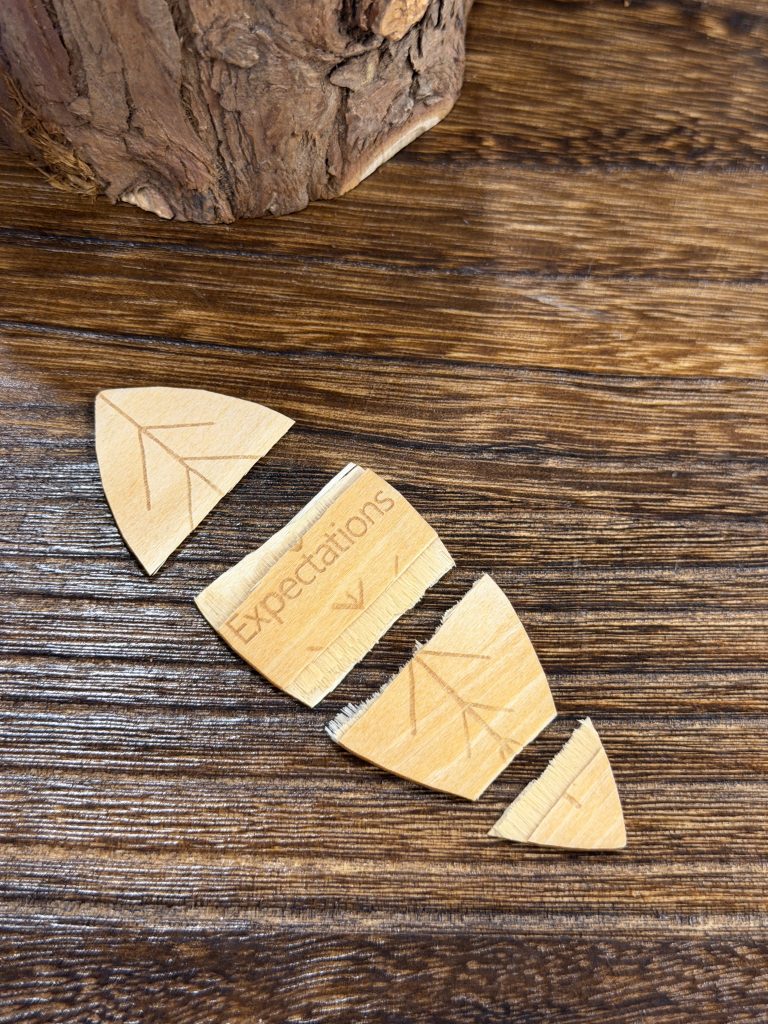
Participant 4 Expectations
Perhaps the most unexpected interaction came from a 30-year-old participant, who selected “Expectations.”
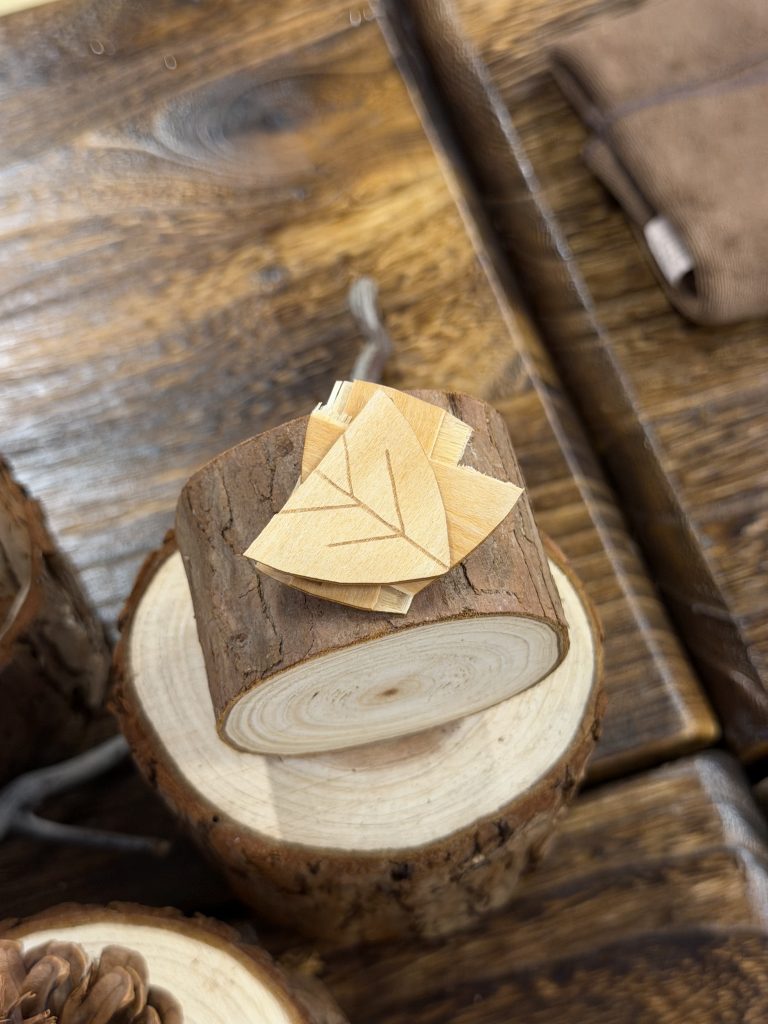
Instead of simply holding the leaf, he slowly broke it into smaller pieces.
At first, I was surprised.
Later, during the discussion, he explained that he has always had the habit of keeping his hands busy by playing with objects whenever he thinks.
Interestingly, after breaking the wooden leaf, his body language became noticeably calmer.
When I later asked whether he felt more relaxed afterwards, he immediately answered yes.
We also discussed whether this reflected how strongly he had been carrying other people’s expectations.
He agreed.
Then he laughed and said,
“Honestly, I think I could sit here playing with water like this all day, it is a good way to relax!”
This reminded me that participants do not simply follow the intervention.
They also reshape it.
Their own behaviours become part of the design itself.
Leave or Carry
The final decision in the intervention invited participants to choose whether to take the wooden leaf with them or leave it behind on what I now call the Space Tree.
4 participants chose to take their leaf away; 7 participants chose to leave it on the Space Tree.
This decision became another unexpected moment of reflection.
Some participants chose to take their leaf home as a reminder of something they still wished to carry consciously in their future lives.
Others felt that, during the experience, they had already found enough space to temporarily let it go.
These participants left their leaf on the installation.
Interestingly, there was no single way of placing the leaves.
Some carefully positioned them in stable locations.
Some placed them high on the branches.
One participant balanced the leaf delicately between two branches.
Another turned the leaf upside down before placing it down.
Figures 30–34. The Space Tree after the intervention.
Although I deliberately avoid interpreting these gestures, I found them incredibly meaningful.
The installation gradually became a collective visual record of individual choices, each one reflecting a different relationship with “emptying.”
Insights from User Testing
Following the intervention, I invited all participants to join a one-hour group discussion and semi-structured interview. In addition, each participant completed a Reflection Card immediately after their individual experience.
Rather than evaluating whether the intervention was simply “successful” or “unsuccessful”, I focused on identifying recurring themes that emerged across participants’ experiences. While each participant interacted with the intervention differently, several shared patterns gradually became visible.
Figures 35–36. Group discussion, participant interviews, and the collected Reflection Cards.
1. Participants began to redefine “Emptiness”
Perhaps the most significant finding was that many participants described a different understanding of emptiness after the experience.
Before the intervention, several participants associated emptiness with “nothingness” or “absence”. However, afterwards, they began using words such as:
Pause
Acceptance
Containment
Relaxation
Letting things flow naturally
Reducing control
One participant wrote,
“Emptiness is not about becoming empty, but about pausing.”
Another described emptiness as
“a form of strength and a form of acceptance.”
Rather than explaining the concept of emptiness, the intervention appeared to create a space in which participants generated their own interpretations.
2. The experience continued beyond the five minutes
Another unexpected finding was that the intervention did not seem to end when participants left the table.
Many participants commented that they continued thinking about the experience afterwards.
Some reflected that they would remember these five minutes in their future daily lives.
Others described the intervention as:
“a way of stopping,”
“a reminder,”
or
“a method I can return to.”
This became one of the most meaningful insights for me.
Initially, I believed I was designing a five-minute embodied experience.
However, the testing suggested that what participants carried away was not simply the experience itself, but the memory of it. The intervention appeared to create a reflective reference point that could continue to influence everyday life after the session had ended.
3. Participants formed personal relationships with the materials
Although everyone experienced the same intervention, each participant interacted with the wooden leaf differently.
Some regarded the leaf as representing themselves.
Others saw it as representing a particular desire.
Several participants became fascinated by the movement of the leaf in the water, noticing how it gradually absorbed water, changed colour, drifted with the current, or slowly settled.
Some participants simply observed.
Others interacted physically with the leaf.
One participant repeatedly pressed the leaf beneath the water.
Another carefully broke the leaf into small pieces.
These behaviours were never instructed.
Instead, they emerged naturally from participants’ own relationships with the material.
This made me realise that the intervention is perhaps less about the wooden leaf itself than about the relationship people construct with it.
4. Reflection gradually shifted from the object to everyday life
As the discussion continued, participants increasingly stopped talking about the wooden leaf and started talking about themselves.
Many connected their chosen word with situations in their own lives.
Several reflected on reducing control over others.
Others discussed becoming less affected by external information, social media or expectations.
One participant commented that they hoped to become less influenced by external voices.
Another described learning to “let things flow naturally.”
These responses suggested that the intervention successfully shifted attention from the physical object towards participants’ own lived experiences.
5. There was no single “correct” experience
Not every participant described the intervention as relaxing or healing.
Some experienced a profound emotional response.
Others reported only a slight change.
One participant simply wrote “none.”
Rather than viewing this as a weakness, I see it as an important finding.
The intervention does not aim to produce a single emotional outcome.
Instead, it offers an open framework in which participants generate different meanings according to their own experiences, memories and emotional states.
6. The final decision became another layer of reflection
At the end of the intervention, participants were invited to decide whether they wished to take their wooden leaf away or leave it on the Space Tree.
Interestingly, this final decision became another reflective moment.
Some participants chose to take the leaf with them as an ongoing reminder in their daily lives.
Others felt they had already created enough space during the intervention and decided to leave it behind.
Among the eleven participants,
four chose to take their leaf away;
seven chose to leave it on the Space Tree.
What fascinated me even more was how participants positioned their leaves.
Some carefully placed them upright.
Some balanced them on branches.
Some positioned them high within the structure.
One participant even turned the leaf over before placing it.
Although I deliberately avoid assigning symbolic meanings to these gestures, the installation gradually became a collective visual record of individual decisions.
Rather than representing a “correct” way of letting go, it reflected eleven different relationships with the act of creating space.
7. Suggestions for future development
The discussion generated several valuable suggestions for the next iteration:
Begin the experience before meals rather than afterwards, allowing participants to connect more directly with the philosophy of Bigu.
Add a short guided body relaxation before the intervention, such as inviting participants to relax their shoulders and breathing.
Strengthen the ending of the experience to create a more memorable closing moment.
Create a more immersive environment through sound, lighting, or other sensory elements.
Explore whether participants should choose one desire word or multiple words, as opinions differed on which approach created deeper reflection.
Consider whether the different placements of the wooden leaves on the Space Tree should remain open to interpretation or become part of the reflective dialogue.
Reflection
This user testing changed the way I understand my own project.
Before the testing, I thought I was designing an experience about emptiness.
After listening to participants, I realised that perhaps I am actually designing conditions that allow people to pause, observe themselves, and construct their own meanings.
The intervention did not provide answers.
Instead, it created opportunities for questions to emerge.
That shift from designing an experience to designing the conditions for personal reflection has become one of the most important outcomes of this first round of testing.
Next Steps
The next iteration will focus on refining the guidance, strengthening the opening and closing of the experience, and exploring how the intervention can better support reflection while remaining open to different interpretations.
Over the past few days, my focus has shifted from developing the concept to preparing the complete intervention for its first round of user testing on 7 August 2026. At this stage, the intervention has become a tangible experience rather than a series of individual prototypes. My priority has been to refine every touchpoint that participants will encounter, from the introduction of the project to the final reflection.
Research Question Development
Following my recent tutorial, I decided to temporarily revise my research question to a more open form:
How can an embodied experience of emptiness create space for reflection and wellbeing in contemporary society?
Rather than directly mentioning Bigu or Chinese philosophy, I intentionally leave the source of the experience open at this stage. The purpose of the upcoming user testing is not to confirm a predetermined answer, but to explore what participants actually respond to.
After analysing the testing results, the answer may naturally emerge. It may reveal that the embodied experience is most strongly connected to Bigu, Chinese traditional philosophy, Daoist philosophy, or perhaps another cultural perspective that has not yet been fully recognised. Therefore, I see this research question as a temporary framework that allows the testing itself to guide the next stage of the project.
Preparing the Participant Journey
To ensure participants can understand the project while still entering the experience with an open mind, I designed a complete set of materials for the intervention.
Project Introduction Card
The project introduction card was produced in both Chinese and English versions. Rather than functioning as an instruction sheet, it briefly introduces the concept of EMPTYING, explains the reinterpretation of Bigu, and invites participants into the experience without revealing or influencing the expected outcome.
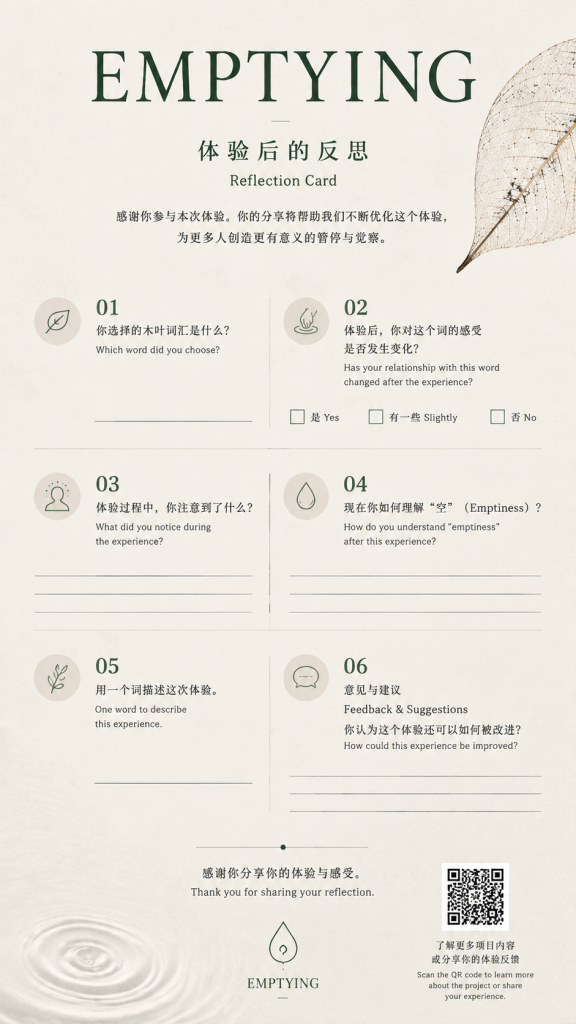
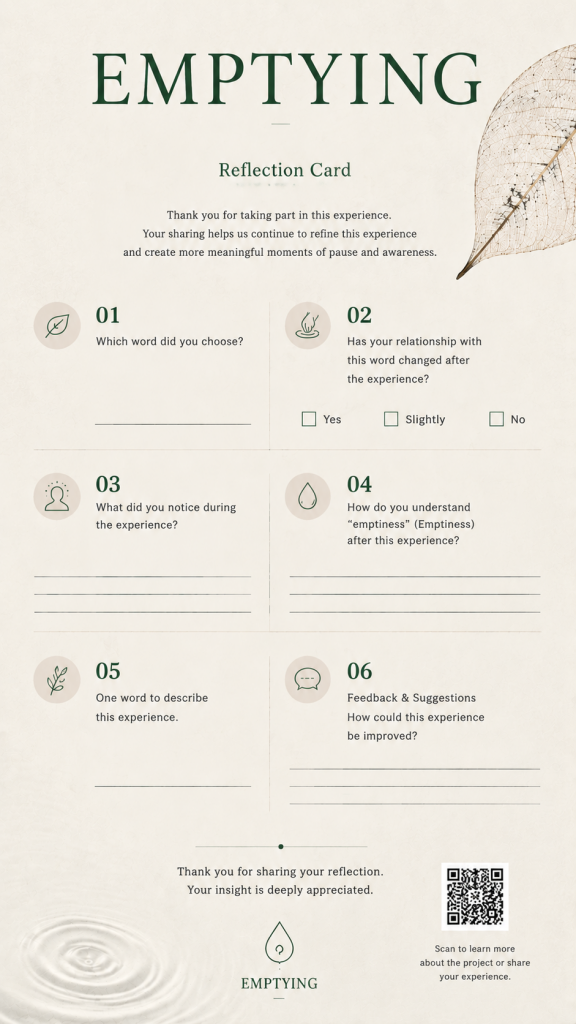
Instead of using a traditional questionnaire, I designed a reflection card that becomes part of the intervention itself. Participants complete the card only after everyone has finished the experience, allowing them time to process their feelings before responding.
The questions focus on reflection rather than evaluation, encouraging participants to describe their own experience, understanding of emptiness, and suggestions for improving the intervention.
Figure 3. Reflection Card (Chinese Version)
Figure 4. Reflection Card (English Version)
Participant Information & Consent
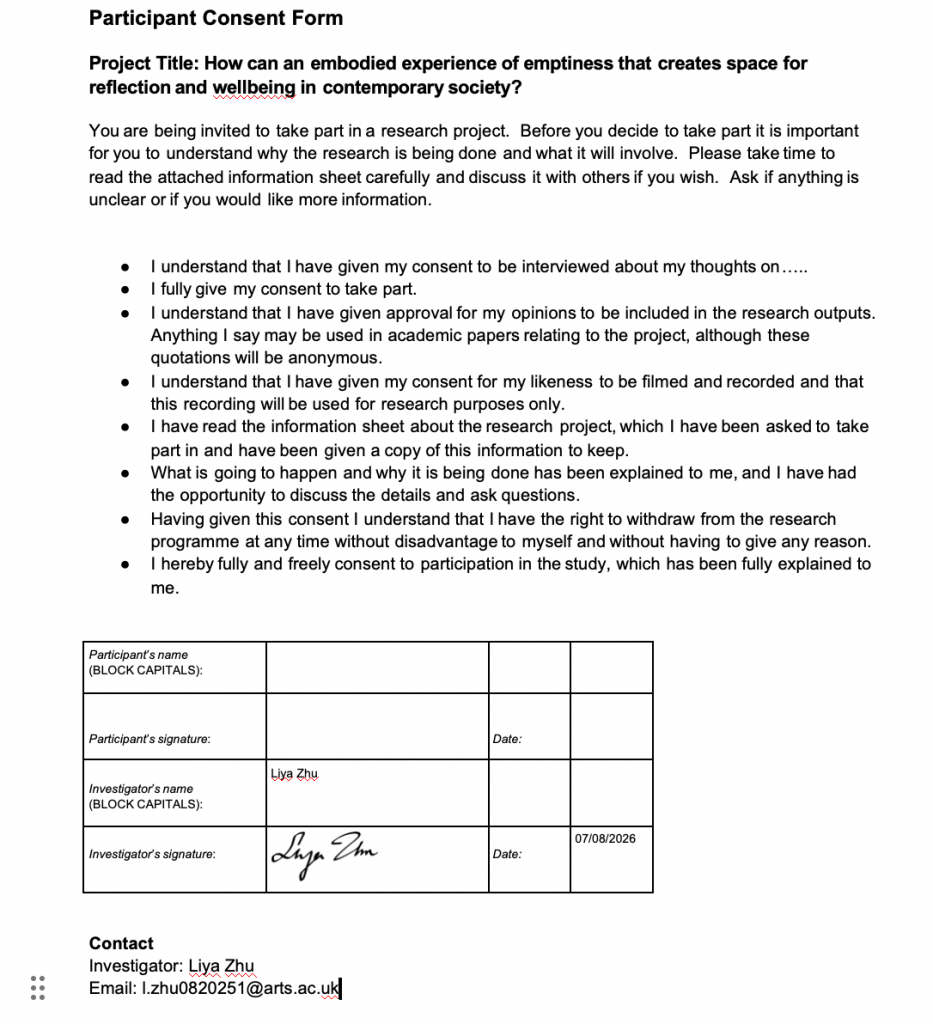
Following ethical research requirements, I also prepared a Participant Information Sheet and Participant Consent Form.
Before the intervention begins, participants are invited to read the project information and sign the consent form, ensuring they understand the purpose of the research, how their feedback will be used, and that participation is entirely voluntary.
Figure 5. Participant Consent Form
Completing the Prototype
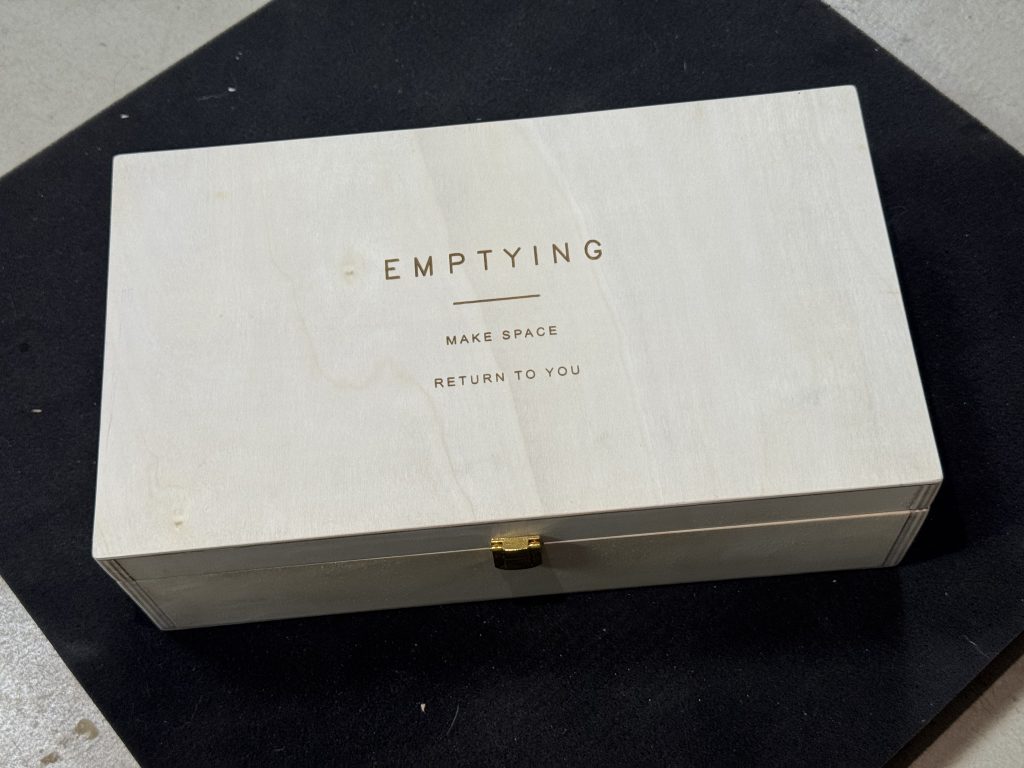
The physical prototype has now been completed and is ready for testing.
This includes the wooden leaves, the interaction materials, the installation for participants to either keep or temporarily leave their wooden leaf after the experience, and the overall participant journey. Seeing the project develop from sketches into a complete embodied experience has been an important milestone in the design process.
Figure 6. Final Intervention Prototype
Looking Ahead
Everything is now ready for the first round of intervention testing on 7 August.
Rather than evaluating whether the intervention is successful or unsuccessful, I see this testing session as an opportunity to observe how participants interpret the experience, how they understand the idea of emptiness, and how the intervention may evolve through their responses.
I am particularly interested in discovering whether the experience itself will reveal a clearer cultural grounding for the project. Instead of assuming the answer is Bigu, I hope the testing will indicate whether the intervention is ultimately understood through Bigu, Daoist philosophy, Chinese traditional philosophy, or perhaps another perspective that emerges from participants’ experiences.
I look forward to learning from this first testing session and allowing the participants’ voices to shape the next iteration of the project.
Following my exploration of Bigu, emptiness and embodied wellbeing, I began translating these philosophical ideas into a physical experience. Rather than explaining the concept of emptiness through words, I wanted participants to experience it through sensory interaction, material transformation and a moment of pause.
2. Final Research Question
How can the philosophy of Bigu be translated into an embodied experience of emptiness that creates space for reflection and wellbeing in contemporary society?
The intervention explores whether a temporary pause from everyday consumption can create an opportunity for self-reflection.
3. Intervention Overview
Creating a Space for Pause
Also, I see myself as part of the intervention, not just an observer, because I will be guiding the participant through the experience. My role is more like a facilitator — creating the atmosphere and supporting their reflection, rather than telling them what they should feel.
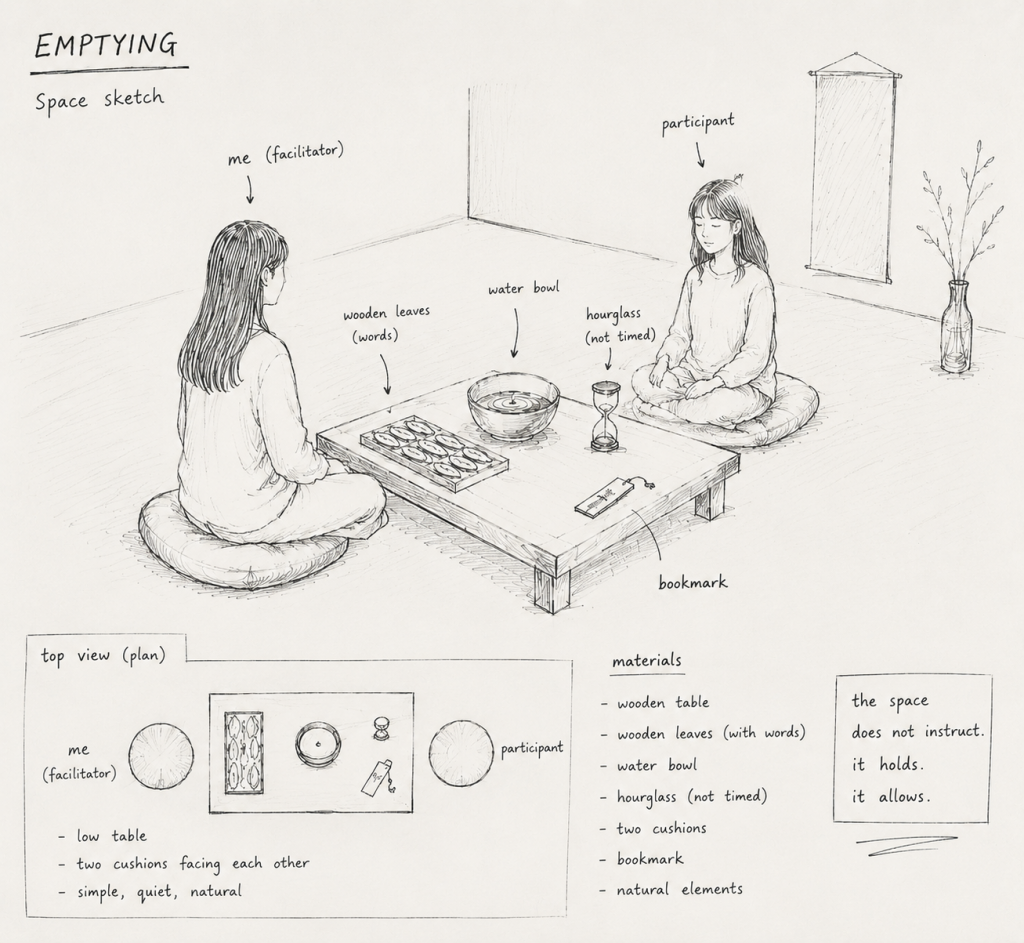
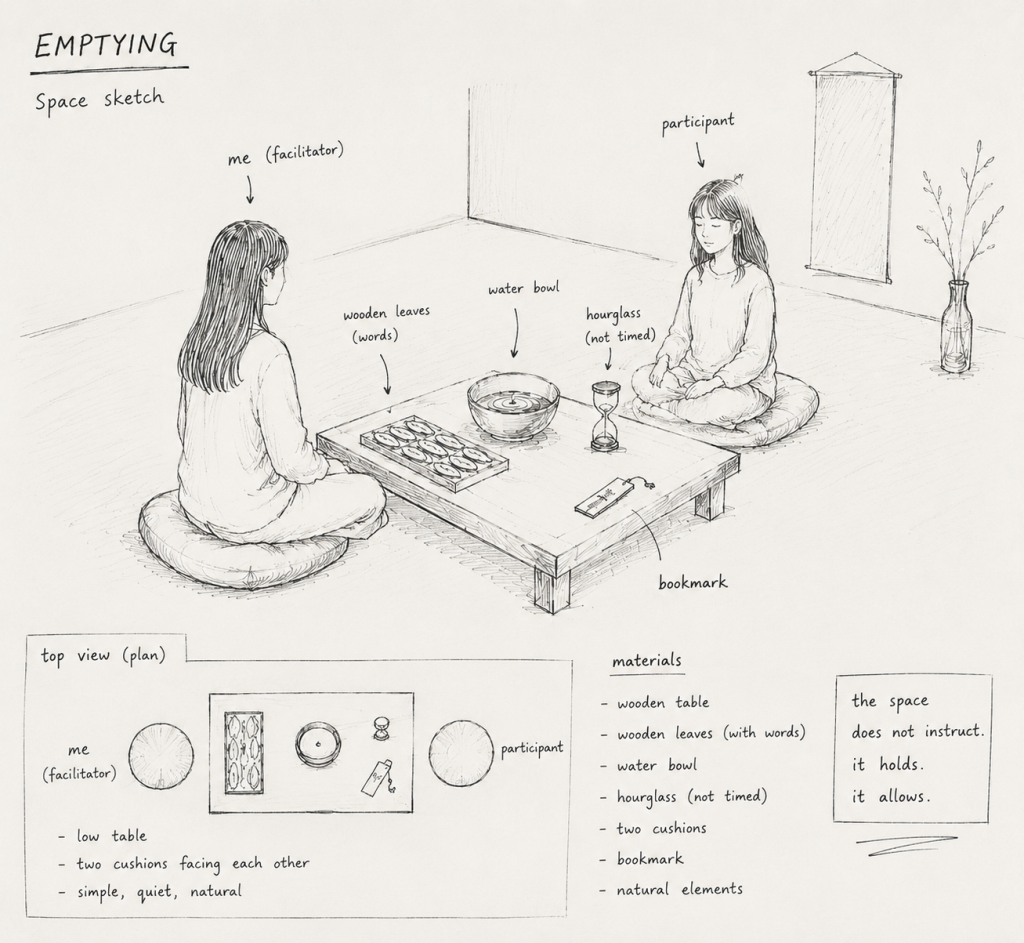
The intervention takes place in a quiet, intimate environment inspired by tea culture and traditional Chinese aesthetics. Instead of creating a performance or guided meditation, I designed a one-to-one reflective experience between myself and the participant.
Two cushions
I was face-to-face with the participants.
Water bowl
wood leaf
Hourglass
Wooden bookmark
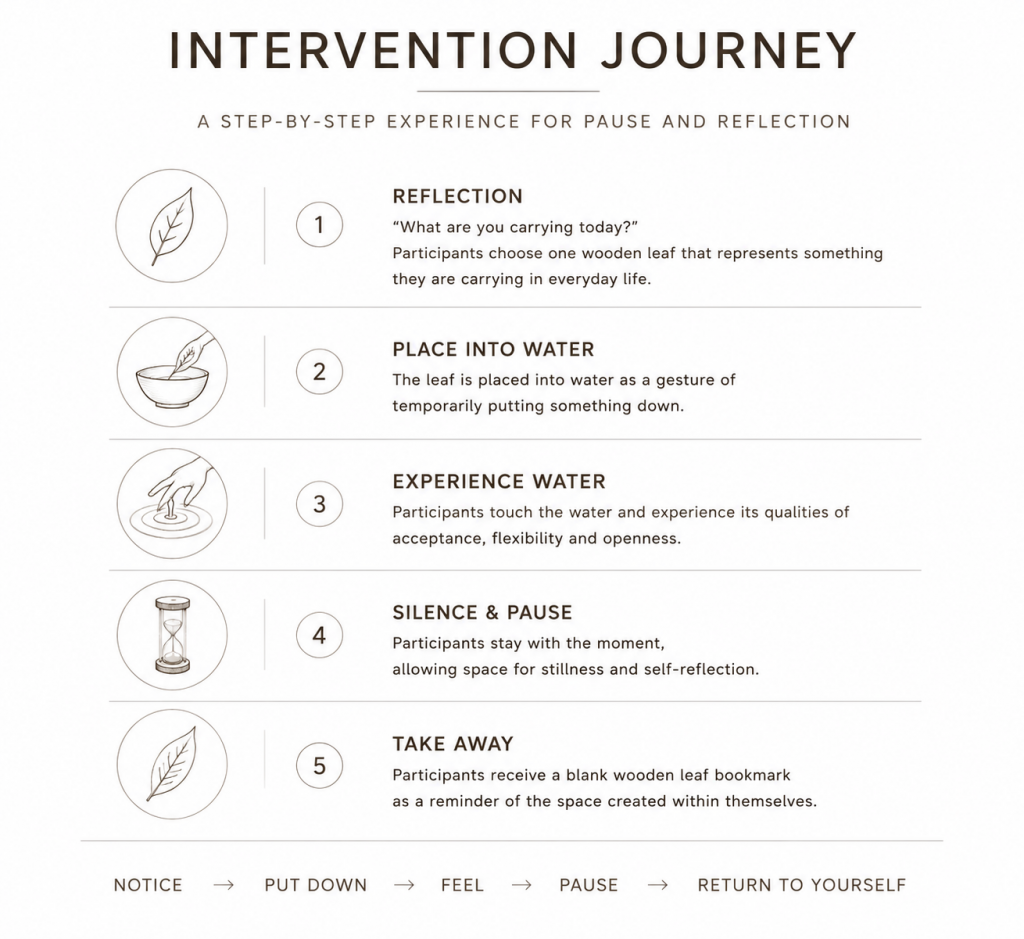
4. Design and the Intervention Journey
My Design
Step 1 — Reflection: “What are you carrying today?”
Participants begin by reflecting on the question: “What are you carrying today?”
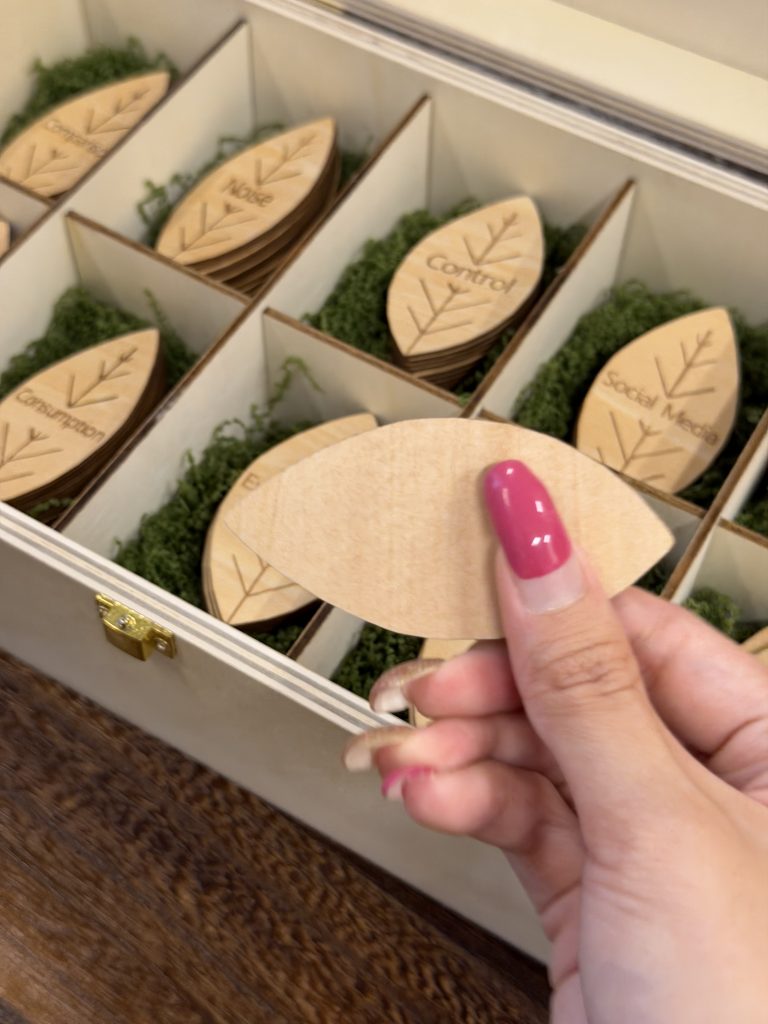
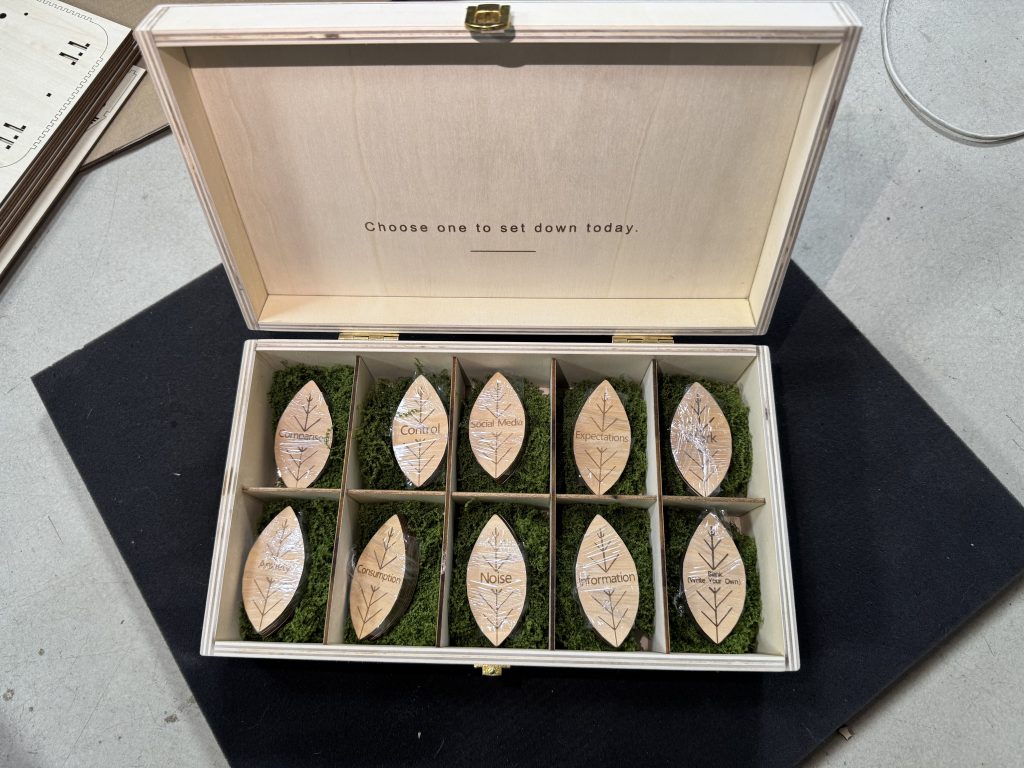
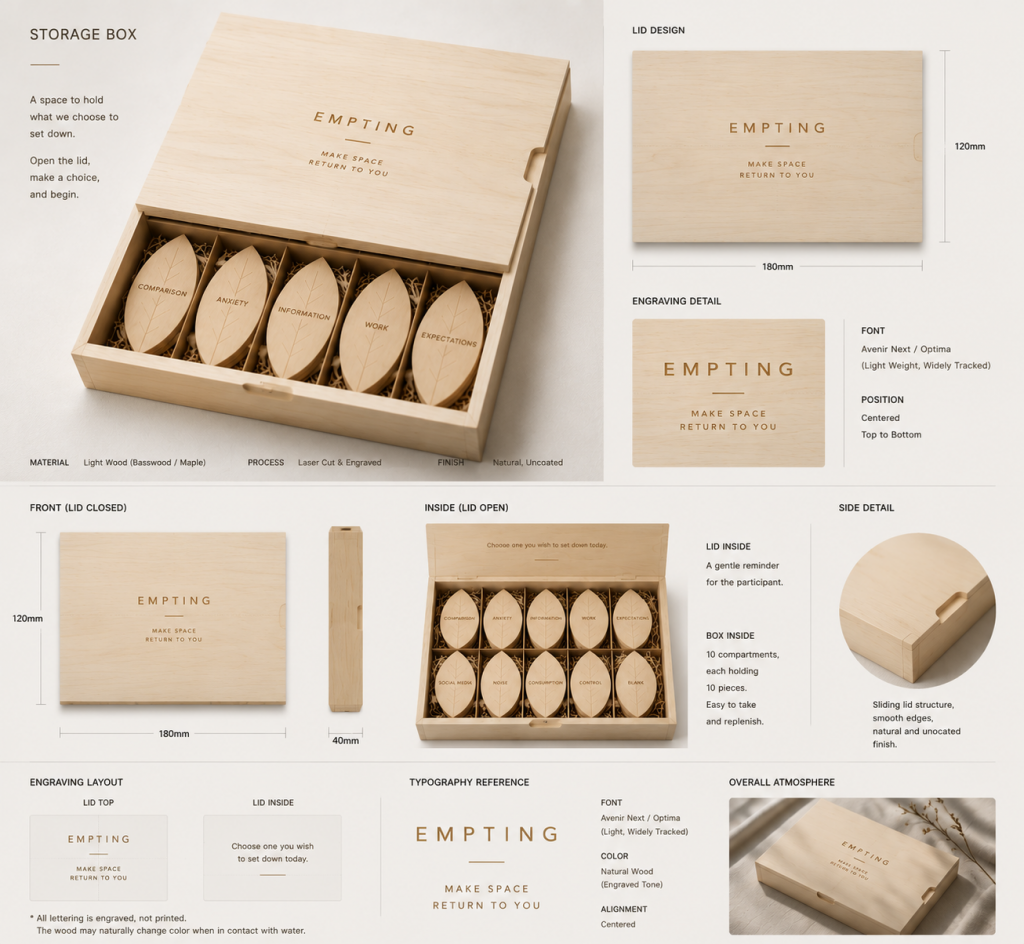
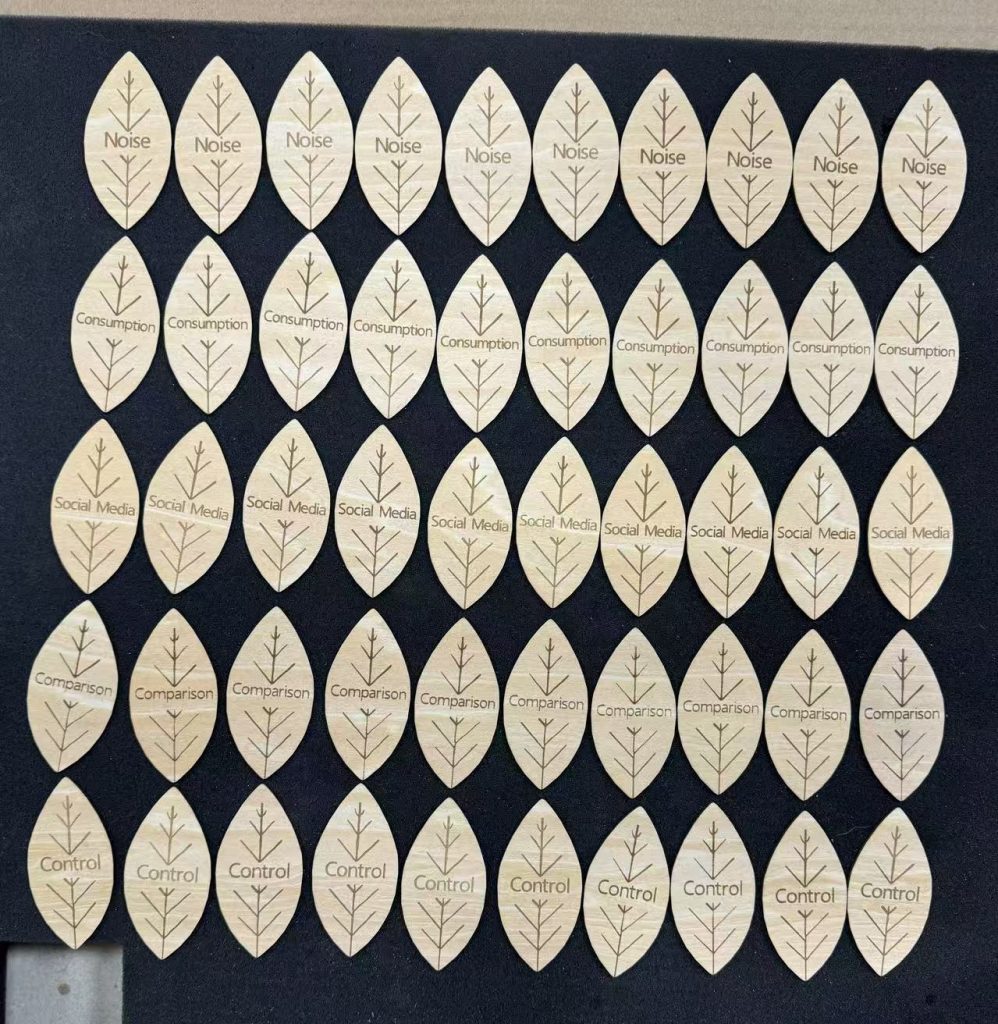
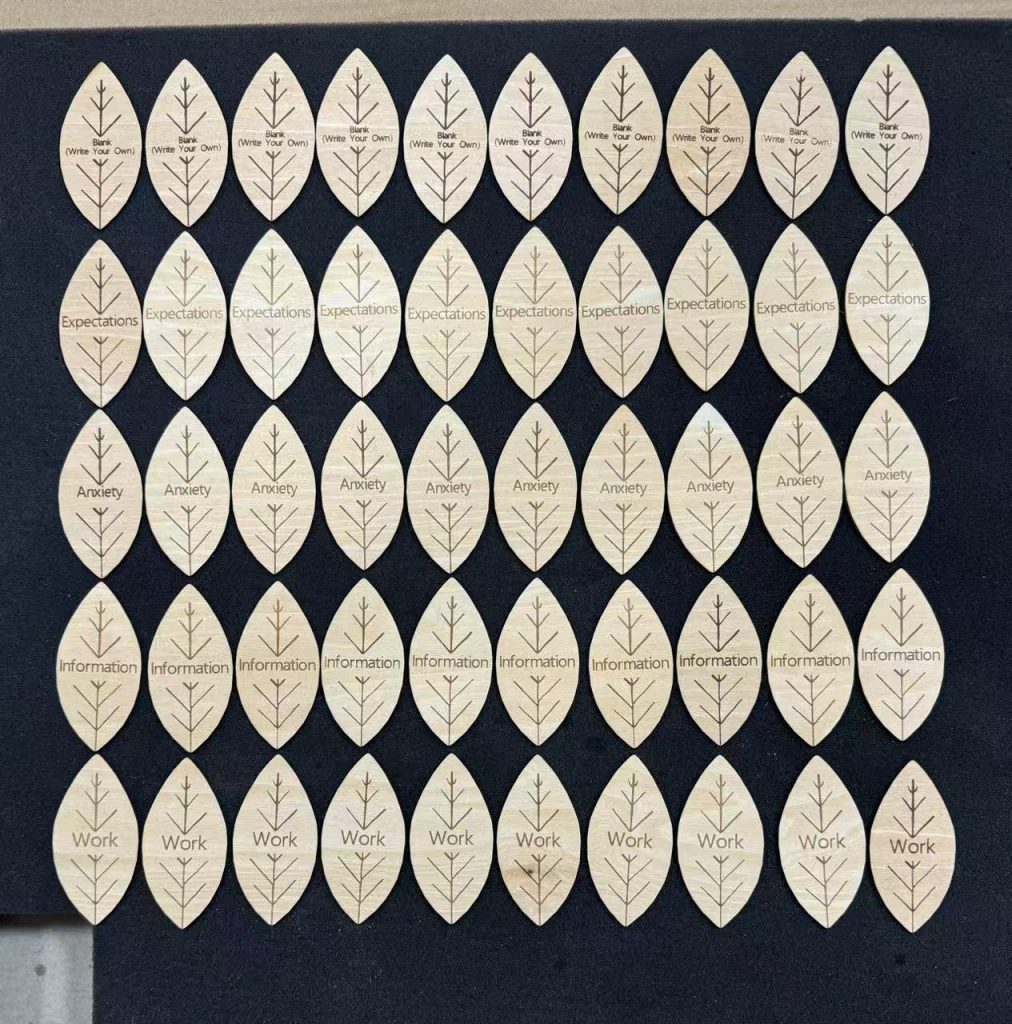
Wooden leaves contain words:
1 Comparison
2
Anxiety
3
Information
4
Work
5
Expectations
6
Social Media
7
Noise
8
Consumption
9
Control
10
Blank(Write Your Own)
These words are not considered problems to remove, but experiences participants may choose to notice.
Step 2 — Placing the Leaf into Water
Participants place their chosen leaf into water.
no discard
no destroy
putting something down temporarily.
This action represents a temporary pause rather than rejection or elimination.
Step 3 — Experiencing Water
Water was selected because of its qualities within Daoist philosophy. The concept of “Shang Shan Ruo Shui” describes water as flexible, accepting and non-resistant.
Through touching water, participants are invited to experience softness, acceptance and stillness through their body rather than only understanding it intellectually.
Step 4 — Silence and Pause
After placing the leaf into water, participants can stay with the experience for as long as they feel comfortable.
The three-minute sand timer is not a requirement, but a visual reminder that this moment does not need productivity or achievement.
Step 5 — Taking Away a Blank Leaf Bookmark
At the end of the experience, participants receive a blank wooden leaf bookmark.
Not only a gift, but also material reminder.
Unlike the first leaf, which carries a word representing what participants choose to put down, the bookmark is intentionally empty.
It represents the space created after letting go.
5. Material Development
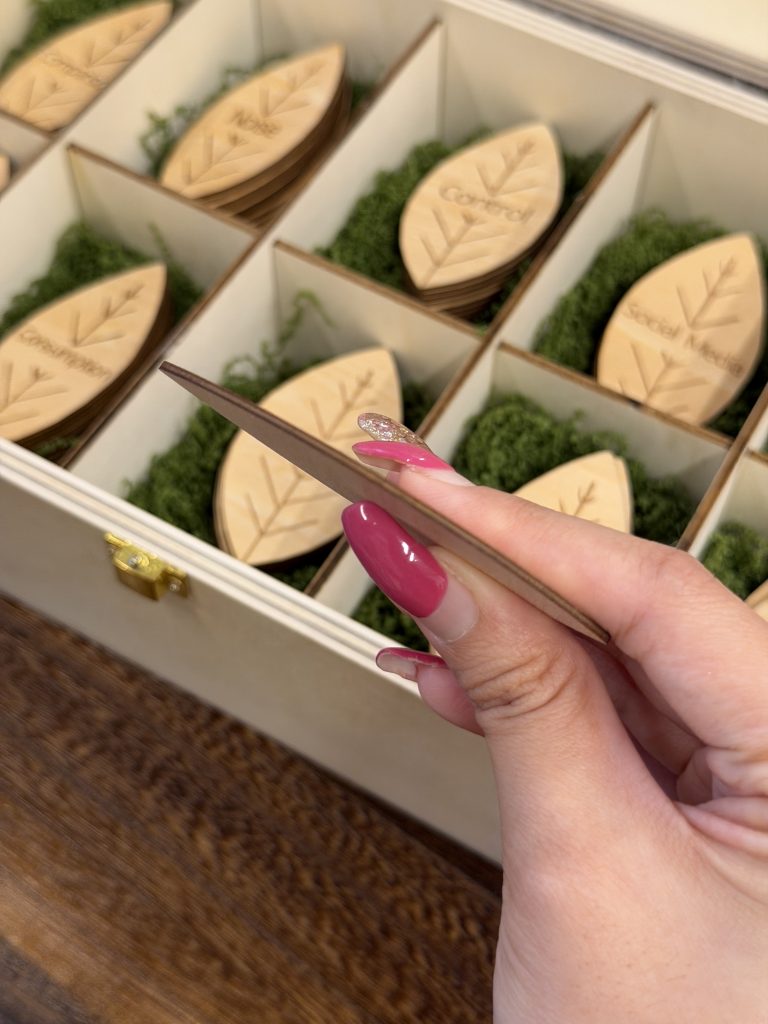
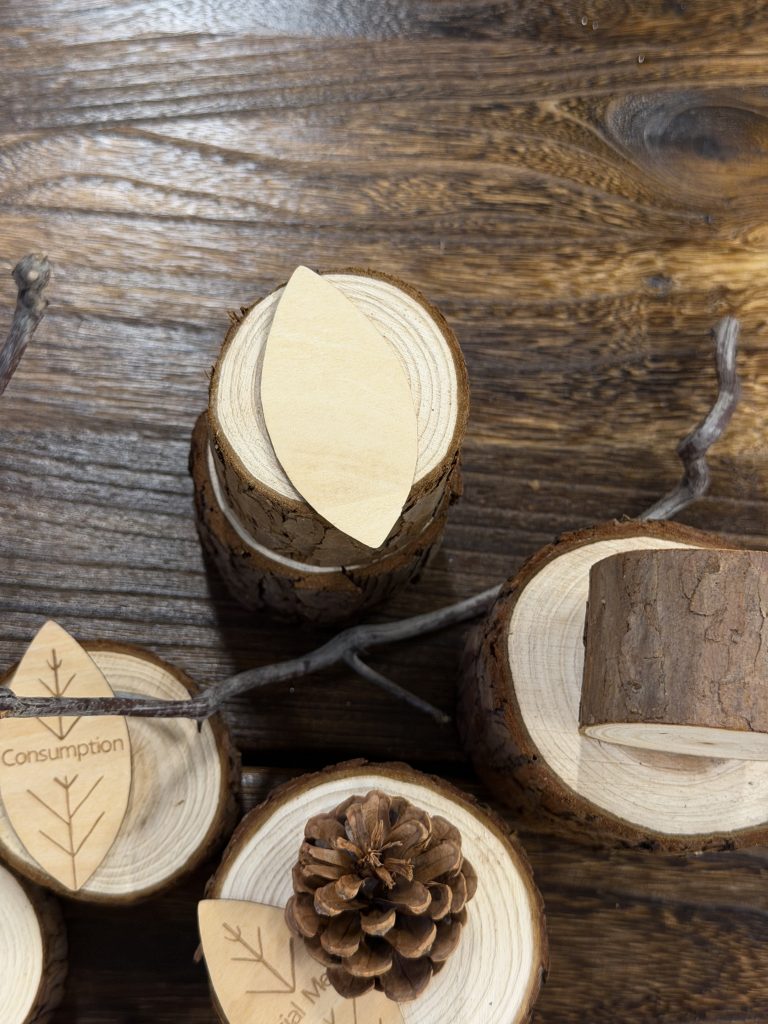
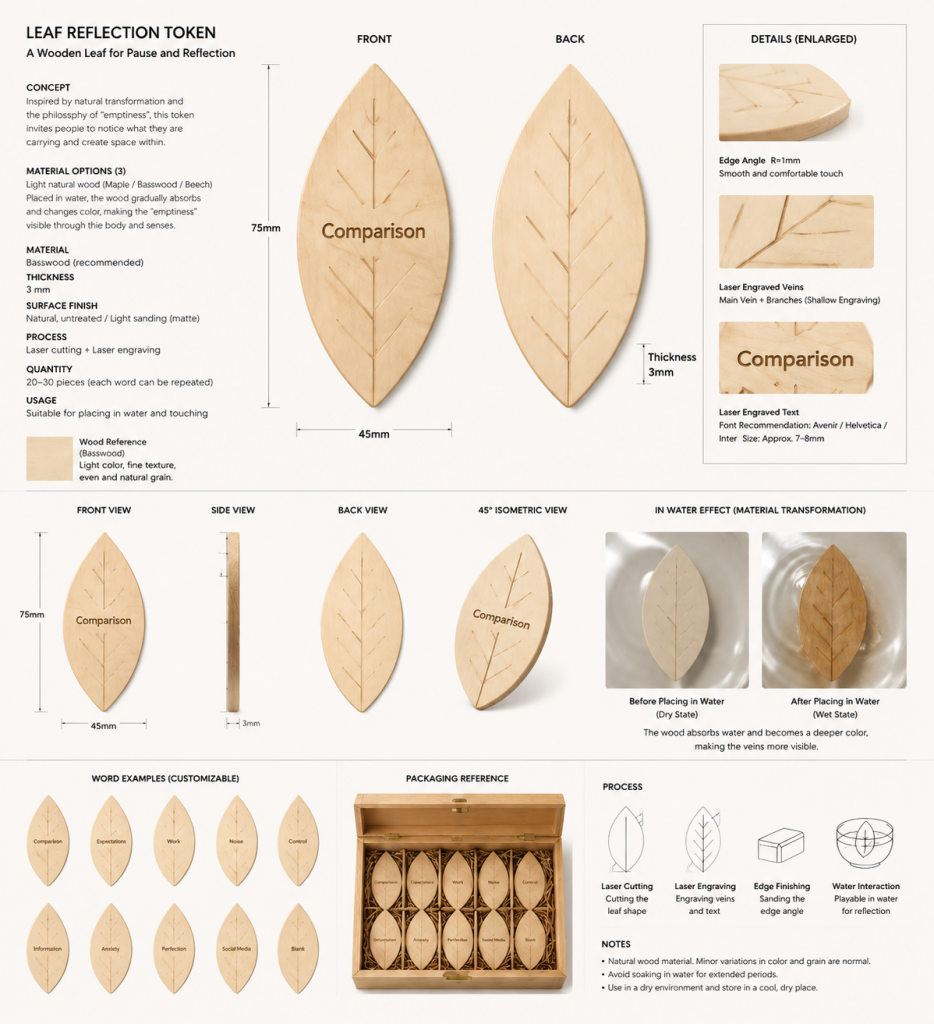
The wooden leaves shown in this image are real prototypes that have already been produced. To ensure sufficient materials for the testing phase, each word category was produced with 10 identical pieces, allowing participants to freely select and interact with the leaves during the intervention.
Wooden Leaves
I chose wood because it connects with natural processes and transformation.
Basswood
Light colour
Laser engraving
Water darkening effect
The experiment showed that 1.5mm basswood created the most noticeable colour change after water absorption, therefore it was selected for the final production. The visible transformation allows the material itself to participate in the reflective process.
Water as Interaction Medium
Water allows the internal reflection to become visible through physical change.
6. Preparation for Testing
Participants
Based on tutorial feedback, I will test the intervention with a more defined participant group to create comparable results.
Participants:
18–30 years old
10 or more than 10 participants
Chinese and international participants
Feedback Collection
Feedback will combine open-ended questions and semi-structured conversations.
How did you feel during the experience?
What did the leaf represent for you?
Did the experience change your understanding of “pause” or “space”?
Later follow-up:
I will also reconnect with participants after several days to understand whether the experience created further reflection over time.
7. Reflection
Through this intervention, I am not attempting to teach participants how to let go or change their lives. Instead, EMPTYING creates a temporary space where participants can notice what they carry and reconsider their relationship with everyday consumption.
During this tutorial, I discussed the latest development of my project and received feedback on my transition from exploring judgement towards unfamiliar wellbeing practices to exploring the philosophy of Bigu (辟谷) as an embodied experience of emptiness.
My tutor recognised that the development of my research question showed a meaningful progression. Instead of focusing only on reducing judgement towards alternative health practices, the project has gradually moved towards exploring how traditional Chinese philosophy can create a contemporary reflective experience.
My current research question:
How can the philosophy of Bigu be translated into an embodied experience of emptiness that creates space for reflection and wellbeing in contemporary society?
was considered a promising direction.
From Stopping to Creating Space
One key reflection from this tutorial was the shift from focusing on “stopping” to questioning what happens after stopping.
Initially, I was interested in the idea of stopping consumption through Bigu. However, I realised that the more meaningful question is:
If we create emptiness, what is this space created for?
Through Daoist philosophy, I began to understand emptiness not as absence or nothingness, but as a possibility for something new to emerge.
As described in the Dao De Jing, a vessel becomes useful because of its empty space.
Therefore, my intervention is not designed to encourage people to remove or reject parts of their lives, but to create a temporary pause where they can reconnect with themselves.
Research Conversations and Material Development
I also shared insights from two conversations that influenced the development of my intervention.
The first conversation was with a Shenzhen-based wellbeing practitioner, who encouraged me to consider:
How can an invisible internal state become something people can notice through their senses?
Although I decided not to use singing bowls in the final intervention, this inspired me to explore sensory and embodied interactions.
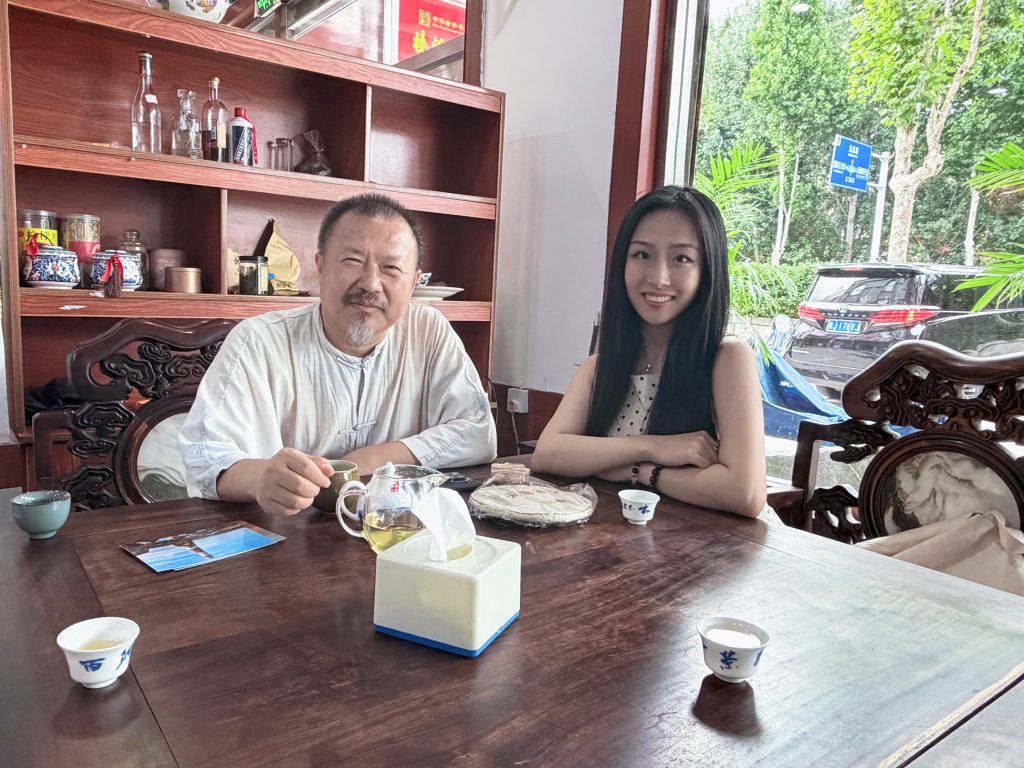
The second conversation was with a Chinese philosophy and traditional wisdom scholar from Taian, who helped deepen my understanding of emptiness. His perspective encouraged me to think about how external situations may remain unchanged, while our relationship with those situations can transform.
These conversations helped me move from explaining Bigu as an idea towards designing an experience where participants can personally encounter the meaning of emptiness.
Final Intervention Development
I presented my current intervention idea:
Participants sit face-to-face with me in a quiet space. On the table, there will be a bowl of water, wooden leaves, a sand timer and a wooden bookmark.
The experience begins with the question:
“What are you carrying today?”
Participants choose a wooden leaf containing words representing contemporary forms of consumption, such as comparison, expectation, control, information and noise.
They then place the leaf into water.
This action does not represent throwing something away, but temporarily putting something down.
The water interaction allows participants to experience qualities associated with Daoist philosophy, such as acceptance, flexibility and openness.
At the end, participants receive a blank wooden bookmark as a reminder of the experience and the possibility of creating space within themselves.
Testing Plan and Feedback Collection
My tutor suggested that the intervention is suitable for testing and recommended beginning with the current version before making major changes.
Instead of designing many completely different interventions, I should test one intervention repeatedly and refine specific elements based on feedback, such as:
the atmosphere of the space the number of leaves and words the amount of time participants need whether instructions are clear
For participants, my initial plan is to test with young adults aged around 20–30. My tutor suggested keeping the participant group relatively consistent, because similarities between participants make it easier to compare results and understand the impact of the intervention.
Next Steps
Based on this tutorial, my next steps are:
Finalise the intervention setup and materials.
Conduct testing with participants.
Collect feedback through open-ended questions and semi-structured conversations.
Follow up with participants after several days or one week to understand whether the experience creates further reflection over time.
This tutorial confirmed that the transformation of my project is not a problem, but an important part of the research journey. The project has developed from questioning judgement towards unfamiliar practices into exploring how traditional philosophy can inspire a contemporary wellbeing experience.
Translating the Philosophy of Bigu into an Embodied Wellbeing Experience
17 July 2026
Research Question
How can the philosophy of Bigu be translated into an embodied experience of emptiness that creates space for reflection and wellbeing in contemporary society?
1. Looking Back: The Beginning of My Exploration
At the beginning of this project, I was interested in unfamiliar wellbeing practices and the way people form immediate judgements towards practices that are culturally different from their own.
Coming from a Chinese cultural background, I became curious about why some traditional practices are easily accepted by certain communities, while others may be questioned, misunderstood or considered unfamiliar.
I initially explored the question:
How can a guided first encounter disrupt immediate judgement and open up alternative understandings of health?
Through my early experiments, I explored different ways of creating a more open first encounter, including sensory activities, Five Elements-inspired embodied practices and reflection exercises.
These experiments made me realise that understanding does not always begin with explanation.
Sometimes, it begins through experience.
A person may not immediately understand a cultural practice intellectually, but through their body, senses and emotions, they may become more curious and willing to explore.
This led me to become more interested in how design can create a space where people can experience rather than simply receive information.
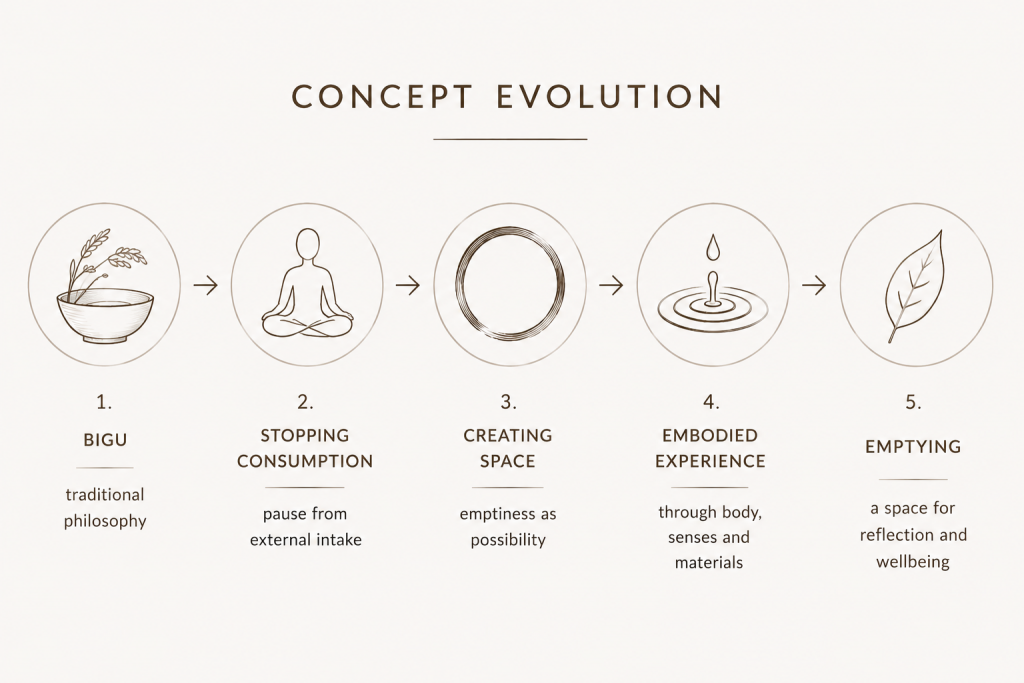
2. First Transformation: From Explaining Bigu to Translating Its Philosophy
As my research developed, I began to focus more specifically on Bigu (辟谷), a traditional Chinese practice that is often translated into English as fasting.
At first, I was interested in how Bigu could be introduced to people unfamiliar with Chinese culture.
However, I gradually realised that translating Bigu simply as “fasting” only describes the visible action, rather than the deeper philosophy behind it.
In contemporary Western contexts, fasting is often understood as a temporary restriction of food intake.
However, historically, the meaning of Bigu was more complex.
The word “谷” refers to grains and food.
Therefore:
BIGU = temporarily reducing or stopping food consumption.
But through my exploration, I began to question:
What does “consumption” mean in contemporary society?
Today, we are not only consuming physical food.
We are constantly consuming:
Information
Social media
Work
Expectations
Comparison
Noise
Anxiety
Desire
The forms of “consumption” around us have expanded.
This led me to reinterpret Bigu not simply as stopping food intake, but as a philosophy of pausing unnecessary consumption.
The question behind my project shifted from:
What is Bigu?
to:
What are we continuously consuming, and what happens when we pause?
3. From Stopping Consumption to Experiencing Emptiness
At this stage, my focus was mainly on the idea of “stopping”.
I was exploring the possibility of a contemporary interpretation of Bigu:
a moment where people could temporarily step away from constant consumption.
However, through further reflection, I realised that the more meaningful question was not only:
What should we stop consuming?
but:
What happens after we stop?
This became the turning point of my project.
The difference between Bigu and fasting led me to think more deeply about the concept of emptiness.
Fasting often focuses on absence:
the absence of food.
However, in Daoist philosophy, emptiness does not simply mean having nothing.
Instead, emptiness creates possibility.
A space becomes meaningful because it allows something else to exist.
As described in the Dao De Jing:
A vessel becomes useful because of its empty space.
This changed my understanding of Bigu.
Bigu is not only about removing something.
It is about creating space.
A space for:
reflection
awareness
reconnection
This became the foundation of my new intervention.
4. Field Research: Conversations That Shaped My Understanding of Emptiness
To further explore how traditional Chinese philosophies can be translated into contemporary experiences, I conducted two conversations with people who have different perspectives on wellbeing and traditional wisdom.
These conversations did not provide a fixed solution for my project.
Instead, they opened new questions about how internal experiences, emotions and states of being could become something people can encounter through design.
Conversation 1: Shenzhen Healing Specialist
Making Invisible Inner States Visible
During my conversation with a healing specialist in Shenzhen, I explored the relationship between sound, body and internal states.
One idea that strongly influenced my project was his perspective on singing bowl practices.
He described how sound and vibration can encourage people to become more aware of their own physical and emotional states.
Although I decided not to use singing bowls as the final medium of my intervention, this conversation raised an important design question:
How can an invisible internal state become something people can notice through their senses?
This shifted my thinking away from simply explaining wellbeing concepts and towards creating an embodied experience.
Revealing What We Carry Before Letting Go
Another important insight from this conversation was the idea that before transformation can happen, people first need to recognise what they are carrying.
Rather than immediately asking someone to “let go”, the first step is to make invisible experiences visible.
This inspired my later exploration of wooden leaves carrying words such as:
Comparison
Expectation
Control
Productivity pressure
These words are not presented as negative things that people should eliminate.
Instead, they represent different forms of contemporary “consumption” that individuals may consciously choose to reflect on.
The purpose is not to judge these experiences, but to create an opportunity for awareness.
Conversation 2: A professor of Chinese Philosophy and Traditional Wisdom in Taian
Understanding the Relationship Between Inner State and Experience
A second conversation with a teacher in Taian, who has deep knowledge of Chinese philosophy and traditional wisdom, further developed my understanding of emptiness.
One idea that particularly influenced me was:
External situations may remain unchanged, but our experience of them can change.
This challenged my previous assumption that wellbeing requires changing external circumstances.
Perhaps the purpose of this experience is not to remove difficulties or eliminate certain emotions.
Instead, it creates a temporary space where people can observe their relationship with what they are experiencing.
Moving Beyond Binary Thinking
During this conversation, I also reflected on how modern life is often structured through oppositions:
good / bad
success / failure
more / less
right / wrong
This connected strongly with my exploration of emptiness.
Emptiness is not about choosing one side or rejecting another.
Instead, it creates a pause before judgement.
A moment where people can observe rather than immediately react.
This understanding became an important foundation for my final intervention.
5. Material Evolution: Searching for a Way to Experience Emptiness
Through these conversations and reflections, I began exploring how the abstract concept of emptiness could become a physical experience.
My material exploration developed through several stages.
Stage 1: Sound — Singing Bowl
Initial question:
Can sound reveal internal states?
The inspiration came from my conversation with the Shenzhen healing specialist.
Sound offered a way to explore invisible experiences through the body.
However, I realised that sound-based interaction remained mainly auditory.
I wanted to create a more participatory experience where participants could actively engage with the transformation process.
Stage 2: Words — Making Invisible Consumption Visible
New question:
How can internal experiences become tangible?
Inspired by the idea of recognising what people carry before transformation, I explored the use of words.
Words such as:
Comparison
Expectation
Noise
Control
became symbolic representations of contemporary forms of consumption.
This stage helped me connect the abstract idea of “letting go” with a physical action.
Stage 3: Wood and Water — Experiencing Emptiness
The current intervention combines:
wooden leaves
water
touch
silence
The wooden leaf becomes a temporary carrier of something participants feel they are carrying.
When placed into water, the action does not represent destruction or removal.
Instead, it represents a moment of pause.
Water was chosen because of its relationship with Daoist philosophy.
Inspired by:
上善若水 (Shàng shàn ruò shuǐ) — The highest goodness is like water
Water represents qualities including:
acceptance
flexibility
openness
non-resistance
Water does not force transformation.
It receives, adapts and allows things to settle.
This reflects my reinterpretation of Bigu:
transformation does not come from forcing change, but from creating the conditions for awareness.
6. Final Intervention: EMPTYING
Creating an Embodied Experience of Emptiness
After exploring Bigu through philosophical reflection, conversations and material experiments, I began to ask a final design question:
How can emptiness become something people experience, rather than simply understand?
This question shaped my final intervention:
EMPTYING
Rather than explaining Daoist philosophy through information, this intervention creates a quiet and participatory experience where participants can explore the process of noticing, temporarily setting down and creating space.
The aim is not to provide a solution or to encourage participants to remove certain emotions or behaviours.
Instead, it creates a moment of pause where individuals can reflect on what they are carrying in their everyday lives.
The Experience Space
The intervention is designed as a small, intimate encounter rather than a large installation.
The space includes:
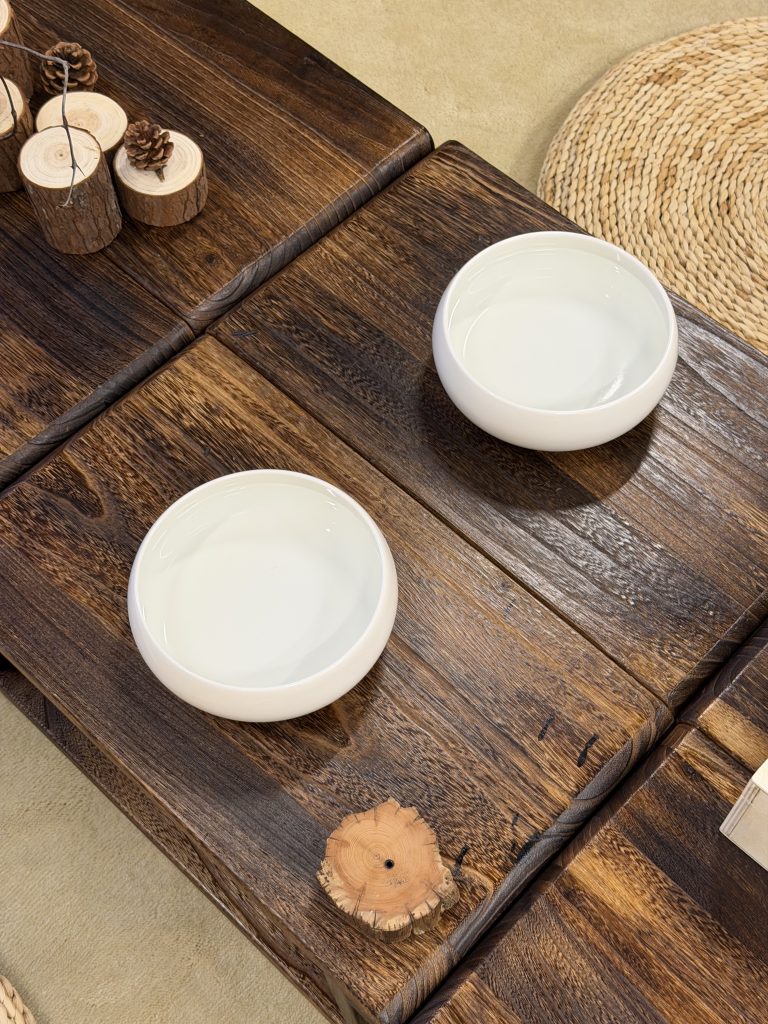
two cushions for the participant and facilitator
a natural wooden surface
a ceramic bowl filled with water
handmade wooden leaves
a small hourglass
The simplicity of the environment is intentional.
Rather than adding more visual information, the space itself creates a sense of slowing down.
The facilitator does not act as a teacher or therapist.
Instead, my role is to hold the space and guide the participant through the experience.
Stage 1: Recognising What We Carry
At the beginning of the experience, participants encounter a collection of wooden leaves.
Each leaf contains a word representing a contemporary form of “consumption”:
Comparison
Expectation
Control
Productivity
Information
Noise
Perfection
A blank leaf is also available for participants to write their own response.
The participant is invited to consider:
What are you carrying today?
This question is intentionally open.
The purpose is not to suggest that these things are negative or should be removed.
For example, comparison can sometimes motivate growth, and work can bring meaning.
Instead, the question creates an opportunity to notice the relationship between ourselves and these experiences.
Stage 2: Temporarily Setting Down
After choosing a wooden leaf, participants place it into the water.
This action represents a temporary pause.
Importantly, the action is not framed as:
“letting go”
or
“removing something unwanted”.
Instead, it is:
setting something down for a moment.
This reflects my reinterpretation of Bigu.
Traditional Bigu is not a permanent rejection of food.
It is a temporary practice of reducing intake.
Similarly, this intervention does not ask participants to permanently abandon anything.
It simply creates a moment of distance.
Stage 3: Experiencing Water Through the Body
After placing the wooden leaf into the water, participants are invited to interact with the water through touch.
This decision came from my exploration of embodied experience.
Reflection does not only happen through thinking.
The body can also become a way of understanding.
Participants may notice:
the temperature of water
the movement of water
the softness and resistance
the relationship between their hand and the material
The interaction with water is inspired by the Daoist concept:
The highest goodness is like water.
Water represents qualities such as:
acceptance
flexibility
openness
non-resistance
Water does not force change.
It receives, adapts and allows things to settle.
Through this interaction, participants are invited to experience the qualities of water rather than simply learn about them.
Stage 4: The Moment of Pause
A small hourglass is placed beside the water.
However, it is not used as a countdown or a requirement.
This is important because the project itself questions modern society’s constant focus on efficiency and productivity.
The hourglass becomes a visual invitation:
a reminder that time can be experienced rather than measured.
Participants can choose:
how long they stay
whether they sit silently
whether they observe the water
when they feel ready to finish
During this moment, nothing is required to happen.
The absence of action becomes part of the experience.
This is where the concept of emptiness becomes embodied.
Stage 5: Leaving with “Empty”
At the end of the experience, participants receive a wooden leaf bookmark.
Unlike the previous leaf, this object does not contain a word representing something they are carrying.
Instead, it contains:
Empty
The wooden bookmark has a natural leaf shape with different patterns and textures.
Each participant receives one randomly, reflecting the uniqueness of natural forms.
The purpose of this object is not to provide a solution, a belief, or a promise of transformation.
It acts as:
a reminder of a moment of pause.
Participants do not take away the thing they temporarily set down.
They take away the memory of creating space.
Why a Wooden Bookmark?
The bookmark was chosen because it allows the experience to continue beyond the exhibition.
Unlike a souvenir that simply represents a past event, a bookmark can return into everyday life.
It may appear when someone opens a book, writes notes or pauses during a busy day.
The object does not ask:
“Have you changed?”
Instead, it quietly reminds:
“You have the ability to pause.”
7. Prototype Development and Testing Plan
To evaluate the experience, I plan to create a low-fidelity prototype using:
Materials:
birch plywood wooden leaves
laser engraving
ceramic water bowl
natural wood surface
hourglass
The choice of materials continues the project’s exploration of natural elements and embodied interaction.
Participant Testing
The intervention will be tested with:
10 participants aged 20–30
Including:
5 Chinese participants
5 international participants
The mixed cultural backgrounds aim to explore how people from different cultural contexts interpret Bigu, emptiness and wellbeing.
Research Questions During Testing
Before the experience:
1.
What comes to mind when you hear Bigu?
Purpose:
To understand whether participants associate Bigu only with fasting.
2.
What do you feel you are consuming too much of in your everyday life?
Purpose:
To explore contemporary interpretations of “GU”.
During the experience, I will observe:
How participants choose their leaf
Their hesitation or reflection
Their interaction with water
Their response to silence
Whether the experience encourages personal interpretation
After the experience:
Participants will be invited to reflect:
1.
Has this experience changed your understanding of Bigu?
2.
What did the moment of pause mean to you?
3.
How did interacting with water influence your experience?
4.
What does the wooden leaf you received represent for you?
Reflection
Through this project development, I moved from exploring Bigu as a traditional practice towards understanding it as a philosophy of creating space.
The final intervention does not attempt to reproduce Bigu.
Instead, it translates its underlying principle into a contemporary experience:
from consuming → pausing from holding → setting down from emptiness as absence → emptiness as possibility
References
Baumer, E.P.S., Khovanskaya, V.D., Matthews, T., Reynolds, L., Schwanda Sosik, V. and Gay, G.K. (2014) ‘Reviewing Reflection through the Lens of Personal Informatics’, Proceedings of the 2014 ACM International Joint Conference on Pervasive and Ubiquitous Computing, pp.109–120. doi:10.1145/2632048.2632052.
Campany, R.F. (2002) To Live as Long as Heaven and Earth: A Translation and Study of Ge Hong’s Traditions of Divine Transcendents. Berkeley: University of California Press.
Giaccardi, E. and Karana, E. (2015) ‘Foundations of Materials Experience: An Approach for HCI’, Proceedings of the 33rd Annual ACM Conference on Human Factors in Computing Systems, pp.2447–2456. doi:10.1145/2702123.2702337.
Kabat-Zinn, J. (1994) Wherever You Go, There You Are: Mindfulness Meditation in Everyday Life. New York: Hyperion.
Kohn, L. (1991) The Taoist Body. Cambridge, MA: Three Pines Press.
Sanders, E.B.-N. and Stappers, P.J. (2008) ‘Co-creation and the New Landscapes of Design’, CoDesign, 4(1), pp.5–18. doi:10.1080/15710880701875068.
Stickdorn, M., Hormess, M.E., Lawrence, A. and Schneider, J. (2018) This Is Service Design Doing: Applying Service Design Thinking in the Real World. Sebastopol, CA: O’Reilly Media.
Varela, F.J., Thompson, E. and Rosch, E. (1991) The Embodied Mind: Cognitive Science and Human Experience. Cambridge, MA: MIT Press.
Zhuangzi (2009) Zhuangzi: The Essential Writings with Selections from Traditional Commentaries. Translated by B. Ziporyn. Indianapolis: Hackett Publishing Company.
Reinterpreting the Philosophy of Bigu Through Contemporary Interaction Design
8 July 2026
Part1
Introduction
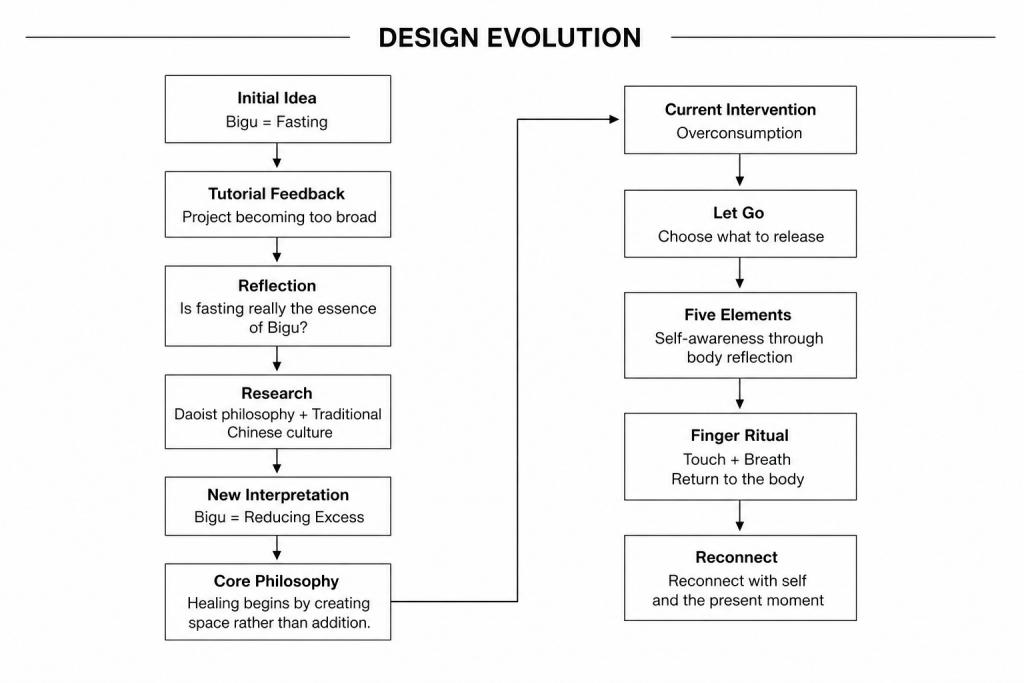
Over the past two weeks, my project has undergone a significant transformation. Looking back, I realised that the biggest change was not my intervention, but the question I was asking.
At the beginning of this project, I was interested in how people respond to unfamiliar Chinese wellbeing practices. My intervention explored whether a guided experience could encourage participants to become more open-minded towards practices such as Bigu (辟谷) and the Five Elements.
However, after reflecting on the feedback from my tutorial and spending more time reading Daoist philosophy, I realised that I was still approaching Bigu as something to explain.
Gradually, I found myself asking a different question.
Instead of asking:
How can people understand Bigu?
I began asking:
Why has Bigu existed for centuries?
Although this may seem like a small shift, it fundamentally changed the direction of my research and my role as a designer. Rather than explaining a traditional Chinese practice, I became interested in translating its underlying philosophy into a contemporary interactive experience.
Reflecting on the Tutorial
One of the most valuable pieces of feedback from my tutorial was that my project had become increasingly broad.
I was trying to include fasting, the Five Elements, tea culture, incense, breathing exercises and several other traditional practices within one intervention. While these examples all belonged to Chinese wellbeing traditions, together they lacked a clear conceptual focus.
My tutor encouraged me to simplify the project and develop one idea in greater depth, rather than introducing many cultural examples. More importantly, he reminded me that the project should not aim to educate people about Chinese traditions or persuade them that these practices are effective. Instead, the intervention should create opportunities for participants to experience, interpret and reflect for themselves.
Looking back, I realised that I had been focusing too much on the practices themselves.
The tutorial encouraged me to look underneath them.
Looking Beyond Fasting
Initially, I understood Bigu simply as fasting.
Like many English translations, I focused on the visible behaviour—choosing not to eat.
However, the more I read about Daoist philosophy, the more I realised that this translation only explains what people do, rather than why the practice exists.
This distinction became increasingly important.
Historically, Gu refers to grain, one of the most important sources of nourishment in ancient China.
Reducing grain consumption therefore represented much more than changing eating habits.
It reflected a particular relationship between the body, nature and desire.
This made me ask another question.
If grain represented what people consumed in the past, what represents “grain” today?
From Grain to Consumption
Today, very few people experience a shortage of food.
Instead, many of us experience something different.
An excess of information.
An excess of notifications.
An excess of comparison.
An excess of productivity.
An excess of expectations.
An excess of digital stimulation.
I realised that contemporary wellbeing might no longer be challenged by physical scarcity, but by cognitive and emotional overload.
At this point, I no longer saw Bigu as fasting.
Instead, I began interpreting it as the conscious practice of reducing unnecessary consumption.
This became the first major turning point in my research.
More importantly, it immediately changed my design thinking.
Rather than designing an experience about fasting, I started exploring how interaction design could communicate the experience of consciously creating space.
Creating Space as a Design Principle
As my interpretation of Bigu changed, so did my understanding of healing.
Many contemporary wellbeing products encourage people to improve themselves by adding more.
More mindfulness.
More exercise.
More productivity.
More self-optimisation.
However, while reading about traditional Chinese philosophy, I noticed a different pattern.
Tea culture values waiting.
Chinese painting values empty space.
Tai Chi values balance rather than force.
Daoism values restraint rather than accumulation.
Although these traditions appear very different, they repeatedly return to one shared idea.
They create space.
This observation gradually became the central design principle of my project.
Healing begins by creating space.
For me, this sentence is no longer simply an observation.
It has become a design principle.
Rather than asking participants to gain more knowledge, complete more activities or receive more information, I want the intervention itself to create moments of pause, reduction and bodily awareness.
In other words, the philosophy should not only be discussed.
It should be experienced.
Part 2
From Research to Design
As my understanding of Bigu developed, I realised that the project was no longer about introducing a traditional Chinese practice.
Instead, it became an exploration of how an ancient philosophy might be translated into a contemporary experience.
This distinction changed the role of design within my project.
Previously, I imagined the intervention as a way of explaining Chinese culture through different activities. Participants would encounter unfamiliar practices and then experience breathing exercises, sensory activities and reflection in the hope that their perceptions might change.
Now, I no longer see the intervention as an explanation.
Instead, I see it as a translation.
Rather than asking participants to understand Bigu intellectually, I want them to experience one of its underlying ideas through a sequence of carefully designed interactions.
This shift also changed my role as a designer.
Instead of asking “How can I explain this philosophy?”, I began asking:
“How can this philosophy be experienced?”
This became the foundation for every design decision that followed.
Current Research Question
As the project evolved, I found that my research question also needed to change.
Initially, my project focused on encouraging people to become more open-minded towards unfamiliar Chinese wellbeing practices.
However, this question gradually became less relevant as my understanding of Bigu deepened.
The project is no longer about changing people’s opinions.
Instead, it explores how a traditional philosophy can be translated into an interactive experience for contemporary life.
At this stage, my working research question is:
How can the philosophy of Bigu be translated into an interactive wellbeing experience for contemporary society?
I intentionally describe this as a working research question because I expect it to continue evolving through prototyping and participant feedback. Rather than fixing the direction too early, I want the research process to continue shaping the project.
Translating Philosophy into Experience
One of the biggest design challenges has been deciding how philosophy should be communicated.
My first instinct was to explain more.
I considered introducing historical information, cultural background and theoretical concepts before asking participants to interact with the intervention.
However, the more I reflected on my research, the more I realised that this approach contradicted the philosophy I was trying to communicate.
If the central idea of Bigu is creating space rather than accumulating more, then the intervention itself should also resist unnecessary complexity.
This became another important design decision.
Instead of explaining philosophy through information, I decided to communicate it through experience.
Instead of asking participants to read more, I wanted them to do less.
Instead of providing answers, I wanted to create moments of pause.
In this sense, the interaction itself becomes the message.
Developing the Intervention
My intervention is now organised as a sequence of simple interactions.
Rather than functioning as separate activities, each stage responds directly to a research insight that emerged during the development of the project.
Stage One — Recognising Overconsumption
The intervention begins by inviting participants to reflect on their everyday lives.
Rather than introducing Chinese philosophy immediately, I first want participants to recognise a condition that many of us already experience.
Information.
Notifications.
Comparison.
Constant productivity.
Endless scrolling.
These forms of consumption have become so ordinary that they are often invisible.
Participants are therefore invited to pause and consider a simple question:
What are you constantly consuming?
Design intention
I deliberately chose not to begin with Chinese culture.
If participants cannot first recognise overconsumption within their own lives, Bigu risks remaining an unfamiliar cultural concept rather than becoming personally meaningful.
Stage Two — Creating Space
Participants are then invited to write down one thing they would like to let go of.
It may be pressure.
Comparison.
Anxiety.
Digital distraction.
Perfectionism.
Or simply the feeling of always needing to do more.
After writing, they place the card into a wooden box.
The action is intentionally quiet and uncomplicated.
It does not symbolise permanently giving something up.
Instead, it represents making space, even if only temporarily.
Design intention
This stage is my interpretation of Bigu.
Rather than asking participants to stop eating, I reinterpret the philosophy as a conscious act of choosing what no longer needs to be carried.
The interaction therefore communicates the philosophy without asking participants to imitate the original practice.
Stage Three — Reconnecting with the Body
Once participants have symbolically created space, they are invited to reconnect with themselves.
At this point, I introduce the Five Elements.
However, the Five Elements are not presented as a medical system, nor as something participants are expected to believe in.
Instead, they function as a reflective framework.
Participants simply choose the element that resonates most with how they currently feel.
Each element is accompanied by a subtle sensory cue, such as colour, sound or texture.
Rather than diagnosing the body, these elements encourage participants to notice it.
Design intention
Earlier versions of my project used the Five Elements as cultural content.
Now, they function as a design language for embodied reflection.
This shift allows the philosophy to remain accessible regardless of participants’ cultural background.
Stage Four — Touch and Breath
The experience concludes with a simple finger-touch ritual combined with slow breathing.
The gesture is intentionally small.
Participants gently hold one finger while focusing on their breathing for a short period of time.
Nothing dramatic happens.
There is no instruction to achieve relaxation or transformation.
Instead, the interaction simply redirects attention back towards the body.
Design intention
Originally, I imagined ending the intervention with explanation.
Now, I deliberately end with silence.
Rather than leaving participants with information, I want them to leave with an experience that remains open to interpretation.
Part3
Design Evolution
Looking back over the past two weeks, I realised that the project has changed much more than I expected.
At the beginning, I believed I was designing an intervention about Bigu.
Now, I feel that Bigu has become a lens through which I explore a much broader design question.
The project is no longer centred on fasting.
Instead, it explores how traditional Chinese philosophy can be translated into contemporary interaction design.
One of the most significant changes has been recognising the difference between representing culture and translating philosophy.
Previously, I focused on introducing traditional practices such as Bigu, the Five Elements and breathing exercises. These practices themselves became the content of the intervention.
Now, I see these practices differently.
They are no longer the destination of the project.
Instead, they have become tools for communicating a much deeper philosophical idea.
This shift has helped me simplify the project considerably.
Rather than asking participants to understand Chinese culture, I now ask how interaction can communicate the experience of creating space.
This has become the central thread connecting every stage of the intervention.
Figure 1. Design evolution of the project.
Critical Reflection
One of the biggest lessons from this stage of the project has been learning to distinguish between research findings and design decisions.
Initially, whenever I discovered something interesting about Daoist philosophy or Chinese wellbeing traditions, my instinct was to include it in the intervention.
As a result, the project gradually became more complex.
Looking back, I realised that I was collecting ideas rather than designing an experience.
The tutorial feedback encouraged me to simplify the project, but it was only through continued reflection that I understood what simplification actually meant.
Simplification was not about removing content.
It was about identifying the one idea that should guide every design decision.
For me, that idea has become creating space.
Once this principle became clear, many design decisions became much easier.
For example, I no longer felt the need to explain the history of Bigu during the intervention.
Instead, I asked myself how participants might physically experience the philosophy through a series of small actions.
Similarly, I realised that the Five Elements did not need to function as a traditional medical framework.
Instead, they could become a reflective language for noticing the body.
Even the decision to avoid a large immersive installation came from this way of thinking.
Rather than building something visually overwhelming, I became interested in how a sequence of quiet interactions might communicate more effectively.
Looking back, I feel that the project has become less about designing objects and more about designing conditions.
Conditions that invite participants to pause.
Conditions that encourage self-awareness.
Conditions that leave room for personal interpretation rather than providing fixed answers.
I think this shift represents the most important development in my project so far.
Next Steps
The next stage of the project will focus on prototyping and participant testing.
Rather than developing the entire intervention at once, I plan to prototype each stage individually in order to understand how participants experience different moments of the journey.
Some of the questions I would like to explore include:
Do participants recognise overconsumption in their own lives before encountering the idea of Bigu?
Does the “Let Go” activity encourage genuine reflection, or does it feel merely symbolic?
How do participants interpret the Five Elements when they are presented as a reflective framework rather than a medical theory?
Can a simple finger-touch ritual create a meaningful shift in attention?
How much explanation is actually necessary throughout the experience?
These questions will guide the next stage of development and allow participant feedback to continue shaping the intervention.
Rather than treating the current intervention as a finished outcome, I see it as an evolving prototype that will continue changing through testing and reflection.
Final Reflection
When I first began this project, I thought I was researching a traditional Chinese wellbeing practice.
Now, I realise that I have been researching something much broader.
Bigu has become the starting point for exploring how philosophy can be translated into interaction.
This has also changed how I understand the role of design.
Rather than communicating information, design can create situations in which people experience an idea for themselves.
Perhaps this is the most valuable lesson I have learned during this stage of the project.
The project is no longer about asking participants to understand Bigu.
Instead, it asks whether interaction design can create the conditions for people to slow down, create space, and reconnect with themselves.
At this point, I no longer see the intervention as a way of presenting Chinese culture.
Instead, I see it as an ongoing exploration of how traditional philosophy might inspire new forms of wellbeing experience within contemporary life.
References
Bell, C. (1992) Ritual Theory, Ritual Practice. Oxford: Oxford University Press.
Brown, K.W. and Ryan, R.M. (2003) ‘The benefits of being present: Mindfulness and its role in psychological well-being’, Journal of Personality and Social Psychology, 84(4), pp. 822–848.
Dourish, P. (2001) Where the Action Is: The Foundations of Embodied Interaction. Cambridge, MA: MIT Press.
Kabat-Zinn, J. (1994) Wherever You Go, There You Are: Mindfulness Meditation in Everyday Life. New York: Hyperion.
Kaptchuk, T.J. (2000) The Web That Has No Weaver: Understanding Chinese Medicine. 2nd edn. New York: McGraw-Hill.
Laozi (1963) Tao Te Ching. Translated by D.C. Lau. Harmondsworth: Penguin Books.
Norman, D.A. (2004) Emotional Design: Why We Love (or Hate) Everyday Things. New York: Basic Books.
Pine, B.J. and Gilmore, J.H. (1999) The Experience Economy. Boston, MA: Harvard Business School Press.
Stickdorn, M., Hormess, M., Lawrence, A. and Schneider, J. (2018) This Is Service Design Doing. Sebastopol, CA: O’Reilly Media.
Zhuangzi (2009) The Complete Works of Zhuangzi. Translated by B. Watson. New York: Columbia University Press.